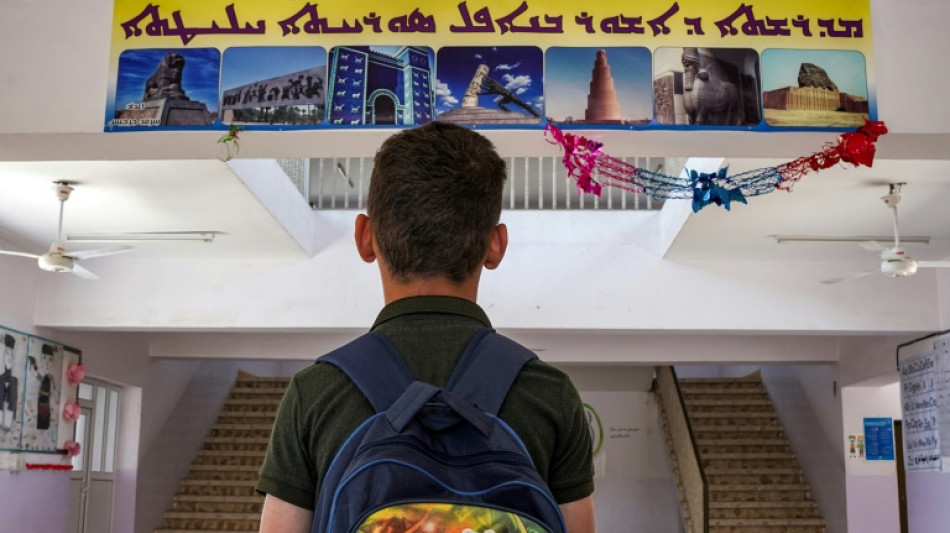
Iraq's Christians fight to save threatened ancient language / Photo: Waleed AL-KHALID - AFP

 Oil companies close in on Venezuela despite hurdles
 Turkey freezes ex-minister's assets as fund scandal grows
 Guardiola backs Man City after bombshell guilty verdicts
 G20 trade ministers open talks under strain of Trump tariffs

 France in talks with UK to end 2025 migrant accord: ministry
 Europe's surging inflation spreads gloom in stock markets

 Truth commission demands compensation for Sweden's Sami people

 Japan win marathon penalty shootout to set up South Korea gold-medal clash

 Djokovic grinds out opening-round win at China Open

 Northern Ireland police probe blockade of disputed parade
 UK PM Burnham reopens divisive debate on rejoining EU

 Man City future in doubt after guilty verdict
 'Do something,' begs Iranian woman after death sentence over protests
 China extends 52-year unbeaten record as Games organisers say sorry
 In Manchester, people say City scandal is 'shame for football'

 Stocks lacklustre as inflation data weighs on sentiment
 Israel-bound plane rerouted, pilots wounded in reported fight

 Truth commission on Sweden's Sami people seeks redress

 Energy costs spark inflation surges in France, Italy

 South Korea break China hearts to reach Asian Games football final

 Eala storms into Asian Games semi-finals to thrill adoring fans

 Turkey freezes ex-minister's assets as fund crisis grows

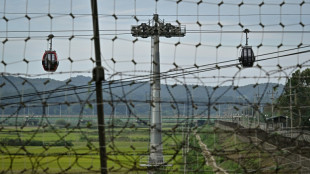 What we know about the North Korean POW dispute

 Most equities rise after oil price plunge, US data in focus

 Polar oceans transformed as warming melts ice habitats: research

Iraq's shrunken and conflict-scarred Christian community is launching a new television channel as part of efforts to save their dying language, spoken for more than 2,000 years.
Syriac, an ancient dialect of Aramaic, has traditionally been the language spoken by Christians in Iraq and neighbouring Syria, mostly in homes but also in some schools and during church services.
However, Syriac-speaking communities in the two countries have declined over the years, owing to decades of conflict driving many to seek homes in safer countries. In Iraq, the Christian population is thought to have fallen by more than two-thirds in just over two decades.
"It's true that we speak Syriac at home, but unfortunately I feel that our language is disappearing slowly but surely," said Mariam Albert, a news presenter on the Syriac-language Al-Syriania television channel.
Iraq's government launched the channel in April to help keep the language alive. It has around 40 staff and offers a variety of programming, from cinema to art and history.
"It is important to have a television station that represents us," said Albert, a 35-year-old mother.
Many programmes are presented in a dialect form of Syriac but Albert said the channel's news bulletins are broadcast only in classical Syriac, a form not widely understood by everyone.
The goal of Al-Syriania is "to preserve the Syriac language" through "entertainment", said station director Jack Anwia.
"Once upon a time, Syriac was a language widespread across the Middle East," he said, adding that Baghdad has a duty "to keep it from extinction".
"The beauty about Iraq is its cultural and religious diversity," he said.
- 'Sidelined' but not dead -
Iraq is known as a cradle of civilisations, including the ancient Sumerians and Babylonians, who produced the earliest known written legal code. The country was also home to the city of Ur, which the Bible cites as Abraham's birthplace.
Today, the country is overwhelmingly Shiite Muslim but also home to Sunni Muslims, Kurds, Christians, Yazidis and other minorities, while Arabic and Kurdish are the official languages.
Before the 2003 United States-led invasion of the oil-rich country, Iraq was home to around 1.5 million Christians.
In the 20 years since, which included the brutal onslaught of the Islamic State group (IS) that swept the country in 2014, their population has declined to roughly 400,000, mostly living in the north.
The Syriac language has been "sidelined", according to Kawthar Askar, head of the Syriac language department at Salahaddin University in Arbil, in the autonomous Kurdistan region.
"We can't say it's a dead language... (but) it is under threat" of disappearing, he said.
The cause is migration, Askar said, adding that families who emigrate often continue speaking Syriac among themselves but later generations abandon it.
Askar's department teaches the language to around 40 students, with more studying it in Baghdad.
Syriac is also taught at around 265 schools across Iraq, according to Imad Salem Jajjo, responsible for Syriac education within the education ministry.
- 'Our mother tongue' -
The earliest written record of Syriac dates to the first or second century BC and the language reached its peak between the fifth and seventh centuries AD, Askar said.
At its height, Syriac was spoken in everyday conversation, used in literature, the sciences and within public administration.
With the seventh-century Islamic conquests, more people in the region began speaking Arabic.
By the 11th century, Syriac was clearly in decline.
Despite the decades of conflict that have ravaged Iraq, hundreds of Syriac books and manuscripts have survived.
In 2014, days before IS fighters seized swathes of northern Iraq, the Chaldean Catholic archbishop of Mosul left the city, salvaging a trove of centuries-old Syriac manuscripts from the invading jihadists.
Around 1,700 manuscripts and 1,400 books -- some dating to the 11th century -- are now conserved at Arbil's Digital Centre for Eastern Manuscripts, which is supported by the United Nations cultural agency UNESCO, the United States Agency for International Development, and the Dominican order.
The conservation will "preserve the heritage and guarantee its sustainability", archbishop Michaeel Najeeb told AFP.
Syriac "is our history, it is our mother tongue", said Salah Bakos, a teacher from Qaraqosh, a town near Mosul, which adopted the language into its curriculum 18 years ago.
"Teaching Syriac is important, not only to children but all segments of our society... even if parents say it is a dead language that serves no purpose".
A.P.Maia--PC