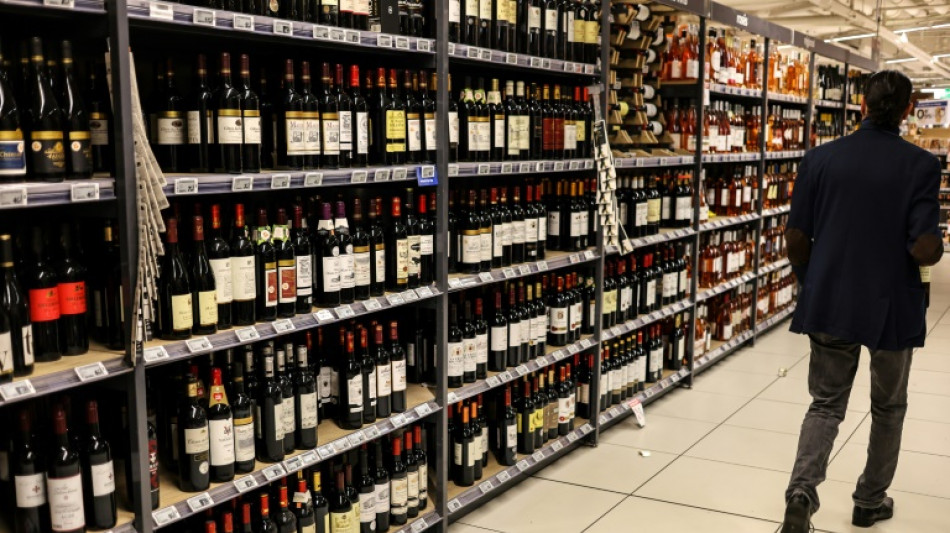
What's in wine? Campaigners want ingredients on the bottle / Photo: Charly TRIBALLEAU - AFP

 Oil companies close in on Venezuela despite hurdles

 Turkey freezes ex-minister's assets as fund scandal grows
 Guardiola backs Man City after bombshell guilty verdicts

 G20 trade ministers open talks under strain of Trump tariffs

 France in talks with UK to end 2025 migrant accord: ministry

 Europe's surging inflation spreads gloom in stock markets

 Truth commission demands compensation for Sweden's Sami people

 Japan win marathon penalty shootout to set up South Korea gold-medal clash

 Djokovic grinds out opening-round win at China Open

 Northern Ireland police probe blockade of disputed parade
 UK PM Burnham reopens divisive debate on rejoining EU

 Man City future in doubt after guilty verdict

 'Do something,' begs Iranian woman after death sentence over protests

 China extends 52-year unbeaten record as Games organisers say sorry

 In Manchester, people say City scandal is 'shame for football'
 Stocks lacklustre as inflation data weighs on sentiment

 Israel-bound plane rerouted, pilots wounded in reported fight

 Truth commission on Sweden's Sami people seeks redress

 Energy costs spark inflation surges in France, Italy

 South Korea break China hearts to reach Asian Games football final

 Eala storms into Asian Games semi-finals to thrill adoring fans
 Turkey freezes ex-minister's assets as fund crisis grows

 What we know about the North Korean POW dispute

 Most equities rise after oil price plunge, US data in focus

 Polar oceans transformed as warming melts ice habitats: research

European wines are finally being forced to reveal their ingredients to customers, but only on a website -- not on the bottle. Environmental campaigners are unimpressed.
Wine can contain a wide array of additives to control taste, strength and appearance: sulfur, sugar, egg white, dried fish bladders, enzymes from a pig or cow pancreas, and a range of chemical compounds.
While most of the food and drink sector has been forced to print ingredients and nutritional information on packaging for decades, the alcohol sector has long had a special exemption.
In 2017, the European Commission concluded there was no "objective grounds" for this exception, and new rules -- which come into force on December 8 -- require wines to reveal their contents.
But there is a twist. The wine industry was allowed to come up with their own method of doing so -- and it decided to give vineyards the option of using QR codes that link to a website, thus keeping the ingredients off the bottles.
An activist group, the Transparency for Organic World Association (TOWA), said this is unworkable.
"Can you really imagine getting out your smartphone in the supermarket and scanning several QR codes to compare the additives in wines, and remembering them all to make your choice?" said Olivier Paul-Morandini of TOWA.
The wine industry claims that it cannot be treated like other foodstuffs.
"Wine does not follow a recipe. The grape evolves in function of the sun, of climatic conditions... the ingredients are not the same from one harvest to another," said Ignacio Sanchez Recarte, of the Comite Europeen des Entreprises Vins (CEEV) , which represents the industry in Brussels.
The CEEV said digital labelling is the only realistic way to get all the EU's winemakers onboard (there were 2.2 million in 2020, according to Eurostat). It also means the ingredients are automatically translated into all EU languages.
"The Commission understood the need to provide a level of flexibility that will allow companies to communicate this information in a way that will not disrupt the way we trade," said Recarte.
The CEEV also filed a complaint this month to the European Commission over Irish plans to put health warnings on alcoholic drinks.
- 'List the consequences' -
For TOWA, e-labels show a lack of commitment to the greening of agriculture which the EU claims is a priority.
Organic and natural winemakers say that if a wine needs a QR code rather than a label, it is probably best avoided.
"An organic winemaker who puts very few additional things into their wine can make a label for the bottle, while a conventional winemaker would need a dictionary, so clearly that's why a QR code is necessary," said Julien Guillot, a well-known natural winemaker in Burgundy.
QR codes and e-labels are typical of a system that still greatly benefits conventional farmers using pesticides and chemical fertilisers, who receive the overwhelming majority of the EU Common Agricultural Policy subsidies, according to TOWA.
"We don't need just a list of ingredients. We should have a list of all the consequences of conventional farming and how much they cost," said Paul-Morandini.
"The pollution of soil, water, health and environment all has a price that is paid by consumers and society."
S.Caetano--PC