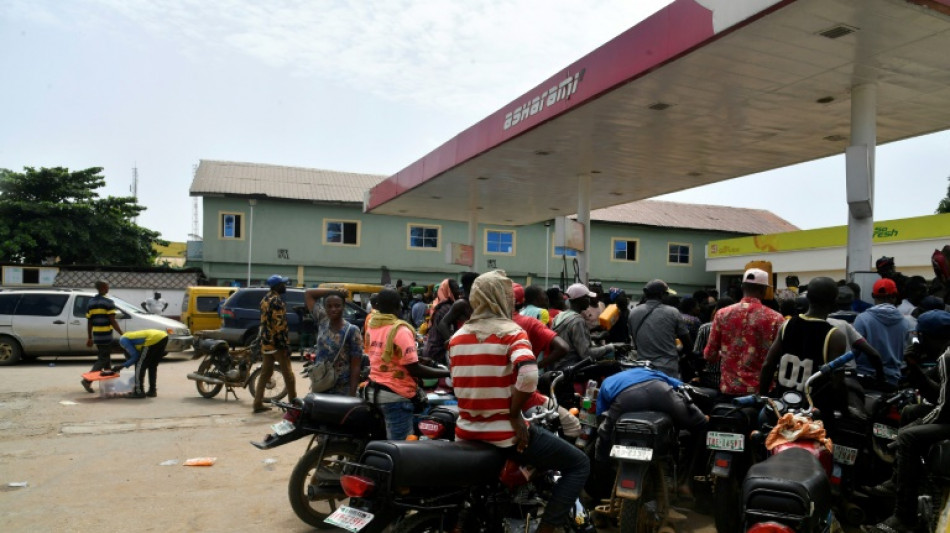
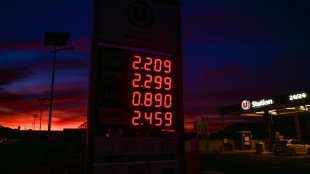
Petrol prices surge in Nigeria after subsidy move / Photo: PIUS UTOMI EKPEI - AFP

 Oil companies close in on Venezuela despite hurdles
 Turkey freezes ex-minister's assets as fund scandal grows

 Guardiola backs Man City after bombshell guilty verdicts

 G20 trade ministers open talks under strain of Trump tariffs

 France in talks with UK to end 2025 migrant accord: ministry
 Europe's surging inflation spreads gloom in stock markets
 Truth commission demands compensation for Sweden's Sami people

 Japan win marathon penalty shootout to set up South Korea gold-medal clash
 Djokovic grinds out opening-round win at China Open
 Northern Ireland police probe blockade of disputed parade

 UK PM Burnham reopens divisive debate on rejoining EU
 Man City future in doubt after guilty verdict
 'Do something,' begs Iranian woman after death sentence over protests
 China extends 52-year unbeaten record as Games organisers say sorry
 In Manchester, people say City scandal is 'shame for football'
 Stocks lacklustre as inflation data weighs on sentiment
 Israel-bound plane rerouted, pilots wounded in reported fight

 Truth commission on Sweden's Sami people seeks redress

 Energy costs spark inflation surges in France, Italy

 South Korea break China hearts to reach Asian Games football final
 Eala storms into Asian Games semi-finals to thrill adoring fans

 Turkey freezes ex-minister's assets as fund crisis grows
 What we know about the North Korean POW dispute

 Most equities rise after oil price plunge, US data in focus

 Polar oceans transformed as warming melts ice habitats: research

The price of petrol in Nigeria tripled at government-run stations on Wednesday, two days after newly-elected President Bola Tinubu announced he would scrap fuel subsidies in his first move after taking office.
His announcement was followed by confusion as to when the measure would take place. The previous government of Muhammadu Buhari had budgeted subsidies until the end of June.
But prices at government-owned gas stations surged on Wednesday from about 190 to 540 naira ($0.4 to $1.2) per litre, suggesting that the subsidies had already scrapped.
"We have adjusted our pump prices of premium motor spirit across our retail outlets, in line with current market realities," the Nigerian National Petroleum Corporation (NNPC) said in a statement.
"Prices will continue to fluctuate to reflect market dynamics."
The uncertainty and sudden change caused panic among many in Nigeria, where more than 80 million people live below the poverty line according to the World Bank.
Prices at privately-owned petrol stations had already started to rise on Tuesday, factoring in expectations about an early end to the subsidies.
In Lagos, a city of some 20 million people, roads were blocked due to massive queues outside petrol stations.
Monday Egbe, a taxi driver in the capital Abuja, was able to buy some fuel but said many people were staying at home because they "cannot afford that price."
"I have increased my prices from about 1,500 to 3,500 naira" for journeys of around 25 minutes, the 39-year-old told AFP.
In the northern city of Kano, Usman Ahmed, a tech worker trying to fill up his tank, described the situation as "madness."
"I just bought 10,000 naira worth of petrol and all I got is 18 litres, in contrast with the 50 litres I would have gotten for the same amount yesterday. It is a nightmare," Ahmed said.
Nearby, civil servant Mustapha Hassan, 45, said he was worried about the wider impact the price hike could have.
"The worse concern is the effect the increase will have on cost of living. The prices of all essential goods will skyrocket and it is the common man that will bear the brunt," Hassan said.
- Anger -
Tinubu's move ends a long-running arrangement to support fuel prices in Nigeria, the continent's most populous country and biggest economy.
Nigeria is oil-rich but has meagre refining capacity. For years, it has swapped crude for gasoline that it then subsidises for its domestic market, causing a huge drain on revenue, foreign exchange and contributing to ballooning debt.
Tinubu had vowed on the campaign trail to remove the costly help and on Monday, after his inauguration, announced the "fuel subsidy is gone".
But on Tuesday the new administration said that the measure would not take "immediate effect" as budget provisions were in place for another month.
It said that "beyond June" the government would be "without funds to continue the subsidy regime".
The NNPC said that the government needed to "settle up to 2.8 trillion naira (about $6 bn)... on subsidies."
So far officials have not announced measures to ease the impact on consumers.
An umbrella group of trade unions, the Nigeria Labour Congress, attacked the decision and demanded it be immediately withdrawn.
"We... are outraged by the pronouncement of President Bola Tinubu removing fuel subsidy without due consultations... or without putting in place palliative measures," it said in a statement.
While fuel subsidies largely benefit the middle class and those who own a vehicle, it does help keep the cost of transport low and is generally popular.
Previous efforts by political leaders to remove it have met with anger, including in 2012 when the army clashed with protesters demonstrating over fuel costs.
T.Resende--PC