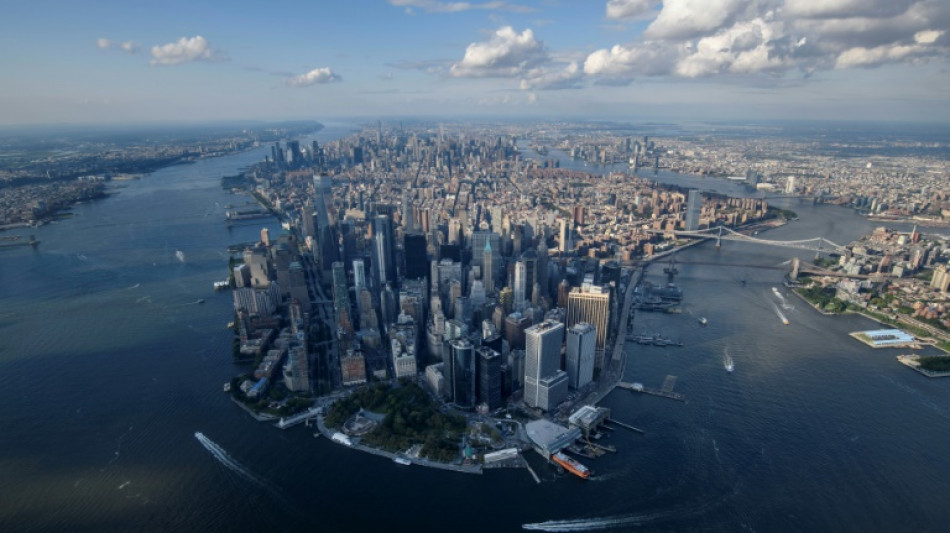
New York sinking under its own weight: study / Photo: Ed JONES - AFP

 Oil companies close in on Venezuela despite hurdles

 Turkey freezes ex-minister's assets as fund scandal grows

 Guardiola backs Man City after bombshell guilty verdicts

 G20 trade ministers open talks under strain of Trump tariffs

 France in talks with UK to end 2025 migrant accord: ministry

 Europe's surging inflation spreads gloom in stock markets

 Truth commission demands compensation for Sweden's Sami people

 Japan win marathon penalty shootout to set up South Korea gold-medal clash
 Djokovic grinds out opening-round win at China Open
 Northern Ireland police probe blockade of disputed parade

 UK PM Burnham reopens divisive debate on rejoining EU

 Man City future in doubt after guilty verdict

 'Do something,' begs Iranian woman after death sentence over protests

 China extends 52-year unbeaten record as Games organisers say sorry
 In Manchester, people say City scandal is 'shame for football'
 Stocks lacklustre as inflation data weighs on sentiment

 Israel-bound plane rerouted, pilots wounded in reported fight

 Truth commission on Sweden's Sami people seeks redress

 Energy costs spark inflation surges in France, Italy

 South Korea break China hearts to reach Asian Games football final
 Eala storms into Asian Games semi-finals to thrill adoring fans

 Turkey freezes ex-minister's assets as fund crisis grows
 What we know about the North Korean POW dispute

 Most equities rise after oil price plunge, US data in focus

 Polar oceans transformed as warming melts ice habitats: research

If New York is the city that never sleeps then how's this for keeping you up at night? It is also sinking.
The Big Apple is gradually going down partly because of the weight of the skyscrapers that make the concrete jungle famous, a new study has found.
The descent makes the metropolis more vulnerable to rising sea levels and coastal flooding caused by climate change, the researchers noted.
The paper, published this month in the Earth's Future journal, sought to estimate how the city's vast infrastructure impacts subsidence.
Subsidence is the sinking of land mass caused by either natural processes such as erosion or human activity like mineral extraction.
The geologists calculated that New York's more than one million buildings added up to a total mass of 1.68 trillion pounds (762 billion kilograms) of downward pressure on the earth.
CNN said that was equivalent to roughly 1.9 million fully fueled Boeing 747-400s.
The report concluded that America's financial capital is sinking at an average rate of one to two millimeters per year.
Some areas built on softer rock or artificial landfill were subsiding as much as four and a half millimeters per year, the study added.
But building fewer skyscrapers will not solve the problem, lead author Tom Parsons told AFP.
"The primary cause of subsidence in New York and along much of the Eastern Seaboard is tectonic and cannot be stopped," said the geophysicist at the US Geological Survey.
The subsidence is set to exacerbate the impact of sea level rise caused by warming temperatures and the melting of the world's ice caps.
The organization Sea Level Rise.org says water levels around New York are nine inches higher than they were in 1950.
The city's government predicts that surrounding waters will rise by between eight inches (20 centimeters) and 30 inches by 2050.
The state is spending billions of dollars building sea walls, raising roads and improving drainage to mitigate the risks.
But low-lying areas have already felt the brunt of devastating floods caused by more intense storms.
Hurricane Sandy in 2012 killed more than 40 New Yorkers, destroyed approximately 300 homes and left tens of thousands of people without power.
Hurricane Ida in 2021 left more than a dozen people dead in New York City, many after they were unable to escape flooding basements.
Parsons said it was impossible to say when parts of New York will be under water but it will happen.
"It's too difficult to predict even a rough time because while city subsidence is relatively steady, forecasts for sea level rise are uncertain and depend on expected future rates of greenhouse gas emissions," he told AFP.
New York is not the only major world city that is sinking.
Subsidence and rising water levels have fueled fears that Venice may one day be entirely submerged.
And Jakarta is sinking at such an alarming rate due to the excessive extraction of groundwater that Indonesia is relocating its capital.
M.A.Vaz--PC