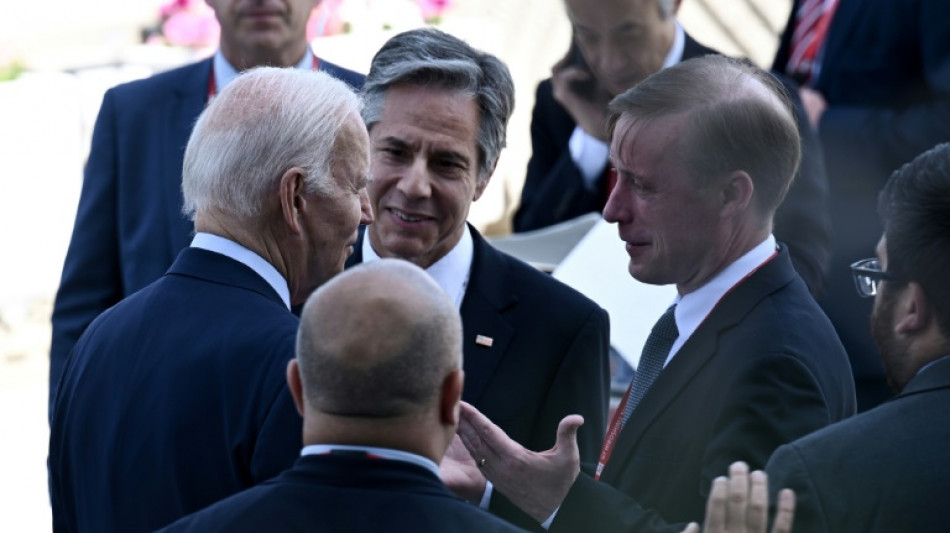
US urges keeping Russia nuclear arms limits, eyes China / Photo: Brendan SMIALOWSKI - AFP/File

 US pushes against overproduction with eye on China at G20 meeting

 Swiss FA withdraws support for FIFA chief Infantino

 Man City's meteoric rise clouded by financial scandal

 Polish activists open first abortion pill locker in Warsaw

 NHL Avalanche ink Bednar to four-year coaching deal

 Polish activists opens first abortion pill locker in Warsaw

 Turkey says news site closed for 'LGBTQ propaganda'

 Oil companies close in on Venezuela despite hurdles
 Turkey freezes ex-minister's assets as fund scandal grows

 Guardiola backs Man City after bombshell guilty verdicts

 G20 trade ministers open talks under strain of Trump tariffs

 France in talks with UK to end 2025 migrant accord: ministry

 Europe's surging inflation spreads gloom in stock markets

 Truth commission demands compensation for Sweden's Sami people

 Japan win marathon penalty shootout to set up South Korea gold-medal clash

 Djokovic grinds out opening-round win at China Open

 Northern Ireland police probe blockade of disputed parade
 UK PM Burnham reopens divisive debate on rejoining EU

 Man City future in doubt after guilty verdict
 'Do something,' begs Iranian woman after death sentence over protests

 China extends 52-year unbeaten record as Games organisers say sorry

 In Manchester, people say City scandal is 'shame for football'

 Stocks lacklustre as inflation data weighs on sentiment
 Israel-bound plane rerouted, pilots wounded in reported fight

 Truth commission on Sweden's Sami people seeks redress

A top White House official on Friday offered to maintain current nuclear warhead limits with Russia, while making the case for putting rising power China at the center of future arms control efforts.
National Security Advisor Jake Sullivan made the comments in a speech at the annual National Arms Control Association meeting in Washington, as he outlined the attempt by Joe Biden administration to confront what he called "substantial" and "deep" cracks in the post-Cold War nuclear landscape.
With the last US-Russia arms control treaty -- New START -- largely moribund and due to expire in 2026, Sullivan said the United States is keen to forge a new treaty.
In the meantime, however, Washington wants the world's two leading nuclear powers to preserve the core of that treaty -- a limit for each of 1,550 warheads.
"We're prepared to stick to the central limits as long as Russia does," Sullivan said.
He also called on Moscow to start new talks for a post-2026 framework, saying "rather than waiting to resolve all of our bilateral differences, the United States is ready to engage Russia now to manage nuclear risks."
Unlike during the Cold War, when there were only two global nuclear powers, the future of arms control will revolve around China's rapidly expanding arsenal and global presence, Sullivan said.
"By 2035, (China) is on track to have as many as 1,500 nuclear warheads -- one of the largest peacetime nuclear buildups in history," Sullivan said, meaning that "the United States will need to deter two near-peer nuclear powers for the first time in its history."
"We're also ready to engage China without preconditions," he said.
A senior US official told reporters that the China factor not only involves the need for Washington to manage the threat directly but to consider the ripple effects created for US nuclear allies Britain and France, whose own smaller arsenals are largely directed at countering Russia.
Agreements with China "of course will affect our ability to come to some sort of accord with the Russians," the official said.
- Difficult path -
With relations at rock bottom with President Vladimir Putin's Russia and currently at a near standstill with Beijing, a difficult path lies ahead.
China "has thus far opted not to come to the table for substantive dialogue on arms control. It has declined to share the size and scope of its nuclear forces or to provide launch notifications. And it has not shown much interest in discussions regarding the changes to its nuclear forces," Sullivan said.
In February this year, Putin announced that Russia was suspending participation in New START, a Cold War-era treaty which limits warheads and allows verification by both sides.
The State Department said Thursday that it has made reciprocal "countermeasures" by suspending various aspects of the treaty, including on-site inspections and exchange of data.
While offering to rebuild arms control treaties, Sullivan stressed that the United States will simultaneously improve its nuclear forces.
"Responsibly enhancing our deterrent capabilities allows us to negotiate arms control from a position of strength," he said.
L.Henrique--PC