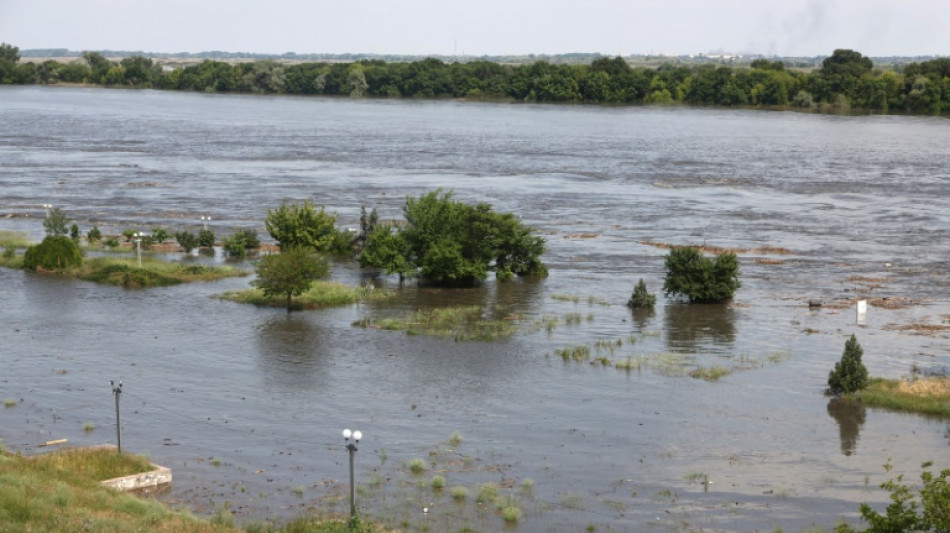
Destroyed dam likely to hinder Ukraine before Russia / Photo: STRINGER - AFP

 Fury, Joshua kick off 'battle of Britain' in good spirits

 Ronaldo leaves Portugal training camp after coach says he is dropped

 Florence Pugh stars in 'East of Eden' adaption on Netflix

 Watchdog finds no criminal misconduct over US Fed renovations despite Trump probe

 In Manchester, City fans 'devastated' while rival fans call for relegation

 UK-France Channel migrant exchange deal scrapped: London

 Portugal boss denies 'incident' with Ronaldo

 Israel PM says one of the pilots of rerouted flight tried to crash plane

 Manchester City: Main points of damning judgement and possible sanctions

 Italy looking for 'identity' under Mancini says Scalvini

 The voices of Spain's housing camp protesters

 Romanian parliament rejects pro-EU PM candidate

 Court halts Tennessee's first execution of woman in 200 years

 Israelis march between once-closed West Bank settlements

 'Welcome back,' says Macron, as UK PM opens door to EU return
 Israel PM says pilot of rerouted flight tried to crash plane

 Demuro hopes to deliver Japan a 'magical' Arc victory

 'Devastated' AI scandal author Orelien returns to Quebec

 US reports firm Q2 economic growth, inflation steady

 Energy costs spark inflation surge across Europe

 Parma appoint Italy World Cup winner Gilardino

 West Indies pile up record 405-7 in second ODI against India

 Romanian parliament rejects pro-EU PM candidate amid political deadlock

 Passenger on rerouted flydubai flight says pilot tried to crash plane

 Russia targets Kyiv power supply as freezing winter approaches

The gaping hole blasted into a key hydroelectric dam in southern Ukraine on Tuesday will severely impede Kyiv's efforts to reconquer territory lost to Russia, even if Moscow risks seeing its defensive lines submerged.
Moscow and Kyiv traded blame for the damage to the Kakhovka dam, which is designed to supply water to the Crimean Peninsula, annexed by Moscow in 2014, which could now be facing serious water supply problems.
But Western observers believe the sabotage is a Russian attempt to harm Kyiv in the short term, just as Ukraine prepares to launch a counteroffensive to regain areas in the east.
Kyiv shares the same view, having accused Russia of having "blown up" the dam in order to "slow down" its operation.
Floods have already forced thousands to evacuate and risks interrupting ongoing Ukrainian military operations.
The rising water in the Kherson region will make it very difficult for Ukraine forces to carry out any operation involving crossing the river to reclaim the eastern bank, in the direction of Crimea.
"Following the logic of cui bono [who benefits], Russia would be the obvious culprit, since by causing floods downstream of Nova Kakhovka, the Russians would complicate Ukraine's efforts to cross, winning time, which would allow them to focus on other sections of the front," said Sergey Radchenko, a history professor at Johns Hopkins School of Advanced International Studies, in a Twitter post.
"I can't see anything near beneficial to Ukraine in this case. More destroyed infrastructure, more downed electricity production facilities, more suffering for Ukrainian civilians, a limitation of Ukrainian offensive and logistics options," said Stephane Audrand, an independent consultant on international risks.
- Floods as a weapon of war -
The risk of strikes on the strategic Kakhovka facility, located in the Russian-occupied areas of the Kherson region, has been brandished since October by both Ukrainians and Russians.
Ukraine President Volodymyr Zelensky accused Moscow of having "undermined the dam", one of the largest in Ukraine. Russian authorities retorted: "lies".
Destruction of this magnitude, likely to cause considerable harm to civilians, is considered a war crime under the 1949 Additional Protocols to the Geneva Convention.
"Dams, dykes and nuclear electrical generating stations, shall not be made the object of attack, even where these objects are military objectives, if such attack may cause the release of dangerous forces and consequent severe losses among the civilian population," according to Article 56.
Contemporary history offers many examples of the destruction of dams and floods in Europe for defensive and offensive purposes.
In 1941, the Soviet Union blew up a huge dam in Ukraine's Zaporizhzhia to slow the German advance.
In May 1943, the British Royal Air Force bombed German dams in the Ruhr valley, the country's industrial heartland.
Carried out by the RAF squadron 617 -- which earned the nickname "Dambusters" -- this operation destroyed two of three dams and damaged the third.
The effort was immortalised in the 1955 film "The Dam Busters".
The flooding tactic was also practised in the First World War.
In the autumn of 1914, during the Battle of Yser, French and Belgian forces unleashed floods to slow the advance of German troops who were attempted in cross the Yser River toward Dunkirk.
The flooding was orchestrated by tampering with the system of locks in Nieuwpoort, which regulates the influx of seawater and drainage to flood plains.
L.Carrico--PC