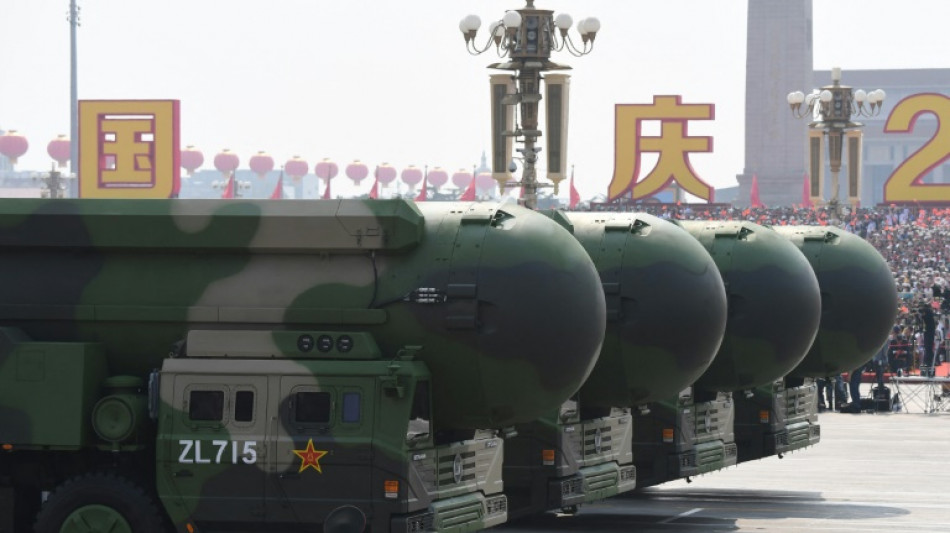
Nuclear arms spending, arsenals swell as global tensions grow: studies / Photo: GREG BAKER - AFP/File

 Panic, anger, tears: Evan Gershkovich's uneasy journey after Russian jail

 UK PM says 'strong indications' Iran involved in airbase incident

 Google restricts access to new AI model over safety concerns

 Watchdog clears former US Fed chief Powell in renovation probe
 Israel PM hails Indian pilot of rerouted flight for averting disaster
 Fury, Joshua kick off 'battle of Britain' in good spirits
 Ronaldo leaves Portugal training camp after coach says he is dropped

 Florence Pugh stars in 'East of Eden' adaption on Netflix

 Watchdog finds no criminal misconduct over US Fed renovations despite Trump probe
 In Manchester, City fans 'devastated' while rival fans call for relegation
 UK-France Channel migrant exchange deal scrapped: London

 Portugal boss denies 'incident' with Ronaldo

 Israel PM says one of the pilots of rerouted flight tried to crash plane

 Manchester City: Main points of damning judgement and possible sanctions

 Italy looking for 'identity' under Mancini says Scalvini
 The voices of Spain's housing camp protesters
 Romanian parliament rejects pro-EU PM candidate

 Court halts Tennessee's first execution of woman in 200 years

 Israelis march between once-closed West Bank settlements
 'Welcome back,' says Macron, as UK PM opens door to EU return
 Israel PM says pilot of rerouted flight tried to crash plane

 Demuro hopes to deliver Japan a 'magical' Arc victory

 'Devastated' AI scandal author Orelien returns to Quebec
 US reports firm Q2 economic growth, inflation steady
 Energy costs spark inflation surge across Europe

The world's nuclear powers, and China in particular, increased investment in their arsenals for a third consecutive year in 2022 amid swelling geopolitical tensions, two reports showed Monday.
The world's nine nuclear-armed states jointly spent $82.9 billion on their arsenals last year, with the United States accounting for more than half of that, according to a new report from the International Campaign to Abolish Nuclear Weapons (ICAN).
The Stockholm International Peace Research Institute (SIPRI) meanwhile released a report showing that the total number of nuclear warheads held by Britain, China, France, India, Israel, North Korea, Pakistan, Russia and the United States was down to 12,512 at the outset of this year, from 12,710 at the start of 2022.
While some of that included older warheads scheduled to be dismantled, SIPRI said that 9,576 were in "military stockpiles for potential use" -- 86 more than a year earlier.
"We are approaching, or maybe have already reached, the end of a long period of the number of nuclear weapons worldwide declining," SIPRI director Dan Smith told AFP.
- 'Beginning to tick up' -
Pointing to the stockpile of usable nuclear warheads, Smith said that "those numbers are beginning to tick up", while adding that they remain far below the more than 70,000 seen during the 1980s.
The bulk of the increase was in China, which increased its stockpile from 350 to 410 warheads.
India, Pakistan and North Korea also upped their stockpiles and Russia's grew to a smaller extent, from 4,477 to 4,489, while the remaining nuclear powers maintained the size of their arsenals.
Russia and the United States together have almost 90 percent of all nuclear weapons.
"The big picture is we've had over 30 years of the number of nuclear warheads coming down, and we see that process coming to an end now," Smith said.
- $157,664 every minute -
The higher spending reported by ICAN appeared to back that up.
ICAN, which was awarded the 2017 Nobel Peace Prize, found that spending on nuclear weapons had risen three percent from 2021, marking the third consecutive annual increase.
The $82.9 billion spent amounted to $157,664 for every minute of 2022, it said in its report entitled "Wasted: 2022 Global Nuclear Weapons Spending".
Washington spent $43.7 billion, which was slightly less than a year earlier but was still far ahead of all other countries, the report showed.
China was next in line with $11.7 billion spent, followed by Russia at $9.6 billion -- both marking an increase of around six percent from 2021.
India meanwhile showed the most drastic spending jump, dishing out $2.7 billion -- 21.8 percent more than a year earlier -- while Britain raised its spending level by 11 percent to $6.8 billion.
The report also highlighted how arms companies involved in the production of nuclear weapons received new contracts worth just under $16 billion last year, and in turn spent $113 million lobbying governments in the United States and France alone.
Globally, nuclear-armed countries have contracts with companies to produce nuclear weapons worth at least $278.6 billion, continuing in some cases through to 2040, it said.
- Diplomatic setbacks -
Researchers at SIPRI also noted that diplomatic efforts on nuclear arms control and disarmament had suffered setbacks following Russia's invasion of Ukraine in February last year.
Russia has for instance suspended participation in New START, a Cold War-era treaty that limits warheads and allows verification by both sides.
At the same time, Smith said the increase in stockpiles could not be explained by the war in Ukraine, as it takes a longer time to develop new warheads and the bulk of the increase was among countries not directly affected.
China has also invested heavily in all parts of its military as its economy and influence have grown.
"What we're seeing is China stepping up as a world power," Smith said.
C.Cassis--PC