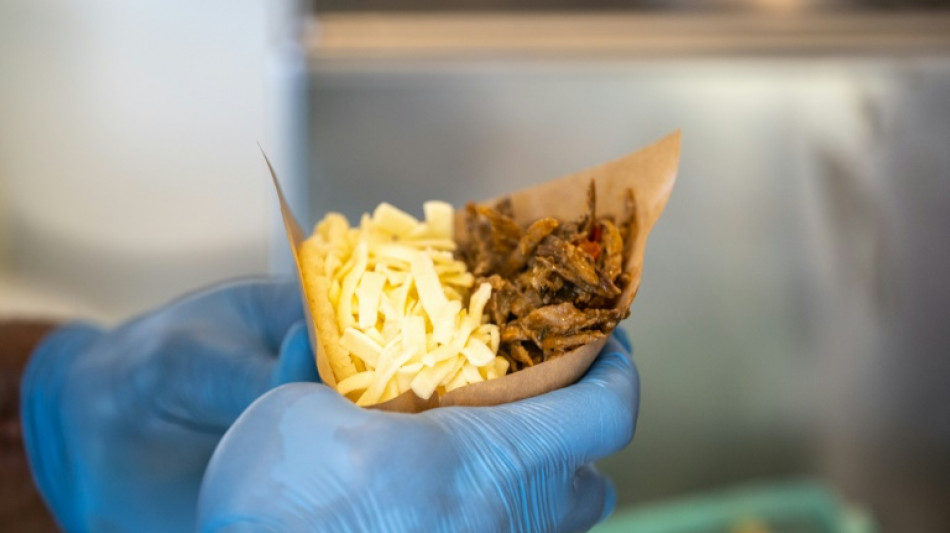
Venezuela's 'daily bread,' humble arepa conquers the world / Photo: Philip FONG - AFP

 Panic, anger, tears: Evan Gershkovich's uneasy journey after Russian jail

 UK PM says 'strong indications' Iran involved in airbase incident

 Google restricts access to new AI model over safety concerns

 Watchdog clears former US Fed chief Powell in renovation probe

 Israel PM hails Indian pilot of rerouted flight for averting disaster

 Fury, Joshua kick off 'battle of Britain' in good spirits

 Ronaldo leaves Portugal training camp after coach says he is dropped

 Florence Pugh stars in 'East of Eden' adaption on Netflix

 Watchdog finds no criminal misconduct over US Fed renovations despite Trump probe

 In Manchester, City fans 'devastated' while rival fans call for relegation

 UK-France Channel migrant exchange deal scrapped: London

 Portugal boss denies 'incident' with Ronaldo

 Israel PM says one of the pilots of rerouted flight tried to crash plane

 Manchester City: Main points of damning judgement and possible sanctions

 Italy looking for 'identity' under Mancini says Scalvini
 The voices of Spain's housing camp protesters

 Romanian parliament rejects pro-EU PM candidate

 Court halts Tennessee's first execution of woman in 200 years

 Israelis march between once-closed West Bank settlements

 'Welcome back,' says Macron, as UK PM opens door to EU return

 Israel PM says pilot of rerouted flight tried to crash plane

 Demuro hopes to deliver Japan a 'magical' Arc victory

 'Devastated' AI scandal author Orelien returns to Quebec

 US reports firm Q2 economic growth, inflation steady

 Energy costs spark inflation surge across Europe

From the streets of Caracas to trendy eateries in New York, Paris and Tokyo, the arepa, a humble cornmeal flatbread, is riding a wave of Venezuelan emigration and feeding a craving for exotic and gluten-free food.
Prepared in just minutes by forming a ball from pre-cooked cornflour and water, it's flattened and then grilled. The arepa can be whatever you want: filled with anything from cheese and meat to beans or seafood, even greens.
A favorite in Venezuela is the "reina pepiada" -- a mix of chicken, mayonnaise and avocado.
The 'viuda' or widow, comes without a filling -- the ideal accompaniment for a soup but also the only option for many among Venezuela's poor.
The arepa "is the daily bread of the Venezuelan. He eats it every day, every night," said Patrick Ribas, who translated into French the book "Arepologo" dedicated to the maize delicacy.
"You can put anything you want in it. It’s a dish. You can also eat it on its own when you don’t have much money. This is unfortunately the case for many Venezuelans," he told AFP.
According to "Arepologo" author Ricardo Estrada Cuevas, the arepa "is a food that has no social class."
"It is eaten by everyone, from the simplest and most humble people to (someone who is) a manager," he told AFP.
"It is a food that everyone eats, in the same way, with the same fillings, with the same characteristics. Where there is a Venezuelan, there are arepas."
- 'Exotic' and gluten-free -
Amid a political and economic crisis that has seen their country's GDP shrink by 80 percent between 2013 and 2022, more than seven million Venezuelans -- almost a quarter of the population -- have emigrated in recent years.
And they've taken their cuisine with them.
Marlyn Quiroga, 47, was a lawyer in Venezuela but left five years ago for New York.
She did odd jobs until 2021, when she started an arepa catering business. This despite saying she "did not know how to cook an egg" before then.
"I went door-to-door in Queens: to beauty salons, offices, clinics. I gave away free samples" to promote the business, Quiroga told AFP.
Success came quickly, said the boss of "Arepa LaNewyorkquina," explaining that more and more people in the City That Never Sleeps now prefer gluten-free arepas to bread.
And on the other side of the Atlantic, "It's a change from the ubiquitous hamburger," said Jean-Francois Lamaison, a 63-year-old digital designer and diner at the Venezuelan restaurant "Ajidulce" in Paris.
Ajidulce boss Luis Fernando Machado, a former petroleum engineer who moved to the French capital in 2011, told AFP he started with a food truck but now employs 10 people.
His restaurant has an open kitchen so customers can see their meals being prepared.
"Parisians love to discover exotic food," he said. "It is a bit like taking a trip to the Caribbean."
It also helps to be listed on a register of gluten-free restaurants in the City of Light. "There are a lot of tourists who come" for that reason, said Machado.
- 'Spread our culture' -
In Tokyo, Venezuelan expat Raul Marquez, 42, and his Japanese wife Miho advertise "gluten-free, healthy street food" at their food truck selling arepas.
"Venezuela has been through a difficult time, you know, for the last few years.... that leads people to emigrate, and you know, to spread our culture in all ways, and food is part of it," Marquez, who himself left about a decade ago, told AFP.
After all these years, for Marquez, an arepa still represents "my mom... eating in the morning before going to school."
"That's what I (bring) when I'm selling arepas -- that passion, that love that comes from home."
Back in Caracas, Lisbeth Marquez has been selling arepas on the street for 15 years, from 4 pm to 2 am every day.
Her personal favorite? The "pabellon," which comes with melted butter, black beans, an egg and grated cheese.
She sells about 1,200 arepas a day, but "I never tire of eating them. The best arepa is the one made at home."
burs-pgf/lab/sf/fio/mlr/nro
G.Teles--PC