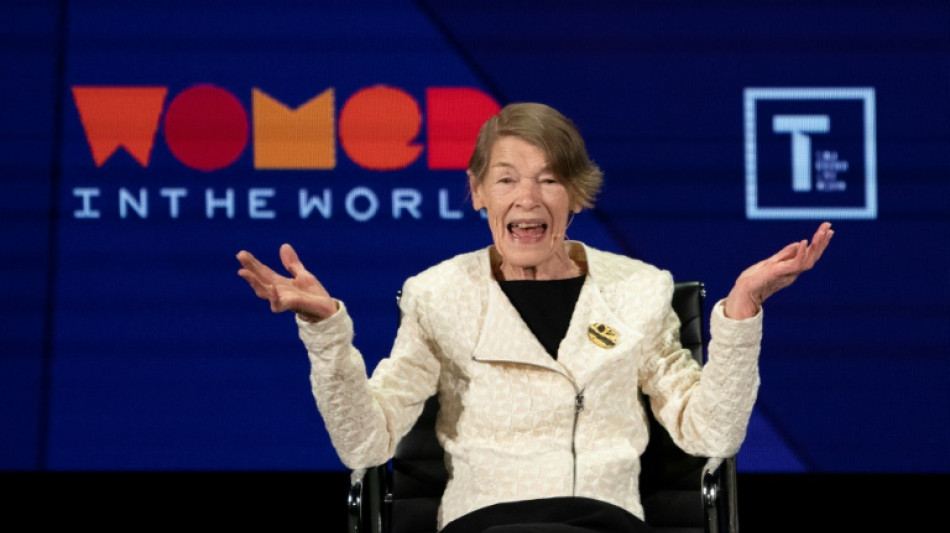
Glenda Jackson: 'fearless' actress turned politician
/ Photo: Don Emmert - AFP/File

 California roller coaster shut after brain damage claims

 Panama ministers push for reopening of huge open-pit copper mine
 Bohm's blast keeps Phillies alive in MLB playoffs
 US judge accepts Paramount's Warner Bros. buyout settlement

 Global stocks mixed as markets weigh higher oil prices, bond yields
 Marsh hails improvements after Australia win final one-day international
 Hegseth says US cut number of generals, admirals by 20%
 Kanye West's Russian concerts have been cancelled, organisers say

 First Hollywood, now Fat Bear Week: nepobaby wins Alaska contest

 Barcelona lay down marker in Women's Champions League, Arsenal slip up
 US pushes against overproduction with eye on China at G20 meeting

 Swiss FA withdraws support for FIFA chief Infantino
 Man City's meteoric rise clouded by financial scandal
 Polish activists open first abortion pill locker in Warsaw
 NHL Avalanche ink Bednar to four-year coaching deal

 Polish activists opens first abortion pill locker in Warsaw
 Turkey says news site closed for 'LGBTQ propaganda'
 Oil companies close in on Venezuela despite hurdles
 Turkey freezes ex-minister's assets as fund scandal grows
 Guardiola backs Man City after bombshell guilty verdicts

 G20 trade ministers open talks under strain of Trump tariffs
 France in talks with UK to end 2025 migrant accord: ministry
 Europe's surging inflation spreads gloom in stock markets
 Truth commission demands compensation for Sweden's Sami people
 Japan win marathon penalty shootout to set up South Korea gold-medal clash

Oscar-winning British actress Glenda Jackson, who died on Thursday aged 87, played powerful female roles before abandoning stage and screen for a career in politics where she was unafraid to speak truth to power.
When she returned to acting in her 80s, she took on a male role and one of theatre's most challenging -- that of King Lear, for which she won high praise.
Jackson's two Oscars for best actress were decades earlier -- as a temperamental young artist in "Women in Love" (1970) and a feminist in the 1973 romantic comedy "A Touch of Class".
After 35 years in theatre and cinema, she quit to become a member of parliament for the Labour party, during years of Conservative rule under Margaret Thatcher and John Major.
In both acting and politics, she compensated for her small, slight stature with what Britain's The Independent newspaper described in 2016 as "a metal-tipped whiplash of a voice" that she used to "inflict devastating, incredulous scorn".
"Who's afraid of Glenda Jackson? Most people, and with some cause," The New York Times wrote in 2019.
- Queen power -
Jackson was born on May 9, 1936, in Birkenhead, a small port town near Liverpool, northwest England, to a bricklayer and a cleaning lady.
At 16 she went to work in a chemist's shop, doing amateur dramatics in her spare time.
When she was 18 she won a scholarship to the prestigious Royal Academy of Dramatic Art (RADA) in London.
Jackson was recruited to the Royal Shakespeare Company, working there from 1964 to 1968, including under fabled director Peter Brook.
Among her standout roles with the company were as Ophelia in "Hamlet" and as Charlotte Corday in "Marat/Sade", both in 1965.
In parallel she worked in cinema, being particularly successful in the early 1970s.
Besides her two Oscars during that period, Jackson won two Emmy Awards for playing Queen Elizabeth I in the hugely successful 1971 BBC television series, "Elizabeth R".
She was the same monarch in the film "Mary, Queen of Scots", also in 1971.
"There was the uncompromising, defiant strength she exuded in every role... She radiated a power that seemed to level her leading men," The Independent wrote in 2018.
- Political stage -
Jackson moved seamlessly to politics, challenging Thatcher's free-market capitalist policies that she said were destroying British society.
At the age of 55 in 1992 -- two years after Thatcher was ousted and Major took over -- she was elected to represent the north London constituency of Hampstead and Highgate in parliament, where she remained until 2015.
She was a junior transport minister in Tony Blair's Labour government from 1997 to 1999, before making an unsuccessful bid to be the party's candidate for mayor of London.
But she became a bitter opponent of Blair over the 2003 war in Iraq and among those who called on him to resign following the suicide of a defence advisor whose report was used to justify the invasion.
In one of her most memorable and controversial parliamentary interventions, Jackson launched an attack on Thatcher's "heinous" record on the day of her funeral in 2013.
"The first prime minister of female gender, ok. But a woman? Not on my terms," she railed.
- Return to acting -
Jackson never achieved a high rank in government but came to be known as a "fearless politician", The Guardian wrote in 2016.
She also advised the Labour mayor of London, Ken Livingstone, on housing policy and campaigned against homelessness in the capital from 2000 to 2004.
Jackson's return to the stage came after an absence of 23 years for a rare gender-swapping role in a London production of "King Lear" in 2016.
In 2018, aged 82, she won her first Tony -- the equivalent of the Oscars for theatre -- for best actress in "Three Tall Women".
In 2019 she reprised the role of "King Lear" in Broadway for a performance The New York Times described as "powerful and deeply perceptive".
Jackson was married to actor Roy Hodges from 1958 to 1976, having with him Dan Hodges, who is a political columnist.
In 1978 she was made a Commander of the British Empire by Queen Elizabeth II.
O.Gaspar--PC