Pause, hike, cut: Central banks diverge over regional challenges / Photo: Mandel NGAN - AFP

 California roller coaster shut after brain damage claims

 Panama ministers push for reopening of huge open-pit copper mine

 Bohm's blast keeps Phillies alive in MLB playoffs

 US judge accepts Paramount's Warner Bros. buyout settlement

 Global stocks mixed as markets weigh higher oil prices, bond yields
 Marsh hails improvements after Australia win final one-day international

 Hegseth says US cut number of generals, admirals by 20%

 Kanye West's Russian concerts have been cancelled, organisers say

 First Hollywood, now Fat Bear Week: nepobaby wins Alaska contest

 Barcelona lay down marker in Women's Champions League, Arsenal slip up
 US pushes against overproduction with eye on China at G20 meeting

 Swiss FA withdraws support for FIFA chief Infantino

 Man City's meteoric rise clouded by financial scandal

 Polish activists open first abortion pill locker in Warsaw

 NHL Avalanche ink Bednar to four-year coaching deal

 Polish activists opens first abortion pill locker in Warsaw

 Turkey says news site closed for 'LGBTQ propaganda'

 Oil companies close in on Venezuela despite hurdles
 Turkey freezes ex-minister's assets as fund scandal grows

 Guardiola backs Man City after bombshell guilty verdicts

 G20 trade ministers open talks under strain of Trump tariffs

 France in talks with UK to end 2025 migrant accord: ministry

 Europe's surging inflation spreads gloom in stock markets

 Truth commission demands compensation for Sweden's Sami people

 Japan win marathon penalty shootout to set up South Korea gold-medal clash

In Washington they paused; in Frankfurt they hiked; and in Beijing, they cut.
Central bankers in three of the world's key economic regions have unveiled divergent monetary policies this week as they each contend with their own challenges.
This week's moves reflect not only the different economic headwinds faced by the Eurozone, the United States and China, but also where they are in their cycle of monetary policy.
The US Federal Reserve began rapidly and aggressively raising rates in March last year, while the European Central Bank (ECB) adopted a more gradual approach to monetary tightening.
"I don't know who has more to do, but certainly the Fed has done more than the ECB," Joseph Gagnon, a senior fellow at the Peterson Institute for International Economics (PIIE), told AFP.
China's situation is markedly different than the United States and the Eurozone, with rate cuts on the menu as policymakers move to tackle lackluster economic growth and soaring youth unemployment.
- Skip, Hike and Cut -
On Wednesday, the US Federal Reserve paused its aggressive campaign of interest rate hikes after 10 straight increases, which brought its benchmark lending rate from close to zero to a range between 5.0 and 5.25 percent.
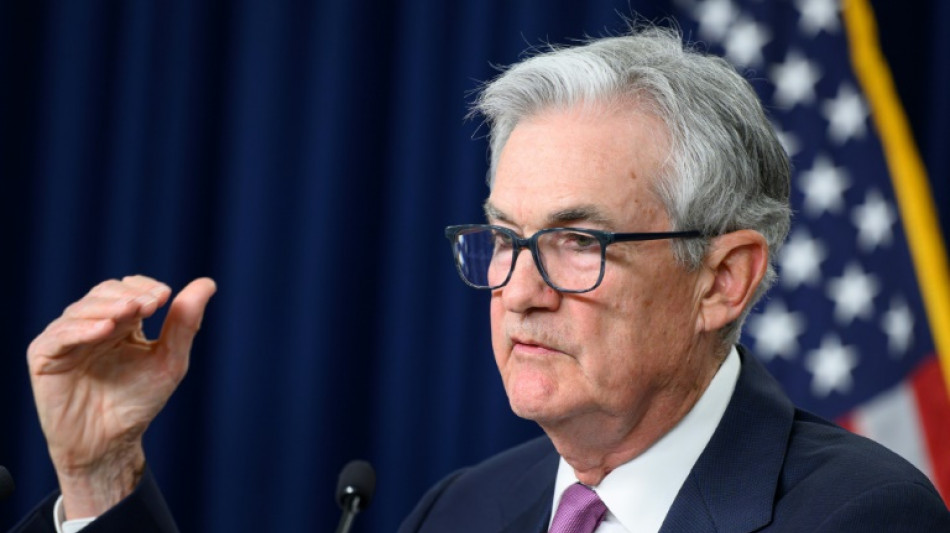
"It allows the economy a little more time to adapt as we make our decisions going forward," Fed chair Jerome Powell explained on Wednesday afternoon, adding that the Fed expects additional hikes were likely in the year ahead.
The Fed's decision to pause was swiftly mirrored by countries like the United Arab Emirates, whose currencies are pegged to the US dollar.
A day later, the ECB took a more proactive decision as it pushed ahead with another quarter percentage-point interest rate hike to tackle sticky inflation, raising its key lending rate to a 22-year high of 3.5 percent.
The ECB's updated economic forecasts also indicated additional hikes on the horizon.
"Unless there is a material change to our baseline, we will continue to hike at our next meeting," ECB chief Christine Lagarde told journalists after the bank raised rates up to their highest level since 2001.
"So we're not thinking about pausing," she said.
Also on Thursday, the People's Bank of China (PBC) announced it was cutting a key lending facility by 10 basis points to 2.65 percent, and extending 237 billion yuan ($33 billion) of fresh funding to lenders "to maintain reasonable and sufficient liquidity in the banking system."
The PBC announcement came two days after it unveiled a surprise cut in short-term interest rates, which analysts said reflected growing concern about the state of the economy among Chinese policymakers.
- Further hikes ahead -
Both the Fed and the ECB have indicated they expect more monetary tightening will be needed to bring inflation back under control.
"Looking ahead, nearly all committee participants view it as likely that some further rate increases will be appropriate this year to bring inflation down to two percent over time," Jerome Powell said Wednesday.
Analysts have taken Powell's comments -- and the Fed's higher interest rate projections -- to indicate support for at least one additional quarter percentage-point hike.
"Our baseline remains for a final 25bp rate hike in July, with the Fed then remaining on hold into early 2024," Deutsche Bank economists wrote in a note to clients after the decision.
Others see US rates going even higher.
"We expect 25bp rate hikes in July and September, though a delay in the second hike to November is also possible," Bank of America economists wrote in a note to clients.
In Europe, analysts say the ECB's updated economic forecasts point to at least two additional hikes.
"The upwardly revised path for headline and, especially, core inflation into 2025 provides a surprisingly clear indication that the ECB’s tightening job is unlikely to be finished next month," said Marco Valli, Chief European Economist at UniCredit.
"We now think the ECB will deliver two more 25bp hikes, in July and September, taking the deposit rate to 4.0 percent, which we think will be the terminal rate," Pantheon Macroeconomics Chief Eurozone Economist Claus Vistesen wrote in a note to clients.
- China to expand stimulus -
The message from China this week has been starkly different, as policymakers at the PBC look to reignite the world's second-largest economy after months of underwhelming data.
Beijing has kept interest rates low compared with other major economies, but near-zero inflation highlights challenges faced by officials trying to stimulate growth.
"All the data points so far sent consistent signals that the economic momentum is weakening," Zhiwei Zhang, president of Pinpoint Asset Management, said in a note on Thursday.
Alongside barely positive inflation in May, exports fell and industrial production growth slowed, as factories returned to full capacity after the pandemic.
Retail sales, which rose in April, are currently "the only functioning engine of Chinese growth," Rob Carnell, Asia-Pacific head researcher at ING, said in a note.
"I don't predict a crisis, but I do think we're in for several months -- if not a year or more -- of somewhat slow, weak growth in China," said Joseph Gagnon from PIIE.
da-jul-sbr-tjx/caw
A.Seabra--PC