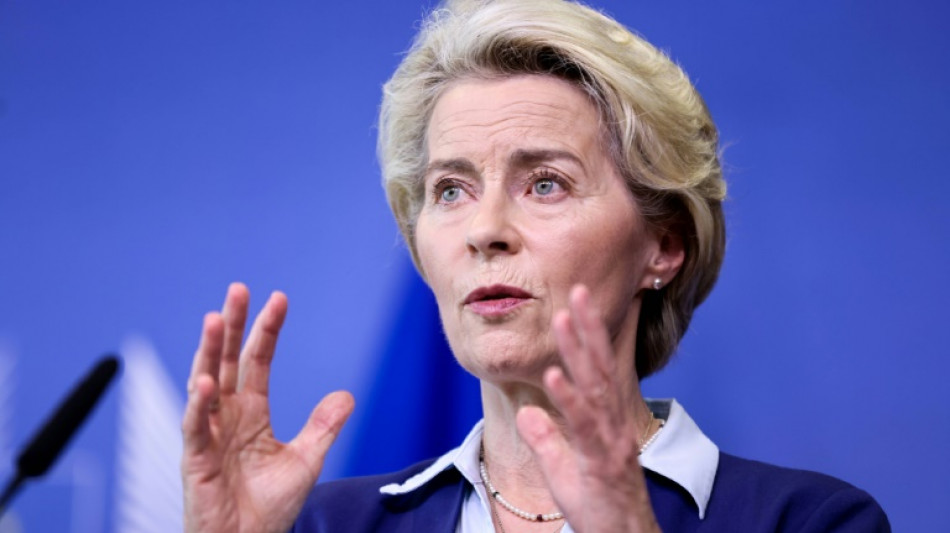
Eyeing China, EU bolsters its armoury to tackle economic risks / Photo: Kenzo TRIBOUILLARD - AFP

 Cable car offers small hope for Mongolia's gridlocked capital

 Man City scandal risks damage to Premier League's booming brand
 First-time Sepang F1 racers will master track 'from opening lap'
 Japan tightens rules for foreigners wanting permanent residency

 'Happiest moment': China's Mu first woman to win eSports Games gold
 EU talks deportations as five nations seek migrant centre in Africa
 Kenneth Branagh examines the scars of Iraq war in 'Atonement'
 Hundreds held, dozens wounded as French school protests escalate
 US government's new AI chatbot pulls back from debunking Trump

 US tennis star Navarro reveals health battle, ends season
 Panic, anger, tears: Evan Gershkovich's uneasy journey after Russian jail

 UK PM says 'strong indications' Iran involved in airbase incident

 Google restricts access to new AI model over safety concerns

 Watchdog clears former US Fed chief Powell in renovation probe

 Israel PM hails Indian pilot of rerouted flight for averting disaster
 Fury, Joshua kick off 'battle of Britain' in good spirits
 Ronaldo leaves Portugal training camp after coach says he is dropped
 Florence Pugh stars in 'East of Eden' adaption on Netflix

 Watchdog finds no criminal misconduct over US Fed renovations despite Trump probe

 In Manchester, City fans 'devastated' while rival fans call for relegation
 UK-France Channel migrant exchange deal scrapped: London

 Portugal boss denies 'incident' with Ronaldo

 Israel PM says one of the pilots of rerouted flight tried to crash plane

 Manchester City: Main points of damning judgement and possible sanctions

 Italy looking for 'identity' under Mancini says Scalvini
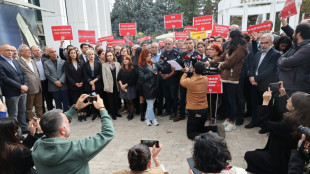
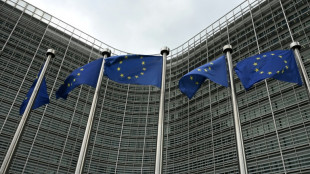
The EU will arm the bloc with tougher tools to confront economic security risks and be more "assertive", the European Commission said on Tuesday, as Brussels seeks to muscle up against rivals Russia and China.
The bloc wants to learn lessons from the aftermath of Moscow's invasion of Ukraine last year when Brussels realised too late how over-reliant the EU had become on Russian energy and had to scramble to find new resources.
Commission President Ursula von der Leyen has aggressively pushed for the European Union to bring more production nearer to or into Europe after the devastating supply chain shocks during the coronavirus pandemic.
"We have to be more assertive," von der Leyen told journalists in Brussels on Tuesday, adding that the EU had to work on "targeted new tools" such as outbound investment.
The commission said it would announce a proposal before the end of the year on outbound investment that could restrict overseas funding by European companies as it outlined the types of risks European economies face.
One major risk identified was the possible leakage of sensitive information about advanced technologies "that could enhance military and intelligence capacities of actors who may use these capabilities to threaten international peace and security".
Key technologies named by the commission in its security strategy doctrine were quantum, advanced semiconductors and artificial intelligence.
"In economic security, we're looking at a limited, small set of cutting-edge technologies," von der Leyen said. "Here we want to make sure they do not enhance the military capabilities of some countries of concern."
While the commission refused to describe the strategy as a response to Beijing, the EU has adopted a series of measures to challenge China's growing economic might in the face of pressure from the United States to take a harder line.
The EU will also review its regulation that scrutinises foreign takeovers in strategic sectors and to strengthen oversight of exports of dual-use goods, civil and military.
Brussels however wants to define its own approach to Beijing that balances concerns over relying too much on China with keeping ties to the world's second-biggest economy.
Von der Leyen described the vast majority of trade and economic relations with countries including China as "business as usual".
- Delicate balancing act -
Some EU member states worry about antagonising China and starting a trade war, while others argue now is the time to act to protect the bloc's economic security.
China's premier said during a visit to Berlin on Tuesday that Beijing "highly regards the development of EU-China ties".
The EU earlier this month agreed to establish a trade tool that would go after countries that seek to put pressure on one of its members after China targeted Lithuania in a spat over Taiwan.
The EU has already announced plans to push Europe to produce more clean technology including critical raw materials needed to manufacture dozens of electrical products.
"It is wise to diversify our supply chains away from the single route to China for example also to Argentina and to Chile," von der Leyen said, a week after a visit to Latin America to boost trade ties between the two continents.
Von der Leyen first described the EU's new approach to China in January as "de-risking rather than decoupling" since the bloc still sought to work and trade with Beijing.
One European diplomat said the EU had to "stop being naive and protect ourselves, we must change the playing field".
The diplomat pointed to the rising number of electric cars from China sold in the bloc, threatening its long-established car-manufacturing industry.
There have also been calls for caution over how the EU confronts the risks.
"The EU needs to strike the right balance between protecting its security interests and maintaining a conducive environment for trade and investment," said Markus Beyrer, director general of BusinessEurope, the EU's main business lobby group.
EU leaders will discuss the strategy at a summit in Brussels next week.
S.Caetano--PC