In Berlin, Ukrainian soldiers begin long road to recovery / Photo: Tobias SCHWARZ - AFP

 Cable car offers small hope for Mongolia's gridlocked capital

 Man City scandal risks damage to Premier League's booming brand

 First-time Sepang F1 racers will master track 'from opening lap'
 Japan tightens rules for foreigners wanting permanent residency

 'Happiest moment': China's Mu first woman to win eSports Games gold

 EU talks deportations as five nations seek migrant centre in Africa
 Kenneth Branagh examines the scars of Iraq war in 'Atonement'

 Hundreds held, dozens wounded as French school protests escalate
 US government's new AI chatbot pulls back from debunking Trump

 US tennis star Navarro reveals health battle, ends season

 Panic, anger, tears: Evan Gershkovich's uneasy journey after Russian jail

 UK PM says 'strong indications' Iran involved in airbase incident

 Google restricts access to new AI model over safety concerns

 Watchdog clears former US Fed chief Powell in renovation probe
 Israel PM hails Indian pilot of rerouted flight for averting disaster
 Fury, Joshua kick off 'battle of Britain' in good spirits

 Ronaldo leaves Portugal training camp after coach says he is dropped

 Florence Pugh stars in 'East of Eden' adaption on Netflix

 Watchdog finds no criminal misconduct over US Fed renovations despite Trump probe

 In Manchester, City fans 'devastated' while rival fans call for relegation
 UK-France Channel migrant exchange deal scrapped: London

 Portugal boss denies 'incident' with Ronaldo

 Israel PM says one of the pilots of rerouted flight tried to crash plane

 Manchester City: Main points of damning judgement and possible sanctions

 Italy looking for 'identity' under Mancini says Scalvini
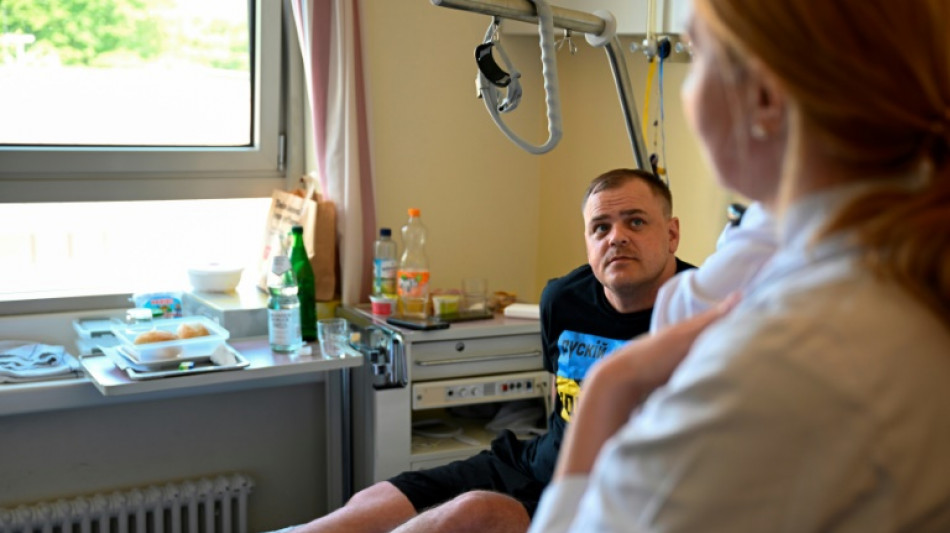
Miner Vitali volunteered to fight against Russia from the first days of the conflict at the front lines in his native Kharkiv, in eastern Ukraine, where orthopaedic surgeon Olga Pidgaiska worked in a hospital.
But it was 1,600 kilometres (1,000 miles) away that the two Ukrainians would meet -- at Charite hospital in Berlin where war-wounded Vitali received treatment and where Olga worked after fleeing the war.
Vitali, who gave his first name only, was shot several times in his limbs shortly after joining battle.
His right arm had to be amputated. He was swiftly transported out of Ukraine for treatment in Germany, arriving in Berlin in March 2022.
Ten operations followed, and doctors were able to save his leg -- which he was told in Ukraine he would lose.
Doctors have also given Vitali an artificial arm.
"It's important for me. When I'm back home, I'll need to drive my car," said the miner.
A doctor comes by every day, accompanied by Olga, who translates the instructions and information given to the patient.
Olga herself fled the war with her mother and son, finding refuge in Berlin, where she obtained employment at the capital's biggest hospital.
- 'Not on this scale' -
Thousands of wounded Ukrainian soldiers are being treated across the EU as part of a programme set up by the European Commission.
Germany has taken in 800 injured Ukrainian soldiers since the start of the war, including about 50 at the Berlin hospital unit specialising in muscular and skeletal wounds.
"We have already seen this in other conflicts, but not on this scale," said Sven Maerdian, who heads the hospital's trauma surgical section.
Their recovery process is long and full of pitfalls.
Over three to six months, the patients are treated far away from their loved ones, and their daily routine is punctuated by injections of antibiotics and medical checks.
Vitali leaves his room sometimes, with the help of a wheelchair, to chat with compatriot Oleh.
Wearing a T-shirt with a Ukrainian flag and sporting tattoos on his arms, Oleh was also wounded in the war.
He stepped on a mine and arrived in Charite at the start of the year, with a large wound on his right hip.
Oleh has undergone several operations, but serious infection set in on the wound, complicating his recovery.
- Resistant infections -
Resistant bacteria infecting the soldiers are hard to treat, Maerdian said, calling it a "medical challenge" that practitioners are fighting with special antibiotic regimes.
The psychological treatment of the patients is likewise a challenge, with doctors watching the process closely and an emergency service dedicated to their recovery.
Away from the war, all that the Ukrainian patients think about are their families back home.
Vitali's wife and two sons are still in Ukraine. His older son is on the frontline.
"It's very difficult to be far from my family, but I'm trying my best," he said, adding that he calls them "every half an hour".
Vitali knows that when he returns to Ukraine, he won't have much time with his loved ones either.
Fighting is raging and all men between 18 and 60 are mobilised.
"I have military obligations," he said.
A.Silveira--PC