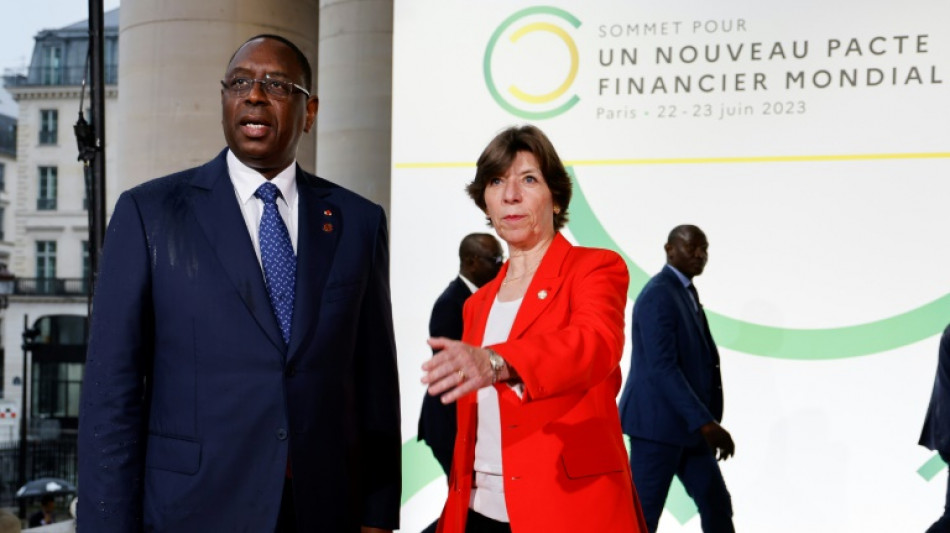
Rich countries pledge $2.7 bn to decarbonise Senegal economy / Photo: Ludovic MARIN - POOL/AFP/File

 Jennifer Lopez Faces Backlash Over Claims of Hollywood Ethnicity Bias

 Veena Vidushi Jayanthi Kumaresh to Host MUSICIQ Quiz at The Music Academy

 Grammy Winner Silvana Estrada Named Creative Chair for Latin Music at LA Phil
A group of wealthy nations and multilateral development banks have promised to mobilise 2.5 billion euros to help Senegal reduce its dependence on fossil fuels, President Macky Sall said Thursday.
"Senegal has committed to increasing the share of electricity generated by renewable energy to 40 percent by 2030 with financing to the order of 2.5 billion euros," equivalent to $2.7 billion, Sall told a roundtable at the two-day Summit for a New Global Financing Pact in Paris.
Currently, just over 30 percent of power comes from renewable sources, but that is based on "unfavourable loans," Sall said.
The deal with Senegal -- underwritten by France, Germany, Britain, Canada and the European Union -- is the latest in a series of so-called Just Energy Transition Partnerships (JETP).
The first of these types of arrangements, announced at the CO26 climate conference 2021, saw $8.5 billion promised to help South Africa wean itself off coal-fired power, but observers have raised concerns that the deal is too reliant on loans rather than grants.
Other deals with Indonesia ($20 billion) and Vietnam ($15.5 billion) followed.
"The renewables target that Senegal have proposed is a good idea, we don't want them to be locked into long term dependence on gas," said Ronan Palmer, an analyst at climate think tank E3G.
"But the finance providers for Senegal's JETP have to very carefully avoid the mistakes made in South Africa," he added. "This should not be a mechanism for more debt."
- 'Transitional energy' -
The 2.5 billion euros will cover a package of grants, subsidies, concessional loans, export credits and technical assistance over an "initial period" of three to five years, according to a joint statement by Senegal and its JETP partners.
Nations supporting the deal have also pledged to help line up funding from multilateral development banks and the private sector.
Senegal has not forsworn fossil fuel development, saying it "intends to use its natural gas resources as a transitional energy."
While the economies of other JETP countries are heavily reliant on coal to generate power, Senegal uses mostly heavy diesel fuel oils.
Earlier this week Sall vowed to strengthen "democracy and freedom" in his country, in his first public reaction to deadly June 1-3 unrest sparked by the conviction of a popular opposition leader, that has shaken the West African state's image for stability.
At least 16 people were killed, according to the authorities. Amnesty International puts the toll at 23, and the opposition at 30.
"Our economic profile has become very attractive. This year we are going to start extracting oil and gas," he said on Tuesday on a state visit to Portugal.
"That may also be the reason for all this frenzy."
S.Caetano--PC