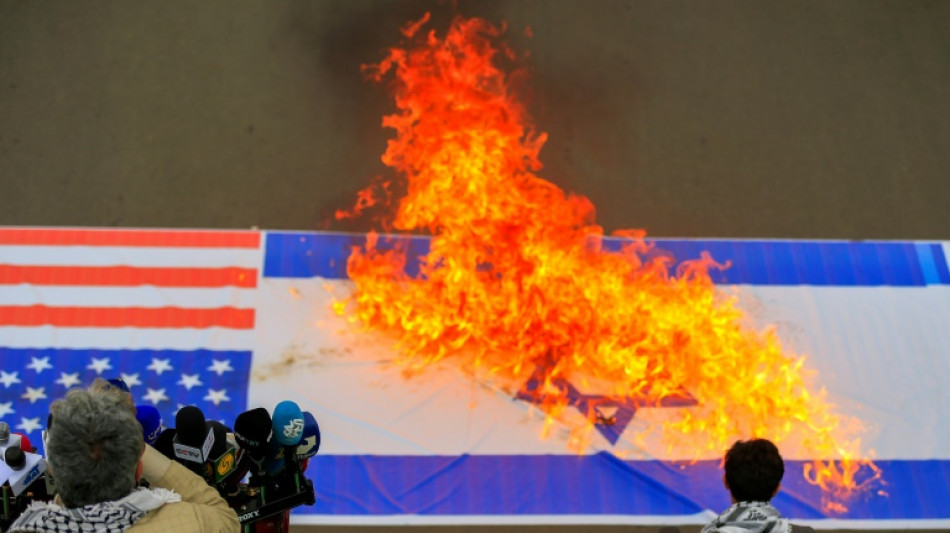
Yemen's Huthis seek propaganda boost from deadly US strikes / Photo: Mohammed HUWAIS - AFP

 Manchester City's Premier League charges: What comes next?

 Brazil's cellphone crime: a security nightmare in every pocket

 Russia pummels Kyiv in latest deadly attack
 NFL Giants obtain QB McCarthy from Vikings

 Deal for evicted Spanish pensioner as PM seeks new housing law

 Clippers apologize, warn fans of 'challenges' after Leonard scandal

 Turkish comedian convicted for Erdogan 'insult' freed pending appeal

 Trump announces 'biggest' US steel plant in battleground Iowa

 Olise wonder strike gives Zidane's France win in Belgium

 US stocks fall, bond yields rise as Middle East war drags on

 Trump denies offering to sell arms to China's Xi

 Wemby ready for NBA Spurs to move rivals in climb to top

 Ukraine to postpone some spending amid delays in aid: PM

 Tuchel says Czech Republic game 'not yet a must-win'

 MaXhosa puts South Africa on the Paris fashion map
 Rose, Scott among 2027 World Golf Hall of Fame finalists

 Brunson says NBA champion Knicks can't get satisfaction

 France puts out largest wildfire since 1949

 Real Madrid's Perez summoned over Barcelona referee payments comments

 Oil takes off again, Wall Street dips after Trump rejects Iran truce offer

 AlgoQuant Asset Management Selects Liquid Mercury to Enhance Digital Asset Trading Infrastructure

 UK to reopen refugee resettlement scheme to push 'safe' migration
 Pope urges Europe to help combat 'lies and deceit' in world affairs

 Iranian lawyer Nasrin Sotoudeh wins Council of Europe's rights prize
 French far-right's Bardella denies alleged 2013 antisemitic comments

As America's escalated bombing campaign and economic sanctions hit Yemen hard, the Iran-backed Huthi rebels in Washington's crosshairs are trying to mine the situation for propaganda and recruitment, analysts said.
On Monday, four days after 80 people were killed in US strikes on a fuel port, the Huthis released a slick promotional video showing special forces marching over the Israeli flag and somersaulting through flaming hoops.
Against a soundtrack of dramatic music, the masked soldiers fire automatic weapons at targets bearing the American, Israeli and British flags -- the three countries involved in attacks on Yemen since January last year.
The Huthis, part of Iran's "axis of resistance" against Israel and the US, have painted themselves as defenders of Gaza during the Israel-Hamas war, launching a drumbeat of missiles and drones both at Israel and at cargo vessels plying the key Red Sea trade route.
In response, the administration of US President Donald Trump has ramped up pressure on the group, redesignating it a terrorist organisation and carrying out near-daily air strikes that have killed more than 200 people since mid-March.
"The Huthis are absolutely trying to use the intensified campaign of US air strikes for propaganda purposes," said Thomas Juneau, a Middle East specialist at the University of Ottawa's Graduate School of Public and International Affairs.
"They are actively using information operations to try to position themselves as champions of the resistance against the United States and its regional partners, including to maximise recruitment domestically."
- Child soldiers -
The Huthis, whose regular rallies against the United States and Israel are attended by large crowds in the rebel-held capital Sanaa, have urged Yemenis to mobilise.
They say that tens of thousands had signed up for military training since the start of the war in the Gaza Strip.
In February last year, Human Rights Watch warned that child recruitment for the rebels' armed forces had "noticeably" increased since the Gaza war began in October 2023.
Rebel television aired interviews with survivors of last week's attack on the Ras Issa fuel port, the deadliest of the US campaign, who vowed support for Gaza even as they lay wounded on stretchers.
The US escalation "comes at a steep human cost, which could intensify Huthi mobilisation and recruitment", said US-based Yemen expert Mohammed Albasha.
But the US raids have also succeeded in destroying some Huthi military capabilities and have forced its leadership into hiding, analysts say.
The Huthis managed to survive a decade of air strikes by a Saudi-led coalition and more than a year of US attacks aimed at deterring their harassment of Red Sea shipping.
"The difference with the American bombing campaign is its relentless pursuit of Huthi leadership," said Maged al-Madhaji, chairperson of the Sanaa Center for Strategic Studies, an independent think-tank.
Attacks on communication networks and control centres have caused "unprecedented damage to the movement's infrastructure", he added.
"However, this damage can be repaired if the campaign stops and neither a ground operation nor a political path is pursued. The Huthis are capable of adapting and enduring pressure."
- Economic damage 'much bigger' -
Meanwhile, Washington is strangling the rebels financially, sanctioning banks and hitting infrastructure like the Ras Issa fuel terminal -- a vital source of energy and funds for the Huthis' precarious economy.
Returning the rebels to the US terror list makes it risky for companies to operate in their territory, including by importing materials, as they could face sanctions of their own.
"The economic damage is much bigger than just (military strikes)," said Baraa Shiban, a Yemen specialist at Britain's Royal United Services Institute, a security think-tank.
He also questioned the effectiveness of the Huthi propaganda among a population already reeling from more than a decade of war with the Saudi-led coalition.
"People are frustrated, tired, and they're exhausted. And, you know, the economic situation is very, very dire," Shiban said.
"People just want the cycle of violence to end."
A.F.Rosado--PC