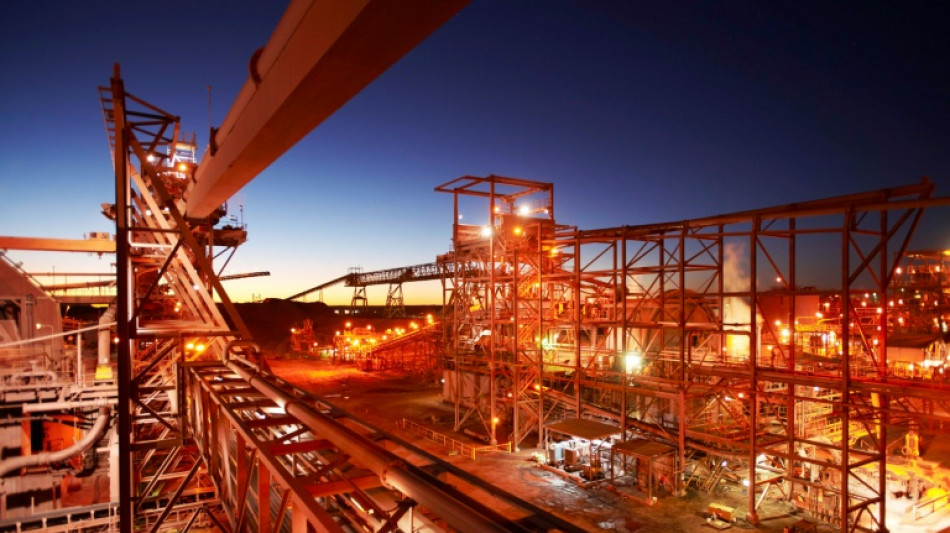
Australia to stockpile critical minerals in strategic reserve / Photo: - - BHP BILLITON/AFP/File

 Manchester City's Premier League charges: What comes next?

 Brazil's cellphone crime: a security nightmare in every pocket

 Russia pummels Kyiv in latest deadly attack
 NFL Giants obtain QB McCarthy from Vikings

 Deal for evicted Spanish pensioner as PM seeks new housing law

 Clippers apologize, warn fans of 'challenges' after Leonard scandal

 Turkish comedian convicted for Erdogan 'insult' freed pending appeal
 Trump announces 'biggest' US steel plant in battleground Iowa

 Olise wonder strike gives Zidane's France win in Belgium

 US stocks fall, bond yields rise as Middle East war drags on

 Trump denies offering to sell arms to China's Xi

 Wemby ready for NBA Spurs to move rivals in climb to top

 Ukraine to postpone some spending amid delays in aid: PM

 Tuchel says Czech Republic game 'not yet a must-win'

 MaXhosa puts South Africa on the Paris fashion map

 Rose, Scott among 2027 World Golf Hall of Fame finalists

 Brunson says NBA champion Knicks can't get satisfaction
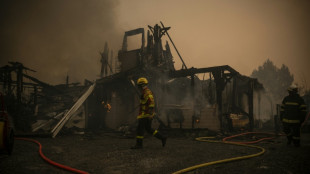 France puts out largest wildfire since 1949

 Real Madrid's Perez summoned over Barcelona referee payments comments

 Oil takes off again, Wall Street dips after Trump rejects Iran truce offer
 AlgoQuant Asset Management Selects Liquid Mercury to Enhance Digital Asset Trading Infrastructure

 UK to reopen refugee resettlement scheme to push 'safe' migration

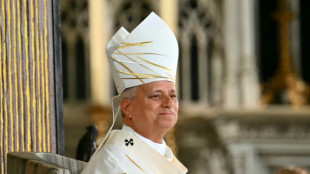 Pope urges Europe to help combat 'lies and deceit' in world affairs

 Iranian lawyer Nasrin Sotoudeh wins Council of Europe's rights prize
 French far-right's Bardella denies alleged 2013 antisemitic comments
Australia will stockpile critical minerals in a new strategic reserve, Prime Minister Anthony Albanese said Thursday, as nations scramble to source rare earths and coveted metals outside China.
Mining superpower Australia sits on bulging deposits of lithium, nickel and cobalt -- metals used in everything from smartphones to electric vehicles.
But most of this boon is sold as raw ore to processing factories in China, which has a chokehold on the global supply of finished critical minerals.
Albanese said Australia would start stockpiling these commodities at home, striking deals to sell them to other "key partners".
"Increasingly uncertain times call for a new approach to make sure Australia maximises the strategic value of critical minerals," he said in a statement.
"We need to do more with the natural resources the world needs, and that Australia can provide."
Australia would initially set aside Aus$1.2 billion (US$760 million) to get the reserve up and running.
Albanese's government has previously suggested Australia could use its critical minerals as a bargaining chip in tariff talks with the United States.
Australia sits on some of the largest lithium deposits in the world, and is also a leading source of lesser-known rare earth metals such as neodymium.
Major manufacturing nations such as the United States, Germany and Japan are eager to obtain these critical minerals from sources other than China.
Japan has its own critical minerals stockpile, while the United States has been investing in metals refineries and other processing technology.
- Rare earth ransom -
"The ability for the government to stockpile is an important safeguard against market pressure, as well as interventions from other nations," Albanese said in a speech later on Thursday.
"It means Australia has the power to sell at the right time to the right partners for the right reasons."
Critical minerals loom as a likely new front in the unfolding trade war between Washington and Beijing.
US President Donald Trump last week ordered a probe that could result in new tariffs targeting China.
Trump's order stated that the United States was dependent on foreign sources of critical minerals, putting its military and energy infrastructure at risk.
China has shown a willingness to hold rare earths to ransom in the past.
At the height of a diplomatic dispute in 2010, China effectively banned the export of rare earths into Japan.
The move rattled Japan's car-making industry, which was heavily reliant on certain rare earth alloys to build magnets used in motors.
China controls some 90 percent of the world's supply of rare earths -- a subset of critical minerals -- and is fiercely protective of its position.
Beijing has banned the export of processing technology that could help rival nations, and has been accused of using state-imposed quotas to control supply.
A.Aguiar--PC