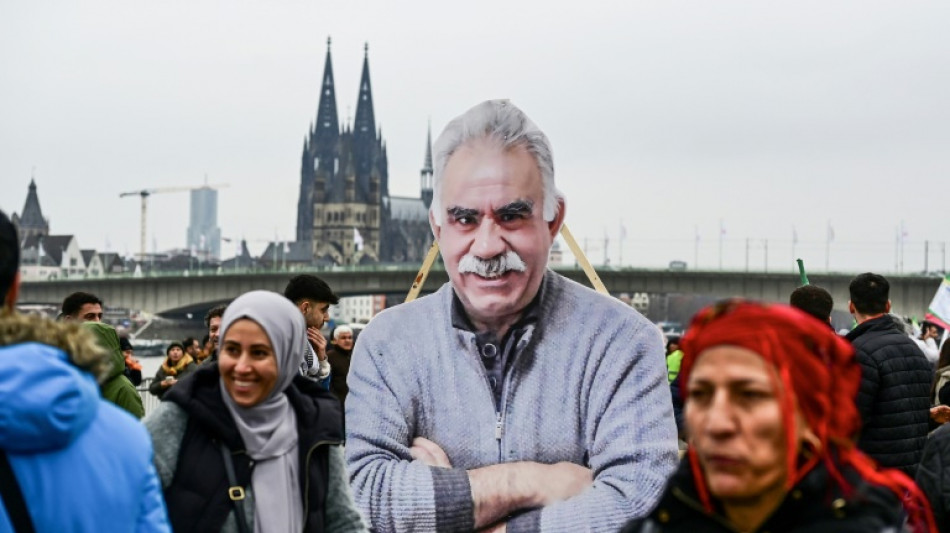
Ocalan: founder of the Kurdish militant PKK who authored its end / Photo: Ina FASSBENDER - AFP/File

 Trump admin finalizes reversal of US fuel economy standards
 US says no China arms sale plans after envoy cites Trump offer
 Dozens kidnapped in two weekend attacks in northern Nigeria
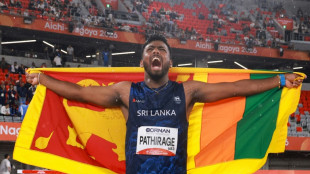 Next stop the world: Pathirage wins Asian Games javelin gold

 Aster Launches Perpetual Grid Trading 2.0 with Up to 140,000 $ASTER Liquidity Mining Campaign
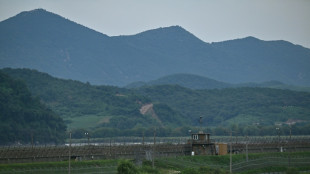 Seoul says North Korean mines 'highly suspected' as cause of DMZ blast
 Russia pummels Kyiv in latest deadly daytime attack
 Wartime Ukraine works to keep its railways on track
 Boy among 3 dead in migrant Channel crossing accident: French authorities
 SGFX Creates a Standout Brand Experience at Forex Expo Dubai 2026
 Pope urges Europe to help combat 'deceit and lies' in international ties
 Injured Buttler to miss England ODI series in Pakistan
 Madrid housing protesters vow to maintain pressure on government
 In kayaks or waist-deep in floodwater, shoppers return to Bangkok markets

 UK police probes Iran link to air base bomb scare: media
 Eala blasts into Asian Games quarters in just 55 minutes
 Taiwan gender-row boxer Lin Yu-ting guarantees Asian Games medal
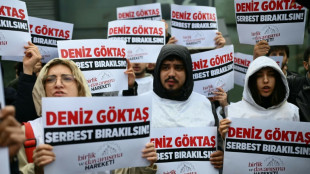 Comedian on trial for allegedly insulting Erdogan in standup show
 More Asian Games transport woes as bus takes Pakistan to wrong venue
 Death toll in South Africa bar shooting rises to 18
 Aide to Venezuelan opposition leader returns from exile

 Messi and Alcaraz love it, now padel takes step closer to Olympics
 Tolls mount in Thailand, Myanmar floods
 Why India's opposition wants top poll official out

 PU Prime Strengthens UAE Momentum with Strong Showing at Forex Expo Dubai 2026
Abdullah Ocalan, the jailed founder of the militant Kurdistan Workers' Party (PKK), is an icon to many Kurds but a "terrorist" to many within wider Turkish society.
After a decades-long insurgency against the Turkish state that resulted in tens of thousands of deaths, the PKK said on Monday it was disbanding and ending its armed struggle.
The move came after Ocalan issued a historic call on February 27 for his fighters to lay down their arms in a major step towards ending the decades-long conflict.
Now 76, Ocalan has been held in solitary confinement since 1999 on Imrali prison island near Istanbul.
But since October, when Turkey tentatively moved to reset ties with the PKK, Ocalan has been visited several times by lawmakers from the pro-Kurdish opposition DEM party.
For many Turks, the PKK leader is public enemy number one.
He founded the group in 1978. Six years later, it began an insurgency demanding independence and later broader autonomy in Turkey's mostly Kurdish southeast.
A Marxist-inspired group, the PKK was blacklisted as a "terror" organisation by Ankara, Washington, Brussels and many other Western countries.
- An olive branch -
Attitudes began shifting in October when ultra-nationalist MHP leader Devlet Bahceli, a close ally of President Recep Tayyip Erdogan, offered Ocalan an olive branch if he would publicly renounce violence.
The next day, the former guerrilla, who embodies the decades-long Kurdish rebellion, received his first family visit in four years.
He sent back a message saying he alone could shift the Kurdish question "from an arena of conflict and violence to one of law and politics", later offering assurances he was "ready to... make the call".
Ankara's move came shortly before Syrian rebels overthrew ruler Bashar al-Assad, upending the regional balance of power and thrusting Turkey's complex relationship with the Kurds into the spotlight.
- From village life to militancy -
Ocalan was born on April 4, 1949, one of six siblings in a mixed Turkish-Kurdish peasant family in Omerli, a village in Turkey's southeast.
His mother tongue is Turkish.
He became a left-wing activist while studying politics at university in Ankara and was first jailed in 1972.
He set up the PKK six years later, then spent years on the run, launching the movement's armed struggle in 1984.
Taking refuge in Syria, he led the fight from there, causing friction between Damascus and Ankara.
Forced out in 1998, he moved from Russia to Italy to Greece in search of a haven, ending up at the Greek consulate in Kenya, where US agents got wind of his presence and tipped off Turkey.
He was arrested on February 15, 1999, after being lured into a vehicle in a Hollywood-style operation by Turkish security forces.
Sentenced to death, he escaped the gallows when Turkey started abolishing capital punishment in 2002, living out the rest of his days in isolation on Imrali prison island in the Sea of Marmara near Istanbul.
For many Kurds, he is a hero whom they refer to as "Apo" (uncle). But Turks often call him "bebek katili" (baby killer) for ruthless tactics that include the bombing of civilian targets.
- Jailed but still leading -
With Ocalan's arrest, Ankara thought it had decapitated the PKK.
But even from his cell he continued to lead, ordering a ceasefire that lasted from 1999 until 2004.
In 2005, he ordered followers to renounce the idea of an independent Kurdish state and campaign for autonomy in their respective countries.
Tentative moves to resolve Turkey's "Kurdish problem" began in 2008 and several years later Ocalan became involved in the first unofficial peace talks, when Erdogan was prime minister.
Led by then spy chief Hakan Fidan -- who is now foreign minister -- the talks raised Kurdish hopes for a solution with their future within Turkey's borders.
But the effort collapsed in July 2015, sparking one of the deadliest chapters in the conflict.
The government has defended its de facto silencing of Ocalan, saying he failed to convince the PKK of the need for peace.
Seen as the world's largest stateless people, Kurds were left without a country when the Ottoman Empire collapsed after World War I.
Although most live in Turkey, where they make up around a fifth of the population, the Kurds are also spread across Syria, Iraq and Iran.
Turkey's widescale use of combat drones has pushed most Kurdish fighters into northern Syria and Iraq, where Ankara has continued its raids.
C.Amaral--PC