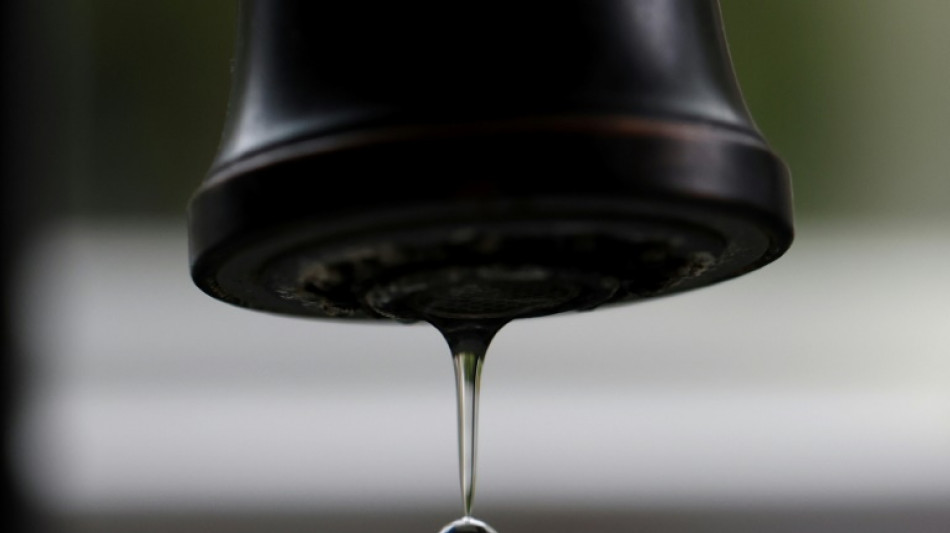
Trump admin drops limits on several 'forever chemicals' in drinking water / Photo: JUSTIN SULLIVAN - GETTY IMAGES NORTH AMERICA/AFP/File

 SpaceX puts Starship megarocket in orbit for first time

 Iran denies link to suspected bomb plot at UK airbase used by US

 Ex-boss Mancini says City charges 'not my concern'

 Berlin Marathon winner Assefa finished race with torn Achilles

 Comedian convicted for Erdogan 'insult' but freed pending appeal

 French prosecutors seek two-year sentence for ex-minister Dati in graft case

 Eala makes fast start as weather and transport woes hit Asian Games

 Hurricane Polo approaches Mexico, threatens severe damage

 Energy markets rally after Trump rejects Iran truce offer
 Japanese convenience store enlists Lady Gaga to bolster recruitment

 Seoul summons Ukraine envoy in row over North Korean POWs

 Ireland 'raised awareness worldwide' in Israel game: Hallgrimsson

 Colombian police capture wife, daughter of Ecuador drug lord

 More Asian Games woes as bus takes Pakistan team to wrong venue

 Radio frequencies vital to Earth observation must be protected: UN

 Comedian on trial for insulting Erdogan in standup show

 Women's Fashion Week kicks off in Paris

 Pope arrives in French border city to speak on united Europe

 The wildfires choking Indonesia, sparking regional haze

 PU Prime Deepens Argentina Presence Through FX Expo Buenos Aires 2026

 Nothing to seal here: NZ police help stranded pup home

 White House releases list of products US, China could tax less

 'Pseudo-journalism': Partisan 'news' sites target US midterms

 'Currently impossible': North Korea defections in freefall

 Erasmus sizes up 'improved' Wallabies ahead of 2027 World Cup

US President Donald Trump's administration on Wednesday announced plans to scrap limits on several "forever chemicals" in drinking water, reversing what had been hailed as a landmark public health victory.
In a statement, the Environmental Protection Agency said it would retain maximum contaminant levels for just two of the most notorious compounds from the so-called PFAS class of chemicals, while removing limits for four others also known to pose health risks.
At least 158 million people across the United States have drinking water contaminated with per- and polyfluoroalkyl substances, which have been linked to health impacts from birth defects to decreased fertility, rare cancers and behavioral disorders in children.
The original rules, imposed by Joe Biden's administration in April 2024, were celebrated as a long-overdue response to decades of industry deception and government inaction.
But under the changes announced by EPA Administrator Lee Zeldin, the limits would now apply only to PFOA and PFOS -- two legacy PFAS chemicals historically used in products including nonstick Teflon pans, fabric protectors like 3M's Scotchgard, and firefighting foams -- while exempting newer-generation PFAS developed as replacements.
The EPA would also extend the compliance deadline for PFOA and PFOS from 2029 to 2031, and rescind the so-called "hazard index," a tool the agency uses to address cumulative risks from mixtures of PFAS chemicals.
"We are on a path to uphold the agency's nationwide standards to protect Americans from PFOA and PFOS in their water," said Zeldin. "At the same time, we will work to provide common-sense flexibility in the form of additional time for compliance."
The move was praised by water utilities, but slammed by health and environment advocacy groups.
"This is a huge step backwards, and it's really a betrayal of the promise this administration made to provide clean drinking water and clean air, and to make America healthy again," Melanie Benesh of the nonprofit Environmental Working Group told AFP.
She noted that the excluded chemicals were developed as substitutes, but the EPA's own research has linked some of them -- including GenX -- to harm to the liver, kidneys, immune system, fetal development, and cancer.
- Planet-wide contamination -
PFAS earned the nickname "forever chemicals" because they take millions of years to break down. First synthesized in the 1930s and prized for strength, heat-resistance, and liquid‑repellent properties, they now blanket the planet -- from the Tibetan plateau to the ocean floor --and circulate in the blood of almost every American.
Internal documents cited by researchers show manufacturers such as DuPont and 3M knew for decades about PFAS dangers yet worked to cloud the science and stall regulation.
In recent years companies have paid billions of dollars to settle lawsuits with water utilities and exposed communities, even as next‑generation PFAS continue to appear in clothing, cookware, and cosmetics.
Water systems will eventually have to install granular-activated-carbon systems, but the newer generation PFAS that have shorter molecular chains clog filters faster, raising operating costs.
"This is a gift to the water utilities and to polluters," said Benesh.
She added that the plans are likely to be challenged in court because of a provision of the Safe Drinking Water Act that states changes to existing water standards have to be at least as or more health protective than current standards.
Activists are also calling on states, which are free to set more rigorous standards, to fill the gap left by federal inaction.
G.Teles--PC