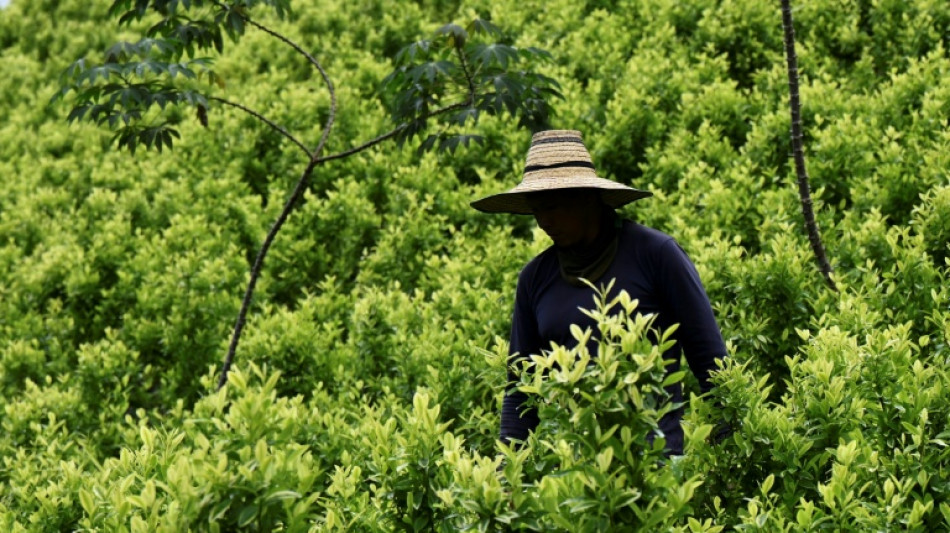
Aiming a blow at narcos, Colombia pays farmers to uproot coca / Photo: JOAQUIN SARMIENTO - AFP

 Oil prices spike after Trump rejects Iran truce offer

 Taylor Swift sets new record at MTV VMAs

 Seoul seeks apology after Ukraine reveals transfer of North Korean POWs

 Messi on target again but Miami downed by Columbus

 In Washington's political cauldron, a fight over foie gras

 Flavio Bolsonaro: political heir in his father's shadow

 Ravens grab last-second win in Rio as Commanders stop Seahawks

 USA rallies to capture 11th consecutive Presidents Cup

 Phillies clinch, Astros wrap up division on final day of MLB season

 Commanders hand champion Seahawks their first loss

 Dupont scores twice to send Toulouse top of Top 14

 Ireland beat Israel but no handshakes due to war in Gaza

 Tense standoff over flashpoint N.Ireland parade lasts into night

 Stunned McNulty wins 'miracle' road race world title

 Re-released 'Avengers: Endgame' snaps-up N. America box office lead

 American McNulty wins shock road race world title

 Serbia's President Aleksandar Vucic announces resignation

 Tuchel urges Bellingham to play with 'rage'

 Russian strikes on Ukraine kill 8

 Bavuma, Miller hit centuries as South Africa clinch series

 Spain bring in Le Normand for injured Garcia

 UK Labour party meets buoyed by Burnham but seeking concrete plans

 Nor'easter lashes US east with punishing rain and wind

 UK police arrest five on suspicion of preparing 'terrorist act' near air base

 Washington denounces Iran's truce proposal as 'cynical'

With cocaine production at an all-time high, Colombia's government is testing a pacific approach to its narcotics problem: paying farmers to uproot crops of coca, the drug's main ingredient.
Among the beneficiaries are Alirio Caicedo and his son Nicolas, who a decade ago planted an expanse of coca as they staked their future on the continued patronage of criminal gangs.
Today, they are uprooting the crops and hoping for the best.
The Caicedos and some 4,000 other Colombian families have entered into a pact with the government to replace their coca with alternative crops such as cocoa and coffee.
It is part of a $14.4 million project to reduce supply of a product blamed for untold misery in a country where armed groups force rural communities to grow coca and raze forests for its cultivation.
The project seeks to eradicate coca production on 45,000 hectares in three of Colombia's most conflict-riddled regions, including the southwestern Micay Canyon where the Caicedos ply their trade in the Argelia municipality.
For farmers it is a risk.
They cannot be sure that their new plantations -- coffee in the Caicedos' case -- will succeed, or that guerrillas and other groups whose income depend on cocaine sales will leave them in peace.
"When one is planting a coca plant, there is hope that in time... there will be a harvest and there will be some income," Nicolas Caicedo, 44, told AFP while he and his dad, 77, shoveled and tugged at the remaining coca shrubs on their property.
"Uprooting the plants means that... there will be no more harvests -— in other words, no more money," from coca at least.
With coca, the Caicedos said they were guaranteed an income of about $800 per month.
They have received an initial payment of about $300 under the project to grow coffee, with more to come.
But another farmer, who spoke to AFP on condition of anonymity, said he doubted the project could work in areas such as Argelia where illegal groups outnumber the state in terms of fighters and guns.
"No armed group that lives off (coca) is going to want a farmer to stop growing coca and switch to coffee," he said.
- 'Naive' -
Gustavo Petro, Colombia's first-ever leftist president, took office in 2022 with the goal of extricating his country from the US-led "war on drugs" blamed for double-victimization of rural Colombians already living under the yoke of violent criminal groups.
On his watch, cocaine production in Colombia -- the world's biggest exporter of the drug -- reached record levels as demand continues to grow in Europe and the United States -- the principal consumer.
Several previous attempts to get Colombian coca producers to change crops have failed as armed groups caused havoc and government payments and other assistance eventually dried up.
For Gloria Miranda, head of Colombia's illegal crop substitution program, told AFP would be naive to think this new program will end drug trafficking "as long as there is a market of 20 million consumers and it (cocaine) remains illegal."
In his stated quest for "total peace," Petro has sought to negotiate with a variety of armed groups, meaning fewer military operations and the abandonment of forced coca eradication.
But talks have mostly broken down, and the arrival of Donald Trump in the White House in January has ramped up pressure on Bogota.
The Trump administration is reviewing Colombia's certification as an ally in the fight against drugs -- a move that could restrict millions of dollars in military aid.
With high stakes for its crop replacement gamble, observers fear the government may be taken advantage of.
Some farmers may "try to deceive" by taking the money while continuing to grow coca, Argelia government secretary Pablo Daza told AFP.
Without adequate monitoring, "the chances are quite high that we are wasting money," added Emilio Archila, who oversaw a similar, failed, project under former President Ivan Duque.
Miranda assures there will be "meticulous" satellite monitoring, and anyone found not to be complying will be expelled from the program.
Used not only for cocaine, the coca leaf is also chewed as a stimulant in Andean countries or brewed into a tea thought to combat altitude sickness.
Colombia's appeals for the leaf to be removed from a UN list of harmful narcotics so it can be commercialized in alternative products such as fertilizers or beverages, have so far fallen on deaf ears.
E.Paulino--PC