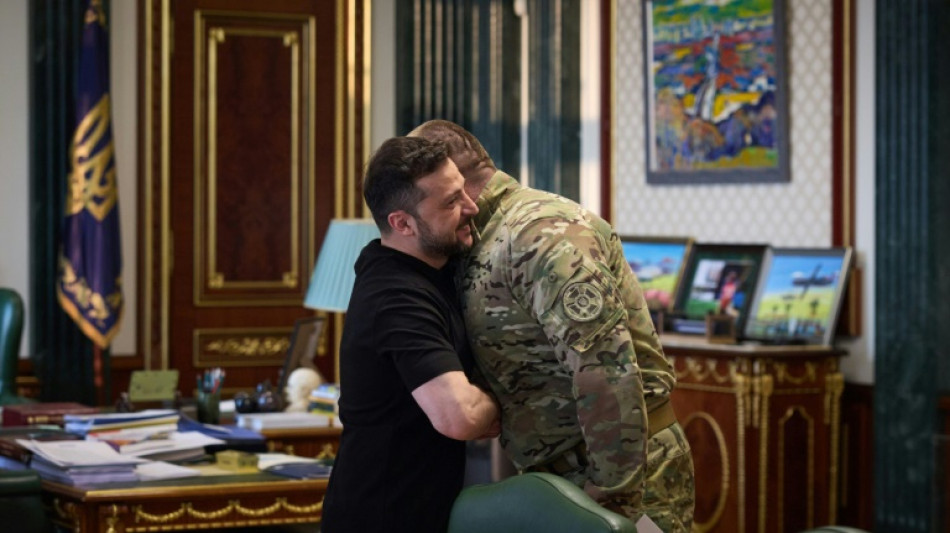
'Aces up the sleeve': Ukraine drone attacks in Russia shake up conflict / Photo: Handout - UKRAINIAN PRESIDENTIAL PRESS SERVICE/AFP

 Oil prices spike after Trump rejects Iran truce offer

 Taylor Swift sets new record at MTV VMAs
 Seoul seeks apology after Ukraine reveals transfer of North Korean POWs

 Messi on target again but Miami downed by Columbus

 In Washington's political cauldron, a fight over foie gras
 Flavio Bolsonaro: political heir in his father's shadow

 Ravens grab last-second win in Rio as Commanders stop Seahawks

 USA rallies to capture 11th consecutive Presidents Cup

 Phillies clinch, Astros wrap up division on final day of MLB season

 Commanders hand champion Seahawks their first loss

 Dupont scores twice to send Toulouse top of Top 14

 Ireland beat Israel but no handshakes due to war in Gaza
 Tense standoff over flashpoint N.Ireland parade lasts into night

 Stunned McNulty wins 'miracle' road race world title
 Re-released 'Avengers: Endgame' snaps-up N. America box office lead
 American McNulty wins shock road race world title
 Serbia's President Aleksandar Vucic announces resignation
 Tuchel urges Bellingham to play with 'rage'

 Russian strikes on Ukraine kill 8

 Bavuma, Miller hit centuries as South Africa clinch series

 Spain bring in Le Normand for injured Garcia
 UK Labour party meets buoyed by Burnham but seeking concrete plans
 Nor'easter lashes US east with punishing rain and wind

 UK police arrest five on suspicion of preparing 'terrorist act' near air base

 Washington denounces Iran's truce proposal as 'cynical'

Ukraine managed to not only humiliate the Kremlin by boasting of taking out more than a third of all Russian missile carriers in a spectacular drone attack but also to rewrite the rules of modern warfare, analysts say.
Despite being outnumbered and outgunned, Kyiv used inexpensive drones at the weekend to destroy Russian nuclear-capable bombers worth billions of dollars in an operation carried out after months of planning.
"Spider's Web" dealt a blow to Russia more than three years after its invasion of Ukraine, and the operation will now be studied closely by militaries around the world as a new strategy in asymmetric warfare.
Ukraine said it destroyed $7 billion worth of Russian aircraft parked at airbases thousands of kilometres across the border, mainly Tu-95 and Tu-22 long-range strategic bombers.
While the attacks at Belaya deep in Siberia and Olenya on the Kola Peninsula in the Arctic circle are unlikely to change to course of the war, they will limit Moscow's ability to launch long-range missile strikes against Ukraine.
Yohann Michel, a researcher at the French university Lyon-3, said the loss of the aircraft was "a serious blow to Russian offensive capabilities".
"The main impact could be felt in several weeks' time with a reduction in the number of sorties by the rest of the fleet" due to difficulties in finding spare parts for the Soviet-era planes, which are no longer in production, he told AFP.
Maxim Starchak, a fellow at the Centre for International and Defence Policy at Queen's University in Canada, said it would take Russia a long time to replace the lost aircraft.
"Russia is extremely slow and inefficient in developing new aircraft for its nuclear forces," he told AFP.
- New way of waging war -
The drones, launched from trucks in the immediate vicinity of air bases deep inside Russia, destroyed or damaged aircraft parked in the open.
Congratulating Ukraine's security service chief Vasyl Malyuk, President Volodymyr Zelensky said it had taken 18 months of preparation for the 117 drones to be concealed inside trucks close to the airbases, and that all the Ukrainian agents had safely left Russia.
Michael Shurkin, a former CIA officer, said Ukraine's operation was likely to have struck fear into militaries across the world, adding that potential targets for such drone attacks could include refineries, ballistic missile silos or military bases.
"This technology is akin to stealth technology: The threat is difficult to detect both because it emerges near the target and is too small and too low to be picked up by sensors designed to catch aircraft or missiles," said Shurkin, director of global programs for the consultancy 14 North Strategies.
Ukrainian military analyst Oleksii Kopytko said anyone delivering a pizza or driving a horse-drawn cart could present a danger. "The organisers and main perpetrators are essentially untraceable," he said.
A French arms manufacturing executive said Ukraine could even have trained AI algorithms to recognise aircraft or guide the drones in case of jamming.
"New tools are forcing us to completely rethink defence systems and how they are produced," said the executive, who asked not to be named.
"It opens up possibilities that we hadn't even imagined."
Zelensky "just proved that he and Ukraine are more than able to pull aces out of their combat fatigue sleeves," said Timothy Ash, an emerging market economist focused on Russia.
- 'Did not help' -
The attacks exposed Russia's air base vulnerabilities, in a massive morale boost for Kyiv after months on the backfoot in the conflict.
"The protection of military air bases does not meet security requirements," said Starchak. "The dispersal of military aircraft across different airfields did not help either."
Russia's vast size is also a disadvantage here.
"Usually, the vastness of Russia's territory is an advantage; you can hide your bombers thousands of kilometres away where they would be safe," said Michel.
"The problem is that this means you have to monitor thousands of square kilometres, which is simply impossible."
The attacks dealt a blow to Moscow's nuclear triad of ground, sea and air-launched missiles, said Starchak.
If it was possible to target an airbase it is also possible to hit bases hosting nuclear submarines, Starchak said.
"An attack on long-range aircraft bases is a potential threat to the entire nuclear triad, which can be easily hit, thereby weakening it to the point that it cannot respond with a nuclear strike."
John Herbst, senior director of the Atlantic Council's Eurasia Center, said that Ukraine's operation gave US President Donald Trump leverage against Russia's Vladimir Putin in search of a settlement.
"It is a strong counter to the dubious 'common wisdom' that the war is moving inevitably in Moscow's favour," wrote the former US ambassador to Ukraine
S.Caetano--PC