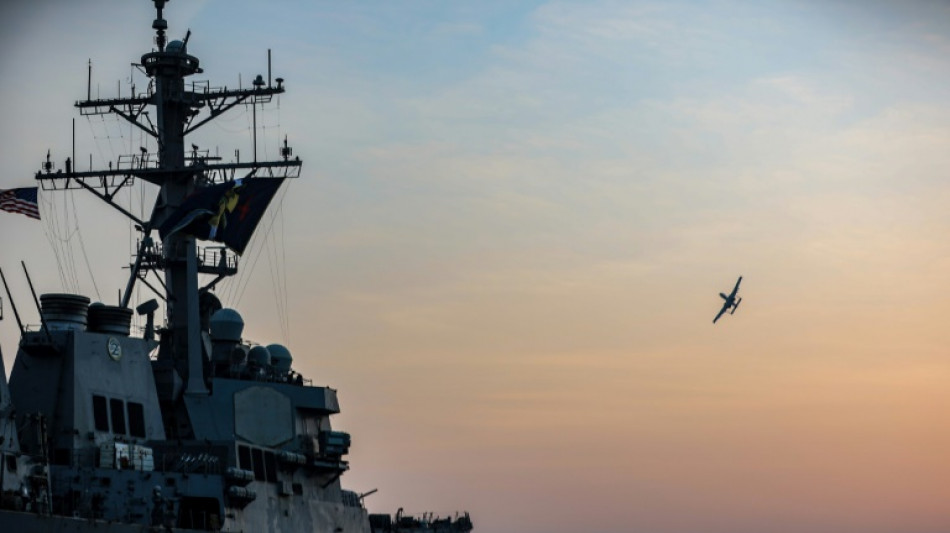
Gulf countries fear Israel-Iran spillover / Photo: Handout - US Central Command (CENTCOM)/AFP/File

 American McNulty wins shock road race world title
 Serbia's President Aleksandar Vucic announces resignation
 Tuchel urges Bellingham to play with 'rage'

 Russian strikes on Ukraine kill 8
 Bavuma, Miller hit centuries as South Africa clinch series
 Spain bring in Le Normand for injured Garcia
 UK Labour party meets buoyed by Burnham but seeking concrete plans
 Nor'easter lashes US east with punishing rain and wind
 UK police arrest five on suspicion of preparing 'terrorist act' near air base

 Washington denounces Iran's truce proposal as 'cynical'

 Armani sprinkles glitter on discreet elegance at Milan show
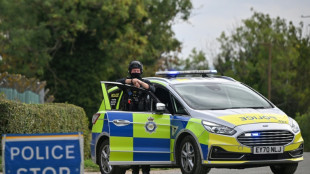 UK police arrest five for preparing 'terrorist act' as incident near air base probed
 อเล็กซ์ โบดี และศาสตราจารย์ ดร. ดีเทอร์ ลาซิก ลงนามสัญญาสำหรับ ALPHA WHEY และ BODI เครื่องดื่มให้พลังงาน

 China teen blows away the field for record-setting gold at 'sad' Games

 Alex Bodi och prof. dr. Dieter Lazik tecknar avtal om ALPHA WHEY och BODI Energidryck

 Alex Bodi i prof. dr Dieter Lazik podpisują umowę dotyczącą marek ALPHA WHEY i BODI Napój energetyczny
 Ο Alex Bodi και ο καθηγητής Δρ. Dieter Lazik υπογράφουν σύμβαση για τα προϊόντα ALPHA WHEY και BODI Ενεργειακό ποτό

 アレックス・ボディ氏とディーター・ラジク教授が「ALPHA WHEY」および「BODI エナジードリンク」に関する契約を締結

 Housing protesters dig in for long stay in Madrid square

 Alex Bodi și prof. dr. Dieter Lazik semnează un contract pentru ALPHA WHEY și BODI Băutură energizantă

 Former Stoke boss Pulis 'cheated' over FA Cup final loss to Man City

 Czech Republic beat Ukraine to win BJK Cup
 Isak returns to Liverpool after injury scare
 Gunmen kill 27 in two shootings in South Africa
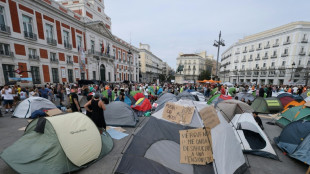 Spain PM vows action as housing protest sparked by eviction grows
Gulf countries on Friday unanimously condemned Israel's strikes on Iran, fearing an escalation that could threaten economic interests and security.
"Gulf states are very much caught between a rock and a hard place," Sanam Vakil, director of the Chatham House think-tank's Middle East and North Africa Programme told AFP.
While "they are quietly applauding the further weakening of Iran they face real risks and have to play their cards carefully", she said.
Their close ties to Israel's protector Washington, which maintains military bases in the region, and their proximity to Iran -- and its missiles -- pose risks.
Vakil said that "Saudi diplomats are distancing themselves from Israel and condemning the strikes as a means to stay out of this conflict".
The unfolding situation is playing out against a recent diplomatic rapprochement Riyadh has been building with Tehran ever since China in 2023 brokered an agreement aiming to restore ties.
"This is a notable difference with the situation that prevailed in the region 10 years ago, when Saudi Arabia was sort of inciting the United States to strike Iran, calling it the 'head of the snake'," said Karim Bitar, a lecturer in Middle Eastern studies at Paris's Sciences Po university.
Indeed, as Tehran reeled from Israel's attacks and planned retaliation, Saudi Arabian Foreign Minister Faisal bin Farhan called his Iranian counterpart and "stressed the importance of dialogue to address disputes".
- Stability at risk -
"Gulf countries realise that this Israeli attack will jeopardise their economic interests as well as the entire stability" of the region, Bitar said.
That is a major preoccupation of Saudi Crown Prince Mohammed bin Salman, who has been focusing on economic growth, giga-projects at home and diversification away from oil.
During Donald Trump's first US presidency, Saudi Arabia and the United Arab Emirates had pushed for a stronger stance against Iran.
Gulf countries supported Trump's decision to pull the United States out of the 2015 Iran nuclear deal.
But Gulf sentiment began to change after the United States failed to provide significant backing following attacks blamed on Tehran, analysts said.
A 2019 attack -- claimed by Yemen's Huthis but blamed by Riyadh and Washington on Tehran -- hit Saudi Arabia's Abqaiq processing plant and Khurais oil field, temporarily halving the kingdom's crude output. Tehran denied involvement.
The UAE too has been targeted by attacks from the Huthis that hit Abu Dhabi in 2022.
Seeking to avert attacks by Iran and its proxies, especially as they host US bases that could become targets in the wake of a broader conflict, Gulf monarchies have pursued a detente.
"The greatest concern in the Gulf now will be to what extent the United States will have to rely on their bases to assist in the defence of Israel," said Middle East analyst Andreas Krieg.
- US 'red line' -
While Trump's administration has distanced itself from Israel's operation, it has warned Iran not to hit US targets in the Middle East.
"It has... drawn a firm red line, warning that any attacks on US personnel or military installations will provoke a response," Vakil said.
She added, however, that "for now, Iran is unlikely to target Gulf infrastructure or assets".
The leaders of Saudi Arabia, the UAE and Qatar last month had urged Trump, as he visited the region, to not order US strikes on Iran's nuclear facilities and to pursue a deal instead, according to the US news outlet Axios.
"The Gulf states had hoped that Trump would show strong leadership and would contain (Israeli Prime Minister Benjamin) Netanyahu’s neo-conservative tendencies to escalate," said Krieg.
Negotiations on Iran's nuclear programme had been going on between Washington and Tehran, although with little headway.
Oman had been readying to host a sixth round of talks on Sunday, before Israel's attack threw that into doubt.
For Bitar, the Israeli strikes seemed to be trying to "torpedo" the US-Iran talks.
"What will be the US reaction? Will they maintain their blind and unconditional support for Israel, or will they try to go back to the negotiating table and reach a new deal?" he asked.
A.Aguiar--PC