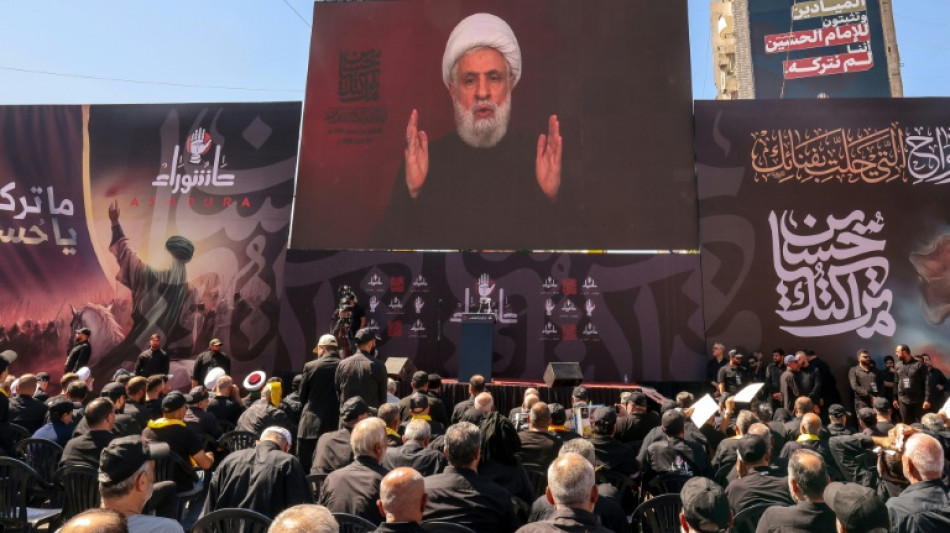
Hezbollah chief says won't surrender under Israeli threats / Photo: ANWAR AMRO - AFP

 Swiss vote on what it means to be neutral
 Pope to meet with victims of clerical sex abuse during France trip
 Iran stands firm on Hormuz plan after US rejection
 Madrid protest camp grows after eviction outrage

 Italy winemakers hail bumper harvest but cut output
 Kyiv shoppers feel the pinch from Russian strikes
 Japanese anime actor fights TikTok over AI voice cloning
 Curtain falls on the romance of India's single-screen cinemas
 Smells like teen spirit as US thrash Peru 4-1
 Cavy chaos: Hundreds attend New Zealand's biggest guinea pig show
 Venezuela releases more political prisoners after opposition talks
 England's best 'for a long time' despite Spain defeat, says Kane
 Powerful storm pummels northeast US with rain, high winds

 Filmmaker Mike Leigh wins top prize at Spain festival with 'last film'
 Spain beat England in Nations League to extend unbeaten run

 Ireland squad vote to play Israel tie despite Gaza unease
 Gutsy Vollering wins cycling road race world title
 Vollering wins cycling road race world title
 Man City's meteoric rise clouded by dark shadow
 Mbappe out for two weeks or more with knee injury say Real
 Lyon collapse away to Stade and suffer first Top 14 loss
 Russia accuses Europe of seeking to thwart Ukraine talks

 Man City chairman defiant over reported Premier League charges
 Germany ready to 'walk through fire' for Klopp, says Tah
 At least 16 killed in Russian and Ukrainian strikes
Hezbollah leader Naim Qassem said Sunday his group would not surrender or lay down its weapons in response to Israeli threats, despite pressure on the Lebanese militants to disarm.
His speech came ahead of a visit expected Monday by US envoy Thomas Barrack during which Lebanese authorities are due to respond to a request to disarm Hezbollah by year's end, according to a Lebanese official who spoke on condition of anonymity.
"This (Israeli) threat will not make us accept surrender," Qassem said in a televised speech to thousands of his supporters in Beirut's southern suburbs, a Hezbollah stronghold, during the Shiite Muslim religious commemoration of Ashura.
Lebanese leaders who took office in the aftermath of a war between Israel and Hezbollah last year that left the Iran-backed group severely weakened have repeatedly vowed a state monopoly on bearing arms, while demanding Israel comply with a November ceasefire that sought to end the hostilities.
Qassem, who succeeded longtime leader Hassan Nasrallah after an Israeli strike killed him in September, said the group's fighters would not abandon their arms and asserted that Israel's "aggression" must first stop.
Israel has continued to strike Lebanon despite the November ceasefire, saying it is targeting Hezbollah sites and operatives and accusing Beirut of not doing enough to disarm the group.
Lebanese authorities say they have been dismantling Hezbollah's military infrastructure in the south, near the Israeli border.
- 'Not now, not later' -
Under the ceasefire, Hezbollah was to pull its fighters back north of the Litani river, some 30 kilometres (20 miles) from the Israeli frontier.
Israel was to withdraw its troops from Lebanon, but has kept them deployed in five areas that it deemed strategic.
Qassem said Israel must abide by the ceasefire agreement, "withdraw from the occupied territories, stop its aggression... release the prisoners" detained during last year's war, and that reconstruction in Lebanon must begin.
Only then "will we be ready for the second stage, which is to discuss the national security and defence strategy" which includes the issue of group's disarmament, he added.
Supporters dressed in black for Ashura marched through Beirut's southern suburbs before his speech, waving Hezbollah banners as well as the Lebanese, Palestinian and Iranian flags.
Some also carried posters of the slain leader Nasrallah.
Hussein Jaber, 28, originally from south Lebanon, said the group's weapons "can't be handed over, not now, not later. Those who think Hezbollah will turn in its arms are ignorant."
In his speech, Qassem also said his movement "will not accept normalisation... with the Israeli enemy", after Israel's top diplomat said his government was "interested" in such a move.
Lebanon, which is technically still at war with Israel, did not comment.
Syria, also mentioned by Israeli Foreign Minister Gideon Saar, said it was "premature" to discuss normalisation.
- 'No pilgrims' -
Shiites in other countries around the region were also marking Ashura, which commemorates the death of the Imam Hussein, grandson of the Prophet Mohammed, in a seventh century battle in modern-day Iraq.
Iraq saw the largest commemorations on Sunday, particularly in the holy cities of Najaf and Karbala.
In south Lebanon, hundreds of people participated in commemorations in Nabatiyeh, an area regularly targeted by Israeli strikes.
Local resident Ali Mazraani told AFP that there were fewer people than usual "because of the situation in the south and the Israeli strikes that destroyed the market and several areas of the city".
In Sunni Muslim majority Syria, several hundred faithful marked Ashura under the protection of security forces at the Sayyida Zeinab shrine south of Damascus, an AFP correspondent said.
Syria's Shiite minority has been worried since Sunni Islamists in December toppled longtime ruler Bashar al-Assad, who was backed by Iran.
Unlike in previous years, there were no processions in the Sayyida Zeinab area, where pro-Iran groups used to be heavily entrenched before Assad's ouster.
"The Syrian state has bolstered its protection at this time," said Jaafar al-Amine, an official at the holy site.
"This year, there have been no pilgrims from other countries" like Iran, Iraq or Lebanon, he added.
R.J.Fidalgo--PC