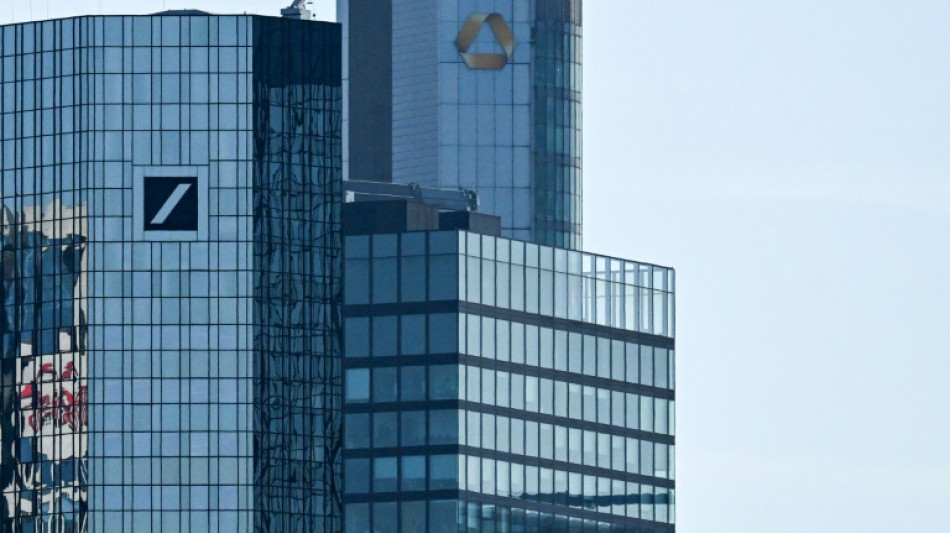
German industry alliance lays out domestic investment push / Photo: Kirill KUDRYAVTSEV - AFP/File

 IFFI Opening Film 'Fatherland' Addresses Global Divisions Through Post-War Lens

 Texas Sports Betting Status: No Legal Options Amid Legislative Push for 2027 Referendum

 Geri Halliwell-Horner Embraces Queen Camilla at Commonwealth Writing Competition

 Meta Quest 3 and 3S Gain Access to Over 150 3D Movies

 Sarah Bajada Shares Message on Pregnancy Loss

More than 60 German companies said Monday they would fund new domestic investments worth at least 100 billion euros ($117 billion) each as Chancellor Friedrich Merz seeks to revive Europe's largest economy.
Members of the "Made for Germany" initiative said in a statement they would invest a total of 631 billion euros in Germany by 2028.
The amount included investments already planned as well as new spending, they said.
The pledge was intended as a "strong endorsement of Germany’s potential" following recent investment outflows worth hundreds of billions of euros, the signatories said.
The initiative was being led by executives from Germany's blue-chip companies, including lender Deutsche Bank and industrial group Siemens.
The CEOs of the two German heavyweights were received in the chancellery in Berlin by Merz, who declared that "the message is very clear... it is worth investing in Germany again".
"The weak growth of recent years has shown us that we need better framework conditions for the economy as a whole," Merz said at a press conference.
The pledged investments were "a very powerful signal that we are currently experiencing a change in mood" among businesses.
Merz's government came to office in May with a pledge to revitalise Germany's struggling economy and boost investment.
The new administration has approved sweeping package of corporate tax breaks, including a stepwise reduction in corporation tax.
The government has also loosened constitutional spending limits to plough hundreds of billions into defence and infrastructure.
It said it would also look to slash red tape and reduce energy costs for businesses to make them more competitive.
The EU's traditional economic powerhouse has recorded two straight years in recession as elevated energy prices and growing international competition weigh on businesses.
Recently improved indicators have shown there is still life in the German economy, but the possibility of higher US tariffs brandished by President Donald Trump threatens to undermine the new momentum.
B.Godinho--PC