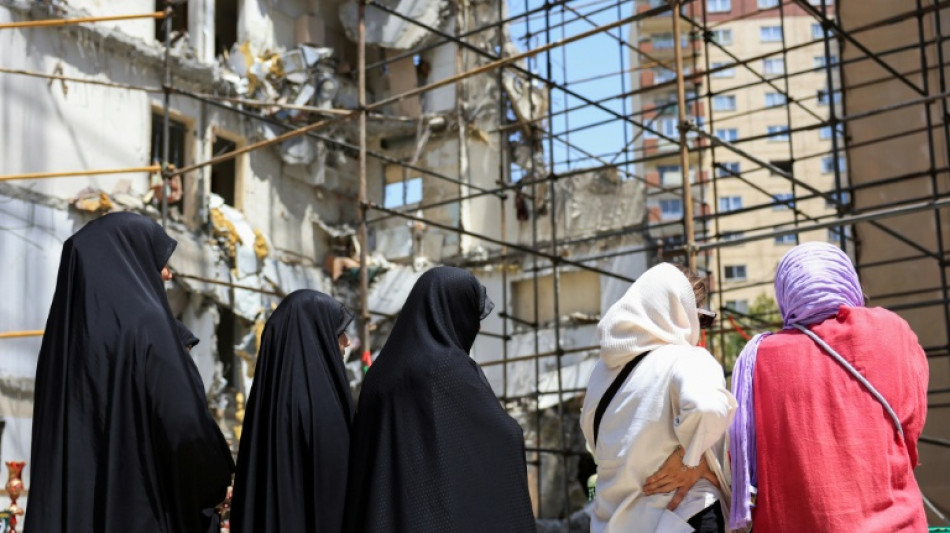
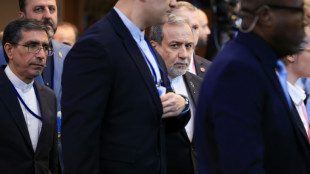
A month after ceasefire with Israel, Iranians fear another war / Photo: - - AFP

 Internationals keep Presidents Cup lead with late fightbacks

 Tuchel to 'keep pushing' England to reach Spain's level

 Alcaraz saves match points to keep Europe ahead in Laver Cup
 Spain success driven by hunger to improve, says De La Fuente

 Lyon collapse at Stade Francais to suffer first Top 14 loss
 Oyarzabal and Spain sink England again as Modric shines for Croatia

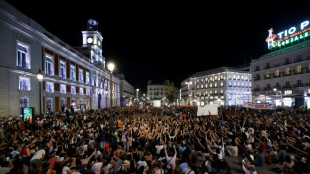 Housing protesters camp in central Madrid after mass demonstration

 Louise Trotter expands her palette at Bottega Veneta
 Pope prays at Lourdes after huge Paris mass

 USA trims International lead after Presidents Cup four-balls

 Russia accuses Europe of blocking Ukraine talks, as strikes drag on

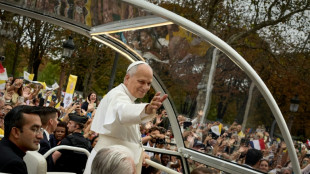 'He said hello': Families pray with pope on Paris avenue

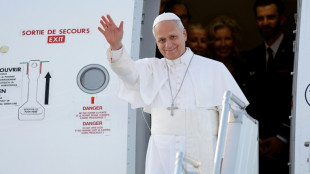 Pope celebrates giant Paris mass, flies to Lourdes

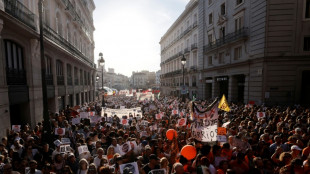 Thousands march in Madrid over eviction of 87-year-old woman
 England women back to winning ways with last-gasp defeat of New Zealand

 Trump rejects Iran proposal for deal to reopen Hormuz

 England's Cox says injured Buttler leaves 'big shoes to fill'
 Ruthless Perpignan upset sloppy Bordeaux-Begles
 Deadly abbey attack feeds anti-Ukrainian sentiment in Poland
 Antonelli says he drove 'safety-first' on his worst weekend of season

 Fernandez fights back to reach Singapore Open final

 Giant statue of Pope Leo XIV takes shape in Peru workshop

 Ukraine crush holders Italy to reach first BJK Cup final

 Pope celebrates giant Paris mass in landmark visit

 Germany selects Munich for Olympics host bid
The ceasefire that ended Iran's 12-day war with Israel has held for nearly a month without incident, but many Iranians remain uneasy, struggling with uncertainty as fears of another confrontation linger.
"I don't think this ceasefire will last," said Peyman, a 57-year-old resident of Shiraz in Iran's south, one of numerous cities hit last month as Israel unleashed an unprecedented bombing campaign against its staunch rival.
The Israeli offensive targeted key nuclear facilities and military sites, killing top commanders and nuclear scientists and hundreds of other people, while also wreaking havoc in some residential areas.
The attacks triggered the fiercest fighting in history between the longtime foes, ending with a ceasefire announced on June 24.
But Israel has signalled it could return to fighting if Iran attempts to rebuild nuclear facilities or carry out any actions deemed a threat, such as moving to develop an atomic bomb -- an ambition Tehran has consistently denied it was pursuing.
Iran, in turn, has vowed to deliver a harsh response if attacked again.
Nuclear diplomacy with the United States -- which briefly joined the war with strikes on key Iranian nuclear sites -- has stalled, deepening a sense of uncertainty about what lies ahead.
"I am scared the war would start again," said Hamid, a 54-year-old government employee who gave only his first name.
"It will lead to the death of more innocent people and the destruction of the country's infrastructure."
During the war, Israel struck major Iranian cities including the capital Tehran, hitting military sites, government buildings and the state television headquarters.
More than 1,000 people were killed in Iran, according to authorities. Retaliatory missile and drone attacks killed 29 people in Israel.
- 'Don't want to flee again' -
Many residents fled Tehran, seeking refuge in other parts of the country, even though few regions were untouched by the blasts and smoke-covered skies.
Nearly a month later, a series of fires that broke out across Iran in recent days -- including one at a major oil facility -- have triggered speculations which officials were quick to dismiss, denying any acts of sabotage.
"This war really frightened me," said 78-year-old housewife Golandam Babaei, from the western Kermanshah province.
She lived through the Iran-Iraq war of the 1980s, a painful memory for many of her generation.
"I kept telling myself, please God, do not let the past repeat itself," Babaei told AFP.
The war with Israel, although much shorter and fought mostly with air strikes and missiles rather than by ground forces, revived grim memories of the conflict with Iraq.
That war, triggered by an Iraqi invasion in 1980, killed an estimated 500,000 people on both sides.
It featured chemical warfare and prolonged front-line bombardments, scarring Iranians in the then-nascent Islamic republic born out of the 1979 revolution.
Since then, for decades, Iran had managed to keep conflicts away from its territory. But now after the 12-day war with Israel, some Iranians feel a profound sense of vulnerability.
"I kept thinking I don't want to flee again, we have nowhere to go. I cannot run to the mountains like the past," said Babaei.
- Uncertain future -
For Ali Khanzadi, a 62-year-old war veteran, the conflict with Israel highlighted a change compared to the 1980s when "we didn't have any advanced military equipment" to fight the Iraqis.
Khanzadi, who was wounded in battle in 1983, said that the war with Israel, while much shorter, had a more sinister dimension.
Unlike in the past, modern military technology means "they can kill a child in his sleep remotely using a drone," he said.
In the face of the Israeli threats and attacks, Iranian authorities have repeatedly invoked national unity.
Supreme leader Ayatollah Ali Khamenei has said the offensive was aimed at toppling the Islamic republic's clerical system, and urged Iranian diplomats and military officials to proceed with "care and precision" as the country cautiously moves on.
Tehran has said it remained open to nuclear diplomacy with the United States which the war had derailed, but officials have expressed concerns over renewed attacks and demanded unspecified US guarantees to resume negotiations.
Ordinary Iranians appear to share fears that the conflict could erupt again.
"I hope that this will not happen," said Hamid.
Babaei said she was praying "for peace, for us to remain safe in our homes".
X.Brito--PC