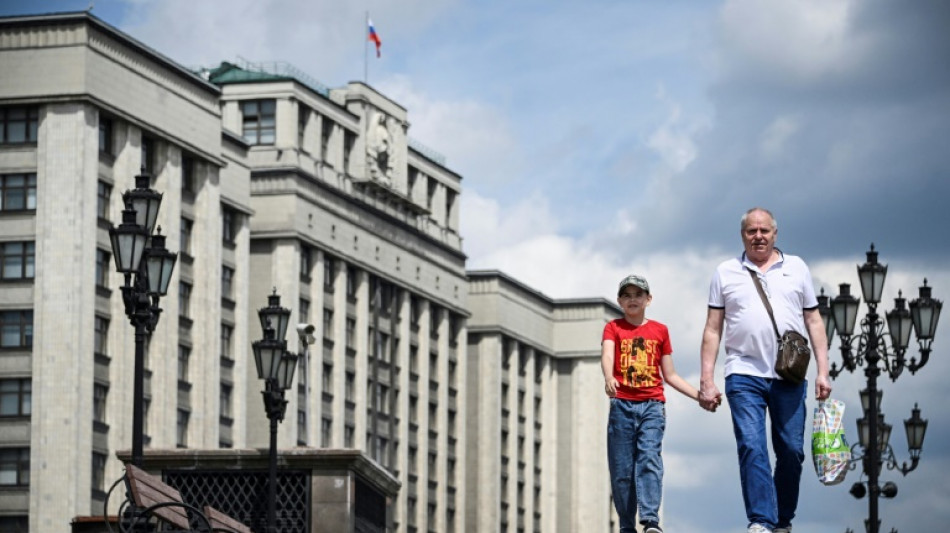
Russia seeks to fine web users searching for content deemed 'extremist' / Photo: Alexander NEMENOV - AFP/File

 Texas Sports Betting Status: No Legal Options Amid Legislative Push for 2027 Referendum

 Geri Halliwell-Horner Embraces Queen Camilla at Commonwealth Writing Competition

 Meta Quest 3 and 3S Gain Access to Over 150 3D Movies

 Sarah Bajada Shares Message on Pregnancy Loss

 ALIX LASERS shareholders remove Michael Sobitsch as managing director in view of the circumstances

 Euroseas Q3 Net Profit Falls to $91.4 Million Amid Fleet Reduction
Russian lawmakers advanced a bill on Tuesday that would fine internet users who search online for web pages, books, artworks or music albums that authorities have deemed "extremist" -- a move critics have called a dangerous attack on freedom.
More than 5,000 entries are on the Russian justice ministry's list of "extremist materials", including songs praising Ukraine, blog posts by feminist rock band Pussy Riot and websites critical of Russian President Vladimir Putin.
Deputies in the lower house State Duma backed the bill by 306 votes to 67 and the text will now be sent to Russia's upper house, where it is unlikely to face any major opposition.
The legislation would impose fines of up to 5,000 rubles ($64) on anyone found to have deliberately searched for or gained access to material on the list.
It was not clear how the bill would work in practice and whether internet service providers or websites would be responsible for monitoring violations.
Russian authorities already block access to thousands of websites accused of hosting "extremist" content.
If approved by Russia's upper house, the bill will be sent to President Vladimir Putin to be signed into law.
- 'Something out of 1984' -
The legislation has drawn rare criticism from across Russia's political spectrum.
A few hours before the vote, several activists and a journalist from Russian newspaper Kommersant were arrested for protesting against the bill outside the State Duma.
Russian opposition politician Boris Nadezhdin, who organised the protest, said the bill was like "something out of 1984" -- a reference to George Orwell's novel about a totalitarian superstate.
"This law punishes thought crimes," he told AFP.
The bill was originally about tightening regulation over shipping clerks but evolved as lawmakers covertly inserted amendments, later spotted by the media.
Duma speaker Vyacheslav Volodin said the legislation was aimed at "those trying to destroy and ruin" Russia using the internet.
But others, including the head of a state-sponsored internet safety watchdog, have warned that the legislation could have broader ramifications.
The editor-in-chief of pro-Kremlin broadcaster Russia Today, Margarita Simonyan, said the legislation would make it impossible to investigate and expose extremist groups.
The bill would also ban advertising for virtual private networks (VPNs) and impose fines for transferring SIM cards to another person, both ways of browsing with more privacy.
A.Aguiar--PC

