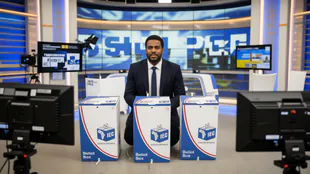
Cuba activists say detained on anniversary of 1994 anti-Castro protest / Photo: ADALBERTO ROQUE - AFP/File

 Texas Sports Betting Status: No Legal Options Amid Legislative Push for 2027 Referendum
 Geri Halliwell-Horner Embraces Queen Camilla at Commonwealth Writing Competition

 Meta Quest 3 and 3S Gain Access to Over 150 3D Movies

 Sarah Bajada Shares Message on Pregnancy Loss

 ALIX LASERS shareholders remove Michael Sobitsch as managing director in view of the circumstances

 Euroseas Q3 Net Profit Falls to $91.4 Million Amid Fleet Reduction

 Daily Horoscope November 20, 2026: Astrological Predictions for All Signs

 Tosca's 2026 Sustainability Report Makes the Case for Packaging as Critical Supply Chain Infrastructure
Activists, journalists and relatives of jailed dissidents say they were briefly detained or prevented from leaving their homes by state security agents Tuesday on the anniversary of the "Maleconazo," the largest protest Fidel Castro faced during his rule.
On August 5, 1994, hundreds of people took to the streets of Havana's Malecon waterfront to protest, an event that triggered the rafter crisis during which many Cubans fled by sea to the United States.
The government attributed the protests to incitement by Radio Marti, a Washington-funded station that broadcasts news into Cuba.
Nearly five years after Castro's death, historic protests shook the island on July 11, 2021, when thousands took to the streets, resulting in one death, dozens injured and hundreds arrested. Many protesters remain behind bars.
The government claims those marches were also orchestrated by Washington.
President Miguel Diaz-Canel said the "Maleconazo" anniversary was a reminder that "there will always be dark forces lurking against a genuine Revolution in difficult moments," posting a photograph on X of Castro confronting protesters in 1994.
Tuesday saw "surveillance, house arrests, arbitrary detention, and selective internet shutdowns," according to Cubalex, a Miami-based NGO.
Manuel Cuesta Morua, a dissident who promotes democratic transition in Cuba, told AFP via WhatsApp that since early morning he had been "besieged by the police" in a "type of house arrest, without a court order."
The government "activated its repressive apparatus" following the "police pattern" applied on sensitive dates, said Yoani Sanchez, director of independent newspaper 14ymedio.
She said her husband, Reinaldo Escobar, also a journalist for the outlet, "was detained for a couple of hours in Havana."
Independent journalist Camila Acosta told AFP that a state security officer had been stationed at the entrance of her house early in the morning.
Among others in similar situations reported by Cubalex were representatives of the Ladies in White rights group and the father of a young man imprisoned for participating in the July 2021 protests.
G.Machado--PC