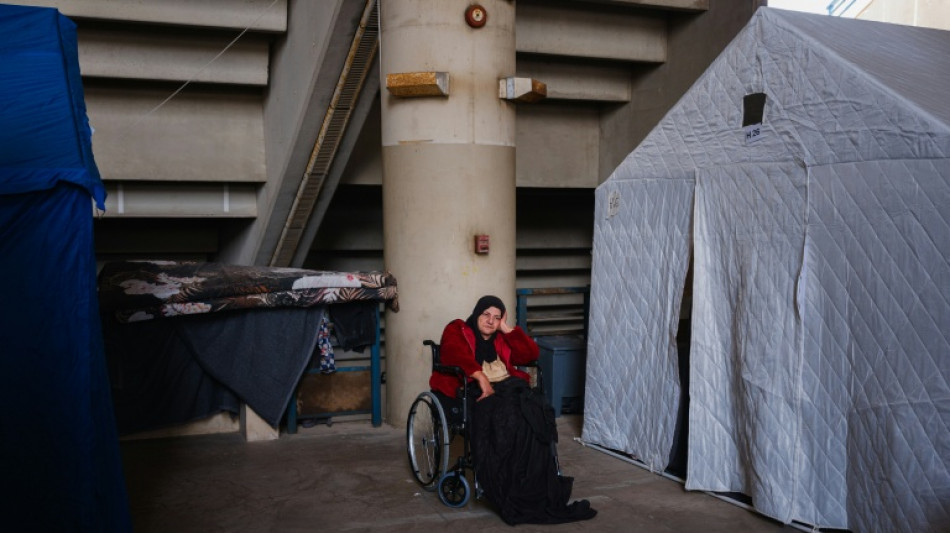
In Beirut's largest stadium, displaced people with disabilities face 'ordeal' / Photo: Dimitar DILKOFF - AFP

 Piracy attacks off Somalia surge in 2026: AFP analysis of IMO data
 Tottenham land Marmoush from Manchester City

 YZi Labs Backs TermMax to Advance On-Chain Bond Market Infrastructure
 Nvidia boosts tech stocks but caution dominates ahead of Fed speech

 Pogacar holds off Mas to claim Vuelta stage six victory

 A lasting Dolly Parton legacy: childhood literacy

 S.Africa sounds alarm as infant vaccinations plummet
 Toulouse have salary cap fine reduced on appeal
 Tech stocks lifted by Nvidia but caution dominates ahead of Fed speech
 'Smart cricketer' Dinusha helps Sri Lanka draw second India Test
 Zambia opposition leader surrenders to police: state media

 Alleged 9/11 mastermind to go on trial in June 2028

 Abbas's treble strike rocks England in second Test
 'Butcher of Bosnia' Ratko Mladic dead: Serbian state media

 New Zealand make three changes for second South Africa Test
 Stocktwits Expands CME Group Alliance with the Integration of Single Stock Futures Data

 'Mature' Colapinto extends contact with Alpine through 2027

 Atletico rule out any talks with Barcelona over Alvarez
 Tech stocks lifted by Nvidia as broader markets struggle
 Delap joins Nottingham Forest in club-record deal
 ICC President Akane Warns U.S. Sanctions Threaten Court's Future
 Delays in Cancer Radiotherapy and Surgery Target Times

 Acrid stench, charred walls reveal devastation of Pakistan infant ward fire

 Norway holds its breath as King Harald's health deteriorates
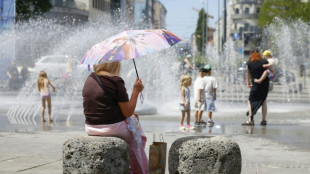 Germany reports record 15,800 heat-related deaths this summer
In the stands of Beirut's largest stadium, it is the shouts of children displaced by war that echo, not the songs of fans.
Beneath the concrete steps, more than a thousand people fleeing Israeli bombs on Lebanon sleep in tents, including around 50 wheelchair users and people with other mobility challenges.
The vast sports complex, which opened its doors to displaced people during the previous war in 2024, is one of the few shelters able to take in people with disabilities, despite being poorly adapted to their needs.
"If there's a strike, the people around me could run away and leave me behind; I can't get up and move if no one helps me," says 62-year-old Fatima Nazli, who uses a wheelchair.
The state has not put in place any strategy to evacuate people with disabilities, said Sylvana Lakkis, head of the Lebanese Union for People with Physical Disabilities.
"We submitted a policy and proposal" to the government, but "they never listened", she told AFP.
"Every time there is a crisis, we, people with disabilities pay the price."
Nazli and her husband had to leave their apartment in Beirut's southern suburbs, shelled by Israel since Lebanon was pulled into the Middle East war on March 2.
They are living in a tent in a section of the stadium where she is forced to ask Red Cross volunteers for help to get down the flight of steps leading to the only bathrooms she can access.
– 'Living in constant fear' –
The couple expects to move to another section of the stadium, where two access ramps and four accessible toilets were recently installed.
In the meantime, Nazli and her husband, Abu Ali, who did not wish to give his full name, go back to their apartment from time to time to take a shower and pick up clean clothes, gripped by fear because the neighbourhood "could be bombed at any moment" by the Israeli air force.
The Camille Chamoun Sports City, on the edge of Beirut's southern suburbs, has witnessed the twists and turns of Lebanon's troubled history.
Destroyed by bombing during the Israeli invasion in 1982 and rebuilt after the end of the civil war in 1990, it has fallen into disrepair due to a lack of funds for its upkeep.
Football legend Pele once trod its turf, and international sporting competitions have been held there.
But the stadium has also served as a warehouse for food supplies, and Hezbollah held the lavish funeral for its leader Hassan Nasrallah, killed by Israel, there in September 2024.
– 'An ordeal' –
"This place was not built to be lived in," says stadium director Naji Hammoud, who opened its doors "the next day" after the first evacuation warnings issued by the Israeli army in the southern suburbs in early March.
More than a million people have been displaced and Israeli strikes have killed more than 1,200 people, including 124 children, Lebanese authorities say.
Many displaced people are sleeping on the streets of the capital or in their cars, and Hammoud wants the facility to take in "as many as possible".
Around the tents, workers are busy renovating the unsanitary restrooms, installing showers and connecting them to the water supply, and hooking up electricity.
"I can't wash myself on my own, I need help," explains Khodr Salem, a shopkeeper from the south of the country, who has difficulty walking and uses a crutch because of an infection in his leg.
"We lived like kings in our homes. Our life has become an ordeal," the old man says through tears, sitting on a mattress in his tent.
For Lakkis, Lebanon doesn't have enough accessible shelters: the few schools able to receive people with disabilities fill up quickly.
Many displaced people therefore have to find relatives who can host them or pay exorbitant rents to landlords, explains Fadi Al-Halabi, executive director in Lebanon of the Ecumenical Disability Advocates Network.
"The international community must take into account the needs of people with disabilities" and allocate a share of the international aid budget to them, he said.
J.V.Jacinto--PC