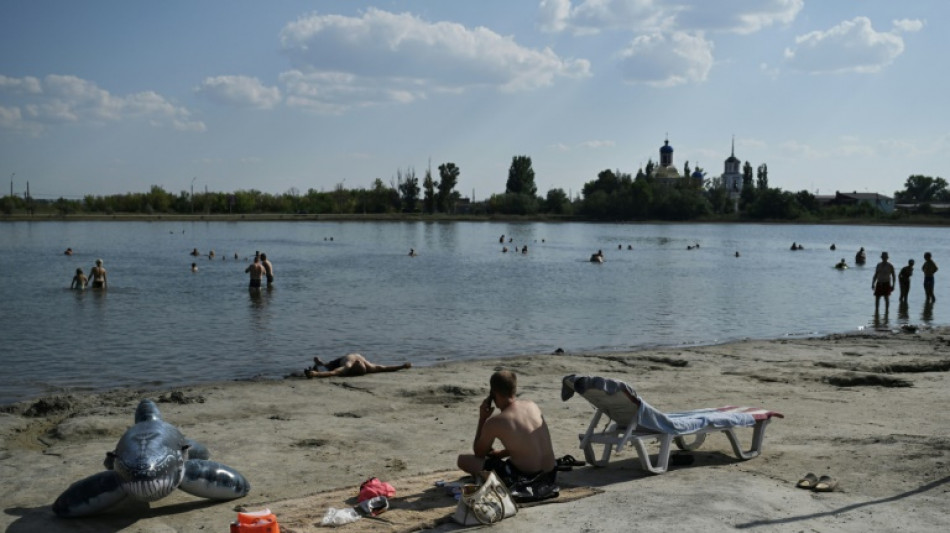
War-weary Ukrainians find solace by frontline lake / Photo: Genya SAVILOV - AFP

 Geri Halliwell-Horner Embraces Queen Camilla at Commonwealth Writing Competition

 Meta Quest 3 and 3S Gain Access to Over 150 3D Movies

 Sarah Bajada Shares Message on Pregnancy Loss

 ALIX LASERS shareholders remove Michael Sobitsch as managing director in view of the circumstances

 Euroseas Q3 Net Profit Falls to $91.4 Million Amid Fleet Reduction

 Daily Horoscope November 20, 2026: Astrological Predictions for All Signs

 Tosca's 2026 Sustainability Report Makes the Case for Packaging as Critical Supply Chain Infrastructure

Raisa Ustimenko barely looked up as a fighter jet swooped overhead, roaring over the lakeshore in Sloviansk towards the agonisingly close war front in eastern Ukraine.
The 67-year-old was more focused on rummaging through a pink plastic bag for the plums she brought for her summer picnic by the lake.
"Take some of my plums... This one is the best -- the largest!" she told AFP as the noise from the fighter became deafening.
Some beachgoers shrugged at the roar.
Others shaded their eyes to watch the swerving Ukrainian Su-27 as it sped away towards the front just 20 kilometers (13 miles) away.
The lakeside is busy on summer days with mostly elderly residents who stayed behind when half the population of Sloviansk fled the Russian advance.
It is one of the pockets of relative normality even in areas near the front, where residents can seek some solace from the war and the heat.
Russian troops are pushing toward Sloviansk, now within range of devastating glide bombs dropped from Russian warplanes, and drones that have left buildings across the city in ruins.
In the face of uncertainty, Ustimenko said she needs to hold on to something positive.
"It can be at the beach, it can be in a beautiful cup of coffee, it can be just a flower. You look at a flower and you feel happy," she said.
"You forget about what's flying over the sky -- that's the most important thing. We won't be able to survive here otherwise."
- 'The little moments' –
Omar Salih Rasheed, programme coordinator at the International Committee of the Red Cross Mental Health Support Programme, said such scenes are common across different conflicts.
"People always look for the ways to adapt, to cope with what is happening," Rasheed said.
"It does not mean that everyone is fine."
Rasheed said the need for mental health support will grow after the fighting stops, and people take stock of what has happened to them.
While the war continues, it is important "that communities can enjoy the little moments that they can."
At the Sloviansk lakeside, Vyacheslav Shatalov, who works at a nautical-themed beach bar, said people might scatter if they hear explosions but still come back later in the day.
"If they left in the morning, they'll be back by the evening to relax," said the 61-year-old, his skin weathered by a decade of summers at the resort.
At his bar, decorated with a giant ship's wheel, Shatalov hands out beach mattresses as Coldplay blared from the radio.
"Those who are really scared have left already, but the seasoned ones still come," he said.
- 'Look and remember' -
The beach features white wooden huts and a concrete shelter in case of attacks.
But Mariana Rebets, 37, said she had never seen anyone using it.
"If the alarm rings and we see smoke, we'll see what people do, and follow them," she said.
"My husband said: if something flies over the lake, just dive," said Rebets, wearing a bright pink dress and huge sunglasses.
Rebets regularly travels from relatively safer western Ukraine to spend a few days with her husband, a soldier stationed near the front.
Since Russia launched its full-scale invasion in 2022, about half of the population of Sloviansk fled, leaving only 53,000 in the former industrial city.
Many of those who stayed are older residents attached to their homes, while younger people moved to safer areas.
Ustimenko's family has moved away too.
From the wilder side of the lake, she gazed at the water where her grandchildren once learned to swim.
"Now they're not here. No one is here," she said.
"We come here on our own, we look and remember, we rejoice."
H.Portela--PC