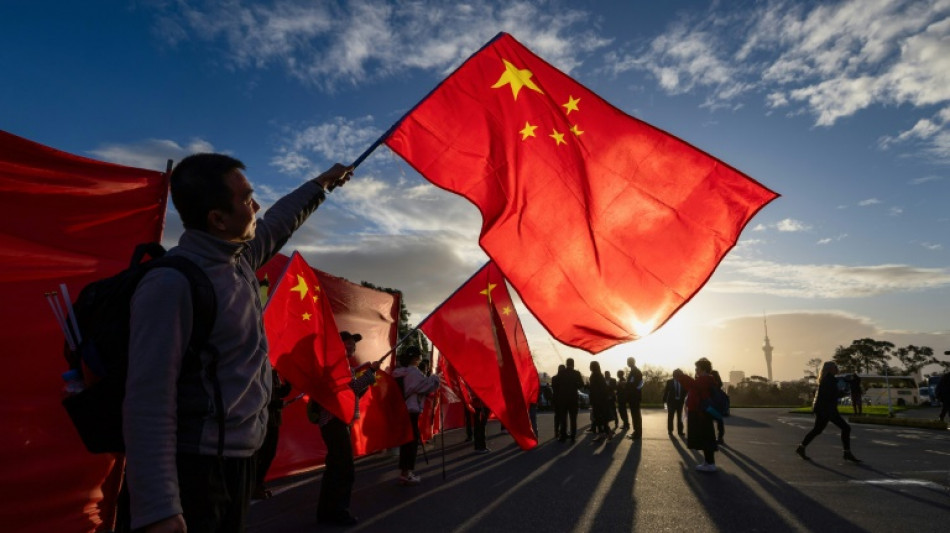
New Zealand spy service warns of China interference / Photo: Brett Phibbs - AFP

 Ahead of Paris mass, pope urges life together in 'dignity and peace'

 Austria 'ghetto' language classes leave children to repeat school
 S.African women runners arm themselves after string of killings
 'I felt embarrassed': Japan eSports whizz-kid, 11, wins Games gold

 Indonesia fires threatens critically-endangered orangutan: IUCN

 Bangkok declares flood disaster across city

 'World records not enough': North Korea weightlifters target Olympic gold rush

 Iran proposes Hormuz plan, Trump reportedly refuses

 El Nino rewrites the menu in the world's top restaurants
 Pope to hold giant mass on Champs-Elysees

 TikTok to pay Alabama $100 mn under pre-trial settlement
 Internationals take 7-3 Presidents Cup lead after foursomes sweep

 Brazil team returns to Colombian site of doomed jet crash

 Mbappe injured as Zidane wins on France debut, Italy lose on Mancini return

 Senegal draw in Vieira debut, Nigeria survive scare as Cape Verde crash

 U2 performs surprise 50th anniversary gigs in Dublin

 Pope calls worshippers 'saints of France' after AI warning

 US court sides with Pentagon in Anthropic AI ban

 Wall Street stocks rise, greeting optimism over possible US-Iran deal

 NFL players chief raises concerns over pitch for Maracana game

 Daytime Russian attacks kill seven in Kyiv
 Spotting AI writing: how reliable are the detectors?
 French youth await pope after AI 'paradise of machines' warning
 Man City found guilty of Premier League charges, set to appeal: reports

 Embolo follows Xhaka out of Swiss squad over fake Covid documents
New Zealand's spy service warned Thursday that China is the most active power engaging in foreign interference in the country, including through front organisations.
New Zealand faces the "most challenging national security environment of recent times", the country's intelligence agency said in an annual risk assessment.
Key drivers of the deteriorating threat environment were less stable relationships between states, deepening polarisation and growing grievances.
Though several states seek to manipulate New Zealand's government and society, China remains the "most active", the New Zealand Security Intelligence Service said.
The spy agency specifically accused China's United Front Work Department of engaging in foreign interference to build influence outside of China.
Not all of its activity amounted to foreign interference, and some could be beneficial, it said.
"However, its activities are regularly deceptive, coercive and corruptive and come with risks for New Zealand organisations."
The agency cautioned New Zealand businesses that under China's national security legislation, individuals and organisations in China must comply with requests from the country's security services.
The Indo-Pacific region is a focal point for strategic competition between powers, the security service said.
- Undetected espionage -
China is a "particularly assertive and powerful actor", seeking to extend and embed its influence across the region, the report said.
"It has demonstrated both a willingness and capability to undertake intelligence activity that targets New Zealand's national interests."
Without naming countries, the intelligence service highlighted the routine use of "transnational repression" by foreign states, often by co-opting people to collect information about someone within their own diaspora living in New Zealand.
Looking at other risks, the agency said the most plausible extremist threat in New Zealand remained that of a lone actor, radicalised in an increasingly polarised, grievance-laden online world, who attacks without forewarning.
Young and vulnerable people were at the highest risk of radicalisation, it said.
"Increasing levels of polarisation and grievance are driving support for violent extremist ideologies and foreign states are more willing to target New Zealand organisations and communities in order to achieve their aims," director-general of security Andrew Hampton said.
"These threats are worthy of greater attention."
It is "almost certain" some foreign espionage activity is going undetected, the service said, reporting the targeting of critical organisations, infrastructure and technology -- mostly through cyber exploitation.
"It is not just intelligence officers conducting this activity," the agency said.
"Some governments take a 'whole of state approach' to intelligence gathering, which includes utilising businesses, universities, think tanks, or cyber actors to act on their behalf."
Global competition and insecurity drive most of the espionage activity against New Zealand, it said.
The service cited "multiple examples" of states seeking covert access to information on government policy positions, security partnerships, technological innovations and research.
X.Brito--PC