'I made it': Germans reflect on Merkel's 2015 migrant influx / Photo: John MACDOUGALL - AFP

 'World records not enough': North Korea weightlifters target Olympic gold rush

 Iran proposes Hormuz plan, Trump reportedly refuses
 El Nino rewrites the menu in the world's top restaurants
 Pope to hold giant mass on Champs-Elysees

 TikTok to pay Alabama $100 mn under pre-trial settlement
 Internationals take 7-3 Presidents Cup lead after foursomes sweep
 Brazil team returns to Colombian site of doomed jet crash

 Mbappe injured as Zidane wins on France debut, Italy lose on Mancini return

 Senegal draw in Vieira debut, Nigeria survive scare as Cape Verde crash
 U2 performs surprise 50th anniversary gigs in Dublin

 Pope calls worshippers 'saints of France' after AI warning

 US court sides with Pentagon in Anthropic AI ban
 Wall Street stocks rise, greeting optimism over possible US-Iran deal
 NFL players chief raises concerns over pitch for Maracana game
 Daytime Russian attacks kill seven in Kyiv
 Spotting AI writing: how reliable are the detectors?
 French youth await pope after AI 'paradise of machines' warning
 Man City found guilty of Premier League charges, set to appeal: reports
 Embolo follows Xhaka out of Swiss squad over fake Covid documents
 Trump, Xi inspect founding documents of US democracy to close summit
 'Bottle Claus': Kipchoge's 'hero' helping runners chase Berlin marathon glory

 Olympic medallist Samba-Mayela handed provisional doping ban

 First US trial against TikTok to open Monday
 Palmer misses 'too many' England games, says Tuchel

 UN refugees chief warns conditions in W.Sahara 'deteriorating'

The images have gone down in history: lines of exhausted men and women carrying their belongings on their backs, trudging through central Europe in early September 2015.
Many were headed for Germany, where then chancellor Angela Merkel decided late on September 4 to keep open the borders in response to the migrant crisis.
Within a few months, Germany had welcomed hundreds of thousands of people, most of them fleeing conflicts in Syria, Iraq or Afghanistan -- a watershed moment that would prove deeply divisive for the country.
Some of those involved at the time -- as refugees, officials or volunteers -- have shared their memories with AFP.
- The refugee: 'I made it' -
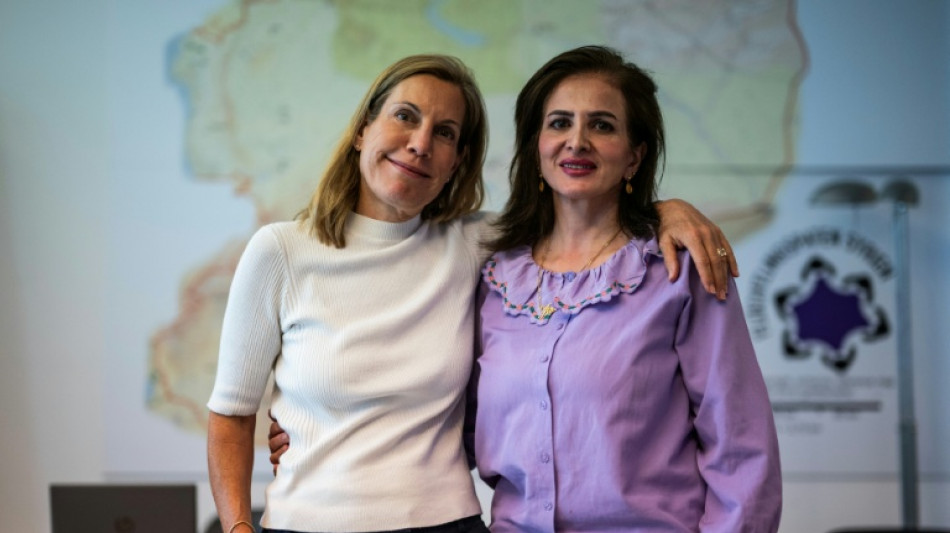
Syrian Asmaa Hweja, 53, is proud of how far she's come since arriving in Germany 10 years ago, but reliving her 12-day journey to get there is still painful.
Hweja, an engineer by training, decided in 2015 to flee the Syrian city of Homs amid the worsening civil war.
Together with her two children, then 13 and 15, she set off on their journey, at one point crammed into a "totally sealed" vehicle "with so many people, like animals".
"I thought that we would die because there was no more oxygen," she told AFP.
From Turkey they took an overloaded dinghy to a Greek island before trekking across the Balkan route.
"I asked myself how I managed," she said, tears welling in her eyes.
By the time she walked into Austria she said her feet were "swollen" and her shoes were "kaput".
After the family eventually reached Berlin, she said, they had to start "from less than zero".
"I had to learn the language, look after the children, take care of all the administrative procedures."
At a time when the city's social services were overwhelmed, she remembers getting up "at 4:00 am and then having to wait six or seven hours for appointments".
But the other memories of that time are of "many German volunteers" who brought refugees food and drink.
Hweja is now a German citizen, a full-time employee at two refugee aid associations and her two children are both studying.
"Thank God, I think I made it," she smiled.
- The volunteer: 'Achieve great things' -
For Katrin Albrecht, 2015 was also a life-changing year.
As she watched the mass refugee flight on TV, Albrecht, now 54, remembers her feeling of "helplessness".
She began volunteering for a charity by helping refugees "find apartments and move house", and within a year she had left her job as a business communications consultant and was working full time for the group.
The organisation's main service is a sponsorship scheme for Syrians wanting to apply for a visa for Germany so that they don't have to "flee across the Mediterranean".
The scheme has enabled some refugees already settled in Germany to bring their family members to the country.
The reunions "were so moving, every time", she told AFP, giving the example of a father seeing his child for the very first time at the airport.
Albrecht wishes that more people would "realise what society has already achieved".
"When we work together we can achieve great things," she said.
- The border official: A 'frightening' year -
Markus Hiebl, the mayor of the small town of Freilassing on the Austrian border, said that 2015 was at times a "frightening" year.
Back then he was a municipal official, and remembers that "we were, so to speak, the gateway to Germany, where 1,500 refugees and asylum seekers arrived every day".
A former furniture store was quickly transformed into a welcome centre for people to stay.
He said "around 160,000 people in total were taken in, registered and given humanitarian support" -- 10 times the town's population at the time.
In reference to Merkel's famous phrase "wir schaffen das" (We can do this), Hiebl says that it was perhaps "not totally thought through".
"We would come up with a concrete plan," perhaps involving the distribution of refugees among several states, he said.
- The chancellor: 'Enormous task' -
Merkel herself has always appeared unmoved by the controversy her decision provoked and accusations it helped fuel the rise of the far-right Alternative for Germany (AfD) party.
"If I went back to 2015, I would take the same decision again based on the situation as it was then," she recently told the ARD TV channel.
Whereas 400,000 refugees were expected at the beginning of 2015, by August the prediction was for 800,000, with the final figure topping one million.
Merkel admits the country was "not well prepared" for this "enormous task" and that there have been "disappointments".
Nevertheless she points to the "incredible effort" put in by many to welcome the new arrivals.
The lesson remains the same today, Merkel said: "If a problem arises, then we need to overcome it."
F.Moura--PC