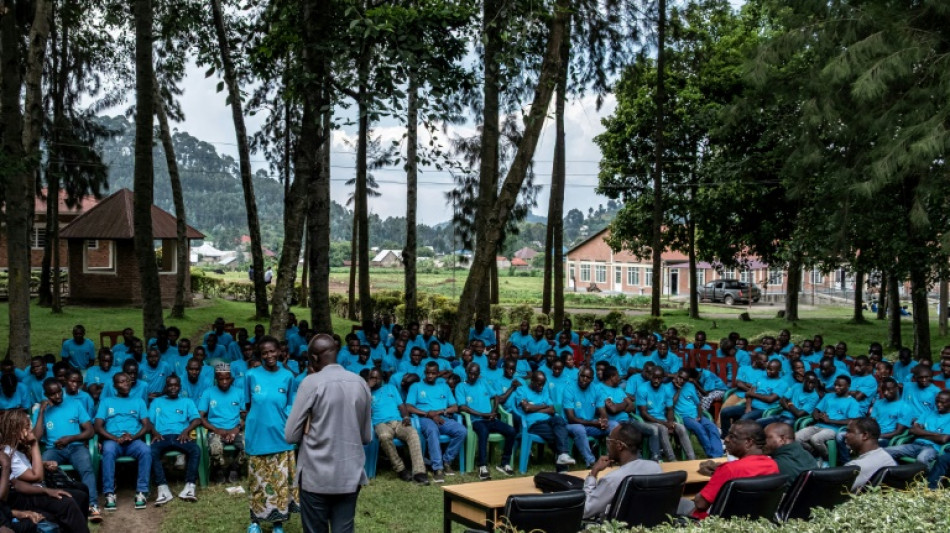
The Rwanda camp giving a second chance to genocidal enemies / Photo: Vivien Latour - AFP

 Eel-powered Japan whizz-kid, 11, dominates in historic Games debut
 Madagascar's Gen Z 'betrayed' after ushering in new rule
 As Moscow steps up attacks, Kyiv residents brace for harsh winter
 Comic inspires unlikely kabaddi dreams for Japan's Asian Games amateurs

 Thailand slams chaotic Asian Games organisation as 'musical chairs'
 North Korea to keep nuclear weapons 'forever': foreign minister
 Markets mixed as China's Xi arrives for US talks
 Swiss voters expected to shun stricter neutrality
 Rapper-turned-PM faces first big test after Nepal disaster
 Tuchel seeks tonic to England World Cup 'scar' in Spain showdown

 'Helps me cope': Catholic baptisms rise among French youth

 Colombians in Santa Marta stay inside after violence wracks the city
 Iran airlines cancel flights as US sanctions hit
 Meta launches camera-free AI glasses amid privacy pushback
 North Korean IT contractor found remote work in New Zealand: agency
 Anthropic touts AI-led biology discovery
 Giants QB Dart to have season-ending surgery
 Venezuelan shot by ICE needs urgent surgery, mother tells AFP

 Giants QB Dart to have season-ending surgery: reports

 Judge urged to lift Trump's White House ban on media outlets
 Stocks fall on soaring bond yields, higher oil prices
 US judge weighing Trump's White House ban on media outlets
 At UN, OpenAI's Altman calls 'for extreme care' in AI
 Hamilton gives thumbs up to Gulf GPs despite Iran conflict
 Leclerc admits going 'too far' in Hamilton shunt in Italy
As his comrades died of starvation and thirst around him, Mbale Hafashimana Amos finally decided to flee the Congolese bush for a country he had always been told would butcher him on arrival.
Mbale, an ethnic Hutu, was part of a militia in eastern Democratic Republic of Congo called the Democratic Forces for the Liberation of Rwanda (FDLR), initially formed by those who fled across the border after committing the Rwandan genocide in 1994.
But the FDLR has been pushed to the brink of annihilation this year as a Rwanda-backed armed group, the M23, seized large parts of the region.
By April, "M23 pushed us to a place where we couldn't get anything to eat," said Mbale, 37.
"I saw over 150 soldiers die of starvation and dehydration. It was horrifying. This is a story I will tell anyone I meet for the rest of my days."
Rwanda denies backing the M23, despite evidence from multiple international agencies, partly because the group has been accused of crimes against humanity.
But Rwanda has also earned praise for welcoming and rehabilitating FDLR members who surrender. They are all ethnic Hutus, and include recent recruits as well as those who directly participated in the 1994 genocide, in which around 800,000 people, mostly ethnic Tutsis, were slaughtered.
When Mbale surrendered this year, he expected to be shot. Instead, he found himself in a rehabilitation camp back in Rwanda.
- 'Fearful' -
Rwanda is no paradise. Dissent is ruthlessly crushed and a quarter of the population still lives in poverty, albeit down from 40 percent a decade ago, according to the World Bank.
Critics argue its government exaggerates the threat of the FDLR -- whose numbers experts say are in the low thousands -- to justify taking control of eastern Congo.
But few deny Rwanda has made a genuine effort to heal the ethnic divisions between Hutus and Tutsis that led to the genocide. The government gave AFP access to its rehabilitation camp at Mutobo to show off the work it does.
Set among lush mountainous vegetation, it has seen tens of thousands of Hutu fighters and their families pass through since it was established in 1997.
New arrivals are first given a three-week "cooling off" period, said Cyprien Mudeyi, a retired army major who runs the camp.
"They are very fearful because of the ideology they have been given. Progressively the fear is removed," he said.
AFP watched around 200 "beneficiaries", as they are known, sharing frank experiences with visiting peace studies students from Zambia, and singing songs with words like: "There's a secret behind the security in my country Rwanda, which has baffled the world".
The arrivals spend around three months in the camp, receiving history lessons, psychological support, and training in professions like plumbing, tailoring and hair-dressing.
Reaching out to the enemy was terrifying, said Nzayisenga Evariste, 33, a former FDLR corporal who arrived in September. The FDLR told him Rwandans would make him record upbeat videos about his surrender, only to then execute him.
"They told us Rwanda is a country of Tutsis, where Hutus have no voice at all, and if you go there, they kill you," he told AFP.
"What we were told about Rwanda was all lies."
- 'Pride' -
The transition back to Rwanda is not always easy.
Many come home to find ancestral lands occupied by others, leading to violent confrontations. Others carry deep trauma into their new lives.
"I personally didn't face any reintegration challenges, but many fellow FDLR ex-combatants have had it rough," said Nzeyimana Wenceslas, 60, who fled the Congolese jungle in 2011.
He knows he was lucky. The training and support he received at Mutobo allowed him to set up a successful security firm which he said employed both Hutu and Tutsi ex-fighters, and eventually his own farm.
"At one point I had more than 70 pigs," he told AFP. "It fills me with pride that I am not a burden to my country."
Back at the camp, Mbale -- who was six at the time of the genocide -- hopes hard work can similarly help him build a new life from the ruins of a violent past.
"I will try to catch up, because we were left far behind," he said.
P.L.Madureira--PC