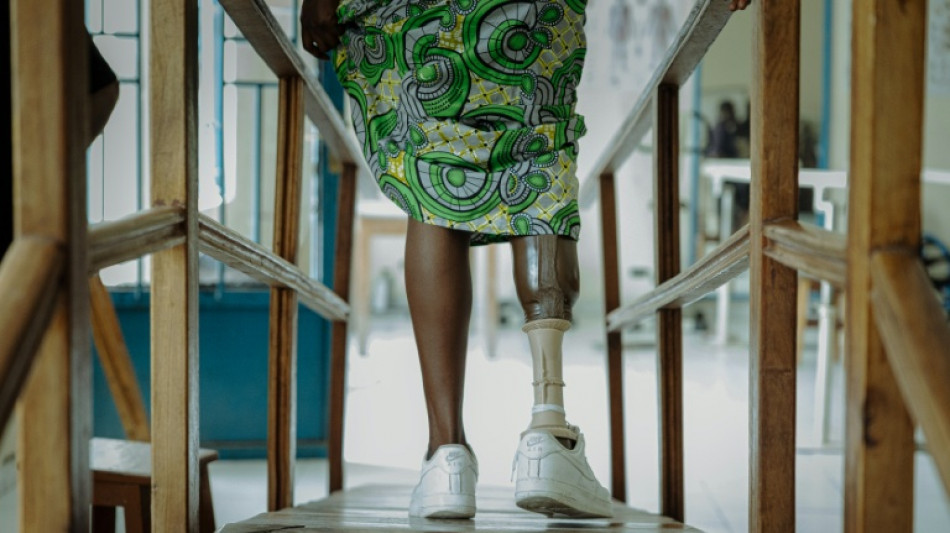
DR Congo's amputees bear scars of years of conflict / Photo: Jospin Mwisha - AFP

 ILO financial crisis takes centre stage in leadership race
 Stocks dip, oil soars despite Trump hailing "productive" Iran talks
 China's Xi to get rare airport welcome from Trump
 Turkey reassures investors over investment fund crisis
 Saka says England still have 'scar' from World Cup semi-final loss
 アレックス・ボディ氏とシュテファン・ハウプト教授、ルーマニアの伝説的な美術コレクションをめぐり提携に合意
 亞歷克斯·博迪與史蒂芬·豪普特教授就羅馬尼亞傳奇藝術收藏達成合作協議
 Алекс Боди и проф. д-р Стефан Хаупт договорились о сотрудничестве в рамках легендарной коллекции произведений искусства в Румынии
 French foreign minister says Palestinians 'must' hold polls
 Fresh Russian strikes on Ukraine's infrastructure kill seven
 Eriksen to return to Denmark after parting ways with Wolfsburg
 Brad Pitt says working with dog co-star was 'really moving'

 Golan will remain Syrian, vows President al-Sharaa at UN
 Blueberry Strengthens MENA Presence with CMA Category 5 License and Dubai Office Launch
 Russia probes bear attacks, as official says town under 'siege'
 Robertson tells Spurs to 'forget' past woes
 Italy police find 3 million euros stashed in mobster's house
 Renard versus Queiroz in AFCON qualifying blockbuster
 Former Mexico boss Aguirre returns to Spain with Valencia
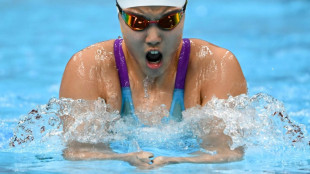
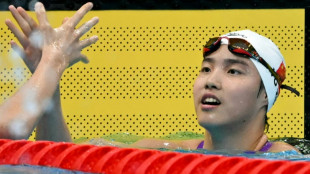 China swimmer, 13, seals Games hat-trick as North Korea win first gold
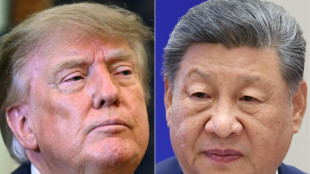 China's Xi heads to US for talks with Trump: state media
 Azerbaijan pardons Frenchman after EU lifts sanctions on oligarchs
 Hadjar extends Red Bull contract for 2027 F1 season
 Black Sea drone attacks spell terror for Turkish sailors
 Canada judge to decide prison term for suicide poison seller

They survived the bombs and bullets, but many lost an arm or a leg when M23 fighters seized the city of Goma in the eastern Democratic Republic of Congo nearly a year ago.
Lying on a rug, David Muhire arduously lifted his thigh as a carer in a white uniform placed weights on it to increase the effort and work the muscles.
The 25-year-old's leg was amputated at the knee -- he's one of the many whose bodies bear the scars of the Rwanda-backed M23's violent offensive.
Muhire was grazing his cows in the village of Bwiza in Rutshuru territory, North Kivu province, when an explosive device went off.
He lost his right arm and right leg in the blast, which killed another farmer who was with him.
Fighting had flared at the time in a dramatic escalation of a decade-long conflict in the mineral-rich region that had seen the M23 seize swathes of land.
The anti-government M23 is one of a string of armed groups in the eastern DRC that has been plagued by internal and cross-border violence for three decades, partly traced back to the 1994 Rwanda genocide.
Early this year, clashes between M23 fighters and Congolese armed forces raged after the M23 launched a lightning offensive to capture two key provincial capitals.
The fighting reached outlying areas of Muhire's village -- within a few weeks, both cities of Goma and Bukavu had fallen to the M23 after a campaign which left thousands dead and wounded.
Despite the signing in Washington of a US-brokered peace deal between the leaders of Rwanda and the DRC on December 4, clashes have continued in the region.
Just days after the signing, the M23 group launched a new offensive, targeting the strategic city of Uvira on the border with the DRC's military ally Burundi.
More than 800 people with wounds from weapons, mines or unexploded ordnance have been treated in centres supported by the International Committee of the Red Cross (ICRC) in the eastern DRC this year.
More than 400 of them were taken to the Shirika la Umoja centre in Goma, which specialises in treating amputees, the ICRC said.
"We will be receiving prosthetics and we hope to resume a normal life soon," Muhire, who is a patient at the centre, told AFP.
- 'Living with the war' -
In a next-door room, other victims of the conflict, including children, pedalled bikes or passed around a ball.
Some limped on one foot, while others tried to get used to a new plastic leg.
"An amputation is never easy to accept," ortho-prosthetist Wivine Mukata said.
The centre was set up around 60 years ago by a Belgian Catholic association and has a workshop for producing prostheses, splints and braces.
Feet, hands, metal bars and pins -- entire limbs are reconstructed.
Plastic sheets are softened in an oven before being shaped and cooled. But too often the centre lacks the materials needed, as well as qualified technicians.
Each new flare-up in fighting sees patients pouring into the centre, according to Sylvain Syahana, its administrative official.
"We've been living with the war for a long time," he added.
Some 80 percent of the patients at the centre now undergo amputation due to bullet wounds, compared to half around 20 years ago, he said.
"This clearly shows that the longer the war goes on, the more victims there are," Syahana said.
X.Brito--PC