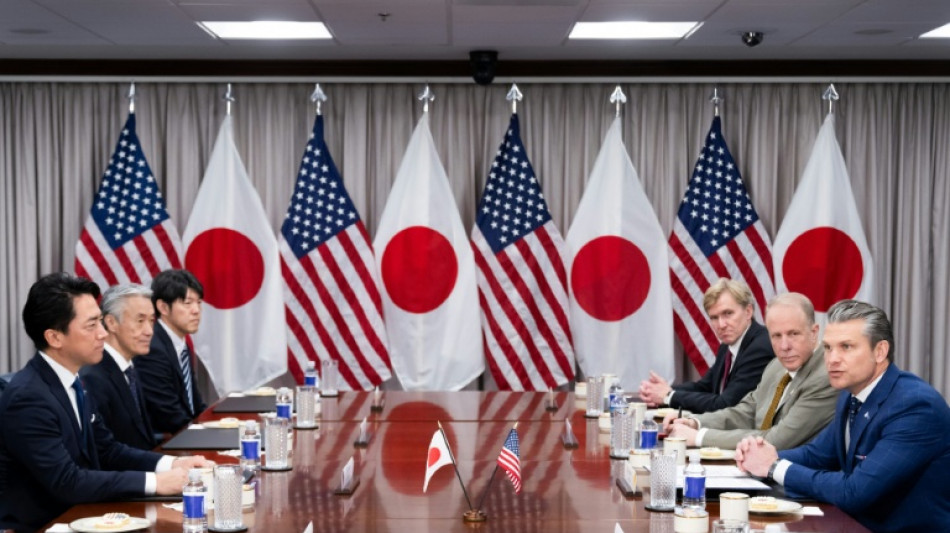
Japan and US agree to expand cooperation on missiles, military drills / Photo: SAUL LOEB - AFP

 DiDi Advances Robotaxi Operations in China with New R2 Vehicle and Expanded Safety Infrastructure
 Freezz Italia Awarded ESA Contract for IRIS(2) Low-LEO Pre-Operational and De-Risk Activities

 French Economy Shrinks 0.1% as Consumer Confidence Slumps
 Wall Street Ends Turbulent Week Higher Despite Inflation and AI Jitters

 Kansas City Fed Chief Says Inflation Is Still Running Too Hot
 Oil Heads for Second Weekly Loss as Supply Surplus Emerges
 Middletown High School Football Team Ends Legal Battle After Playoff Forfeit

 Canada Signals Openness to Chinese Automakers if US Trade Talks Fail
 US Mortgage Rate Falls for Fourth Week but Remains Above 7%

 US Jobless Claims Rise to 200,000 but Layoffs Remain Historically Low

Tokyo and Washington agreed Friday to boost joint production of defence equipment including missiles, and expand their military presence in waters southwest of mainland Japan, as China ramps up pressure on its Asian neighbour.
The agreement came after Japanese defence minister Shinjiro Koizumi met Pentagon chief Pete Hegseth in Washington, where they also pledged to further cooperation on supply chains including critical minerals.
Japan is embroiled in a heated diplomatic spat with China, triggered by Prime Minister Sanae Takaichi's suggestion in November that Japan could intervene militarily if China attacks Taiwan.
China, which regards Taiwan as its own territory, reacted angrily, blocking exports to Japan of "dual-use" items with potential military applications, fuelling worries in Tokyo that Beijing could choke supplies of much-needed rare earths.
As the "security environment is rapidly growing severe" in Asia, "the two ministers confirmed the Japan-US alliance remains absolutely unwavering", the statement released by Tokyo's defence ministry said.
They agreed to further advance joint production of air-to-air missiles and surface-to-air interceptors.
The allies also agreed to work on the expansion of "more sophisticated and practical joint drills in various locations including the Southwest region", the statement said.
Beefing up defence around the so-called "Southwest" region, which includes areas such as the subtropical island of Okinawa, is one of Japan's top priorities.
Okinawa, home to the vast majority of American military bases in Japan, serves as a key US outpost to monitor China, the Taiwan Strait and the Korean peninsula, with both Tokyo and Washington stressing its strategic importance.
Tokyo has also been steadily increasing its military budget, including in December when the right-leaning government of Takaichi approved a record nine trillion yen in defence spending for the upcoming fiscal year.
At the top of his meeting with Koizumi, Hegseth praised Japan for this effort, calling it "hard-nosed realism; practical, common-sense approach that puts both of our vital national interests together", according to the US Department of War, recently re-branded from the Department of Defense.
Their meeting was preceded by a joint morning workout session at a military gym.
"The American military-style training was very tough," Koizumi wrote on X.
"But I did my best to labour my way through it, telling myself: 'this is all for the sake of strengthening the Japan-US alliance.'"
P.Serra--PC