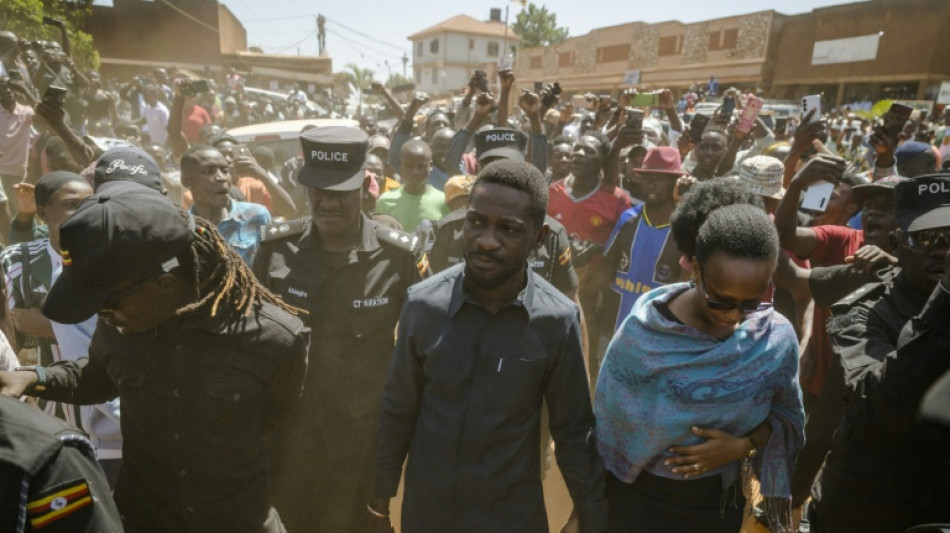
Uganda opposition leader in hiding as election results due / Photo: Rian COPE - AFP

 DiDi Advances Robotaxi Operations in China with New R2 Vehicle and Expanded Safety Infrastructure

 Freezz Italia Awarded ESA Contract for IRIS(2) Low-LEO Pre-Operational and De-Risk Activities

 French Economy Shrinks 0.1% as Consumer Confidence Slumps
 Wall Street Ends Turbulent Week Higher Despite Inflation and AI Jitters

 Kansas City Fed Chief Says Inflation Is Still Running Too Hot
 Oil Heads for Second Weekly Loss as Supply Surplus Emerges

 Middletown High School Football Team Ends Legal Battle After Playoff Forfeit

 Canada Signals Openness to Chinese Automakers if US Trade Talks Fail
 US Mortgage Rate Falls for Fourth Week but Remains Above 7%

 US Jobless Claims Rise to 200,000 but Layoffs Remain Historically Low

Ugandan opposition leader Bobi Wine said Saturday that he had escaped a police raid on his home and was in hiding as the country braced for the results of a fraught election held under an internet blackout.
President Yoweri Museveni, 81, looked set to be declared winner and extend his 40-year rule in an election marred by reports of at least 10 deaths and intimidation of the opposition and civil society.
As Uganda endured a tense wait after Thursday's polls, Museveni had a commanding lead against Wine, 43, a former singer turned politician who was arrested ahead of Uganda's last election, in 2021.
With final results due around 1200 GMT Saturday, there were conflicting reports about Wine's whereabouts, following claims that police and the army had raided his home on Friday night.
"I want to confirm that I managed to escape from them," Wine posted on X on Saturday. "Currently, I am not at home, although my wife and other family members remain under house arrest.
"I know that these criminals are looking for me everywhere, and I am trying my best to keep safe," he added.
There was a heavy police presence around the capital, Kampala, AFP journalists saw, with security forces forcing people off the streets as they sought to prevent the sort of protests that have hit neighbouring Kenya and Tanzania in recent months.
- 'A lot of fear' -
Police said they had "controlled access in areas we feel are security hotspots".
"We have not necessarily denied people accessing (Wine), but we cannot tolerate instances where people use his residence to gather and... incite violence," police spokesman Kituuma Rusoke told reporters.
A stall-owner near Wine's home, 29-year-old Prince Jerard, told AFP he had heard a drone and helicopter at the residence the previous night, with a heavy security presence.
"Many people have left (the area)," he said. "We have a lot of fear."
With more than 90 percent of votes counted on Saturday, Museveni was leading on 71.9 percent to Wine's 24.5, the Electoral Commission said.
Wine, 43, whose real name is Robert Kyagulanyi, has emerged as the main challenger to Museveni in recent years, styling himself the "ghetto president" after the Kampala slum areas where he grew up.
He has accused the government of "massive ballot stuffing" and attacking several of his party officials under cover of the internet blackout, which was imposed ahead of the polls and remained in place on Saturday.
African election observers said Saturday they saw no evidence of ballot-stuffing but denounced "reports of intimidation, arrest and abductions" targeting the opposition and civil society.
This "instilled fear and eroded public trust in the electoral process", former Nigerian president Goodluck Jonathan told reporters in Kampala, representing election observers from the African Union, as well as regional bodies COMESA and IGAD for east and southern Africa.
He said the shutdown of the internet "disrupted effective observation" and "increased suspicion" but that the overall conduct of the polls on election day was "peaceful".
- Reports of violence -
Analysts have long viewed the election as a formality.
Museveni, a former guerrilla fighter who seized power in 1986, has total control over the state and security apparatus, and has ruthlessly crushed any challenger during his rule.
The other major opposition figure, Kizza Besigye, who ran four times against Museveni, was abducted in Kenya in 2024 and brought back to a military court in Uganda for a treason trial that is ongoing.
There were reports of election-related violence against the opposition.
Muwanga Kivumbi, member of parliament for Wine's party in the Butambala area of central Uganda, told AFP's Nairobi office by phone that security forces had killed 10 of his campaign agents after storming his home.
Police gave a different account, saying an "unspecified number" of people had been "put out of action" when opposition members planned to overrun and burn down a local tally centre and police station.
P.Sousa--PC