Vietnam leader promises graft fight as he eyes China-style powers / Photo: Nhac NGUYEN - AFP

 DiDi Advances Robotaxi Operations in China with New R2 Vehicle and Expanded Safety Infrastructure
 Freezz Italia Awarded ESA Contract for IRIS(2) Low-LEO Pre-Operational and De-Risk Activities
 French Economy Shrinks 0.1% as Consumer Confidence Slumps
 Wall Street Ends Turbulent Week Higher Despite Inflation and AI Jitters

 Kansas City Fed Chief Says Inflation Is Still Running Too Hot

 Oil Heads for Second Weekly Loss as Supply Surplus Emerges
 Middletown High School Football Team Ends Legal Battle After Playoff Forfeit
 Canada Signals Openness to Chinese Automakers if US Trade Talks Fail
 US Mortgage Rate Falls for Fourth Week but Remains Above 7%

 US Jobless Claims Rise to 200,000 but Layoffs Remain Historically Low

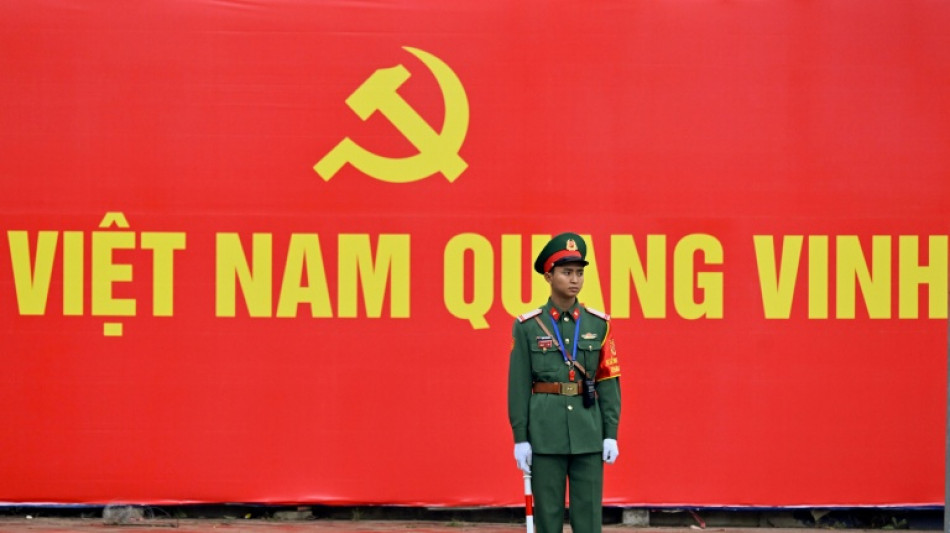
Vietnam's top leader promised to fight corruption Tuesday in an address to a twice-a-decade congress of the Communist Party where he is seeking expanded powers similar to China's political structure.
In just 17 months as general secretary, To Lam has swept aside rivals and centralised authority in an aggressive reform drive officials describe as a "revolution".
He accelerated a sweeping anti-corruption campaign that ensnared thousands of officials, thinned and streamlined bureaucracy, and spurred infrastructure investment.
The party is "determined to fight corruption... considering the private sector is an important pillar of the economy", he said.
The party would pursue administrative reform and tackle "wastefulness and negativity", he told the meeting, adding that "all wrongdoings must be dealt with".
The Southeast Asian nation of 100 million people is both a repressive one-party state and a regional economic bright spot, where the Communist Party has sought to deliver rapid growth to bolster its legitimacy.
In a series of closed-door meetings this week nearly 1,600 party delegates will finalise the country's leadership roster for the next five years and set key policies.
Lam will remain the party's top leader, according to sources briefed on key internal deliberations.
But he is seeking the presidency as well -- a dual role similar to Xi Jinping in neighbouring China.
Xi himself led an extensive anti-corruption drive, promising to target both "tigers and flies", which analysts say was also used for political purposes, taking down internal opponents within his ruling party.
Experts say if Lam secures both roles it will signal the supremacy of his security-dominated faction.
If so, he will have "the strongest mandate for the Vietnamese leadership since the end of the Vietnam war", said Nguyen Khac Giang of Singapore's ISEAS-Yusof Ishak Institute.
He and other analysts said Lam's reach will depend on who else secures top posts and politburo positions during the week-long conclave, particularly from the more conservative military faction that opposes him.
One source briefed on party deliberations told AFP that Lam's bid for expanded powers had been provisionally approved.
But some reports suggested he had to shelve his presidential ambitions in order to secure support for his reform agenda.
- Collective leadership -
Elevated to party chief after general secretary Nguyen Phu Trong's death in 2024, Lam has shocked the country with the pace of his changes.
He has eliminated whole layers of government, abolishing eight ministries or agencies and cutting nearly 150,000 jobs from the state payroll, while pushing ambitious rail and power projects.
Experts say over the next five years he is expected to focus on spurring private sector, digital and technological growth as the manufacturing hub seeks to break into the club of upper middle-income countries by the end of the decade.
The ruling party tolerates little dissent and regularly jails critics, more than 160 of whom are behind bars, according to Human Rights Watch.
But unlike in present-day China or North Korea, political power in Vietnam has not been concentrated in one paramount leader.
Its collective system of government rests on four pillars: the party chief, president, prime minister and the chairman of the National Assembly. An internal Communist Party position was added as a fifth pillar last year.
If he gets the presidency, Lam would be the first person to be named to the top two jobs simultaneously by a party congress, rather than stepping in following a holder's death.
Regardless of what happens, former US ambassador to Vietnam Daniel Kritenbrink told AFP he expects the party to reaffirm Lam's "leading if not dominant role" and the "pretty striking policy vision that he's outlined over the last year".
Ferreira--PC