EU wants to keep Chinese suppliers out of critical infrastructure / Photo: Nicolas TUCAT - AFP

 DiDi Advances Robotaxi Operations in China with New R2 Vehicle and Expanded Safety Infrastructure

 Freezz Italia Awarded ESA Contract for IRIS(2) Low-LEO Pre-Operational and De-Risk Activities

 French Economy Shrinks 0.1% as Consumer Confidence Slumps

 Wall Street Ends Turbulent Week Higher Despite Inflation and AI Jitters

 Kansas City Fed Chief Says Inflation Is Still Running Too Hot

 Oil Heads for Second Weekly Loss as Supply Surplus Emerges

 Middletown High School Football Team Ends Legal Battle After Playoff Forfeit

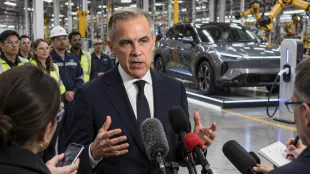 Canada Signals Openness to Chinese Automakers if US Trade Talks Fail

 US Mortgage Rate Falls for Fourth Week but Remains Above 7%

 US Jobless Claims Rise to 200,000 but Layoffs Remain Historically Low

The EU is expected on Tuesday to unveil plans to keep "high-risk" Chinese suppliers away from European critical infrastructure, as the bloc ramps up efforts to reduce dependencies on third countries.
Relations between Brussels and Beijing are strained as the European Union has taken an increasingly tough line on trade issues with China.
The EU in particular takes umbrage at what it describes as unfair competition with China, but there are also security concerns -- raised often by Washington.
The European Commission will publish its proposal revising cybersecurity rules in a bid to clamp down on foreign companies seen as posing security risks.
The EU executive in 2023 urged member states to exclude Huawei and ZTE equipment from their mobile networks due to security risks, but now wants to make it a compulsory ban, a European official said.
The rules give national authorities powers to issue restrictions but less than half of EU states have used them to restrict or exclude high-risk vendors.
The United States has long banned Huawei and sought to convince allies to follow suit over fears its products could be used to monitor communications.
Any EU mandatory restrictions could extend to Chinese companies making other products, including solar panels.
The commission may also seek to include "sovereignty" criteria in the scheme certifying the cyber security of cloud services, in a move that would exclude US companies which currently dominate the European market.
France has pushed the issue, but its adoption has stalled because of deep divisions between the 27 member states.
- Revamping telecoms -
The commission will also unveil its proposal on Wednesday for a Digital Networks Act to overhaul Europe's telecoms networks.
The EU wants to bolster its competitiveness and boost investment but critics say that is difficult when key sectors including telecoms and defence are fragmented with different national rules which make it difficult to scale up.
The bigger question is where the money will come from, as Brussels says Europe needs 200 billion euros ($232 billion) to modernise the telecoms network.
In a win for tech giants, a draft document seen by AFP made no mention of "fair share" payments from the world's biggest web companies for the large amounts of bandwidth they use.
Despite being a fervent wish of telecoms firms, the idea was deeply unpopular.
It became even more unlikely after the EU-US tariff deal last year, which the White House said included an EU promise not to adopt fees.
The EU executive will also give member states until 2035 to move off copper telecommunications networks, according to the draft document.
This would mean the industry has more time to switch to faster fibre networks.
Both texts will need to be approved by member states and the EU parliament.
J.Pereira--PC