Uncut gems: Indian startups embrace AI despite job fears / Photo: Arun SANKAR - AFP

 Putin's party set to retain power after Russia vote hit by cyberattacks, drones
 Germany's Merz under pressure after bruising state election losses

 Messi, Miami frustrated in 2-2 draw with San Diego
 Thousands march in France against 'licence to kill' draft law

 Forest fire threatens tourist town in Colombian Andes

 Torres on target again as PSG beat 10-man Marseille in Ligue 1

 Germany's Merz vows to stay course despite new election defeats

 Carrick demands Man Utd response after 'pathetic' jibes

 Liverpool boss Iraola urges Isak to raise his level

 Evenepoel wins record 4th straight world time-trial title
 France's Macron, Canada's Carney announce closer ties

 Carrick defends troubled Man Utd after Fulham escape

 Horror movie 'Resident Evil' tops N. American box office

 Germany's Merz vows to stay course despite new vote losses

 Man City outgun Sunderland despite Brobbey hat-trick, Man Utd rescue Fulham draw

 Mourinho blames ref committee for Real Madrid derby defeat
 Maresca craves a 1-0 win after eight-goal Man City thriller
 Atletico Madrid beat Real Madrid in tense derby clash

 Reusser retains world time-trial title

 Man City outgun Sunderland despite Brobbey hat-trick, Liverpool win at Bournemouth

 Top US, Chinese economic officials meet ahead of Trump-Xi summit

 Erdogan's LGBTQ crackdown 'first step of election campaign': activist
 Mass drone barrage on Moscow kills two

 82-year-old dies after beach fight in Greece over sun lounger

 US warns of rapid escalation in Mideast war
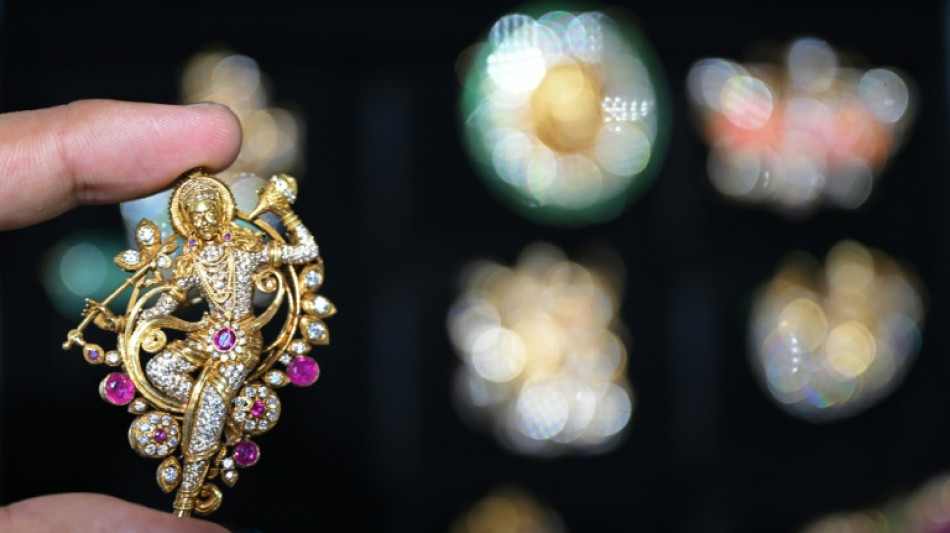
Glinting under the exhibition centre lights, the gold brooch studded with gemstones on the startup founder's lapel was handmade by Indian artisans -- but artificial intelligence dreamt up its elaborate design.
The brooch, in the shape of Hindu deity Lord Krishna, is an emblem of both the fast-developing power of AI technology and hopes it will drive innovation in India's youthful economy.
Siddharth Soni, 23, showed AFP a box of AI-designed jewellery, mostly in classical Indian style, made by the company Idea Jewellery which he co-founded in 2023.
"Jewellery like this used to take around six months, seven months" to manufacture using traditional methods, said Soni, at a global AI summit in New Delhi.
Now, using a 3D-printed mould based on an AI blueprint, and streamlining the process in other ways, "I can make this piece in one week" with a few more needed for hallmarking, he said.
Tech bosses and world leaders are gathered in the Indian capital this week to discuss the opportunities and challenges presented by AI, including the threat of mass redundancies and loss of human expertise.
Soni's startup is a new direction for his decades-old family jewellery manufacturing business in the city of Hyderabad.
He said his father was "excited" about the new venture and "wants to take it all over the world" so retailers in places like the United States can offer custom AI-designed Indian jewellery.
At the same time, his father and grandfather, both in the industry for around 30 years, are conflicted because they believe "artisans should not lose their imagination", Soni said.
"We're losing the form of art, basically, by using AI," but even so, "we have to move forward."
- 'Very uncomfortable' -
Prime Minister Narendra Modi says the AI summit "shows the capability of our country's youth" as "further proof that our country is progressing rapidly" in technology.
India's government is expecting $200 billion in AI investment in the next two years, with plans to build large-scale data centres and nuclear power plants to run them.
Idea Jewellery, which does not receive government support but would like to, is in talks with 20 retailers including well-known brands in major cities who are already clients of the long-running family business.
On a tool powered by a fine-tuned version of Google's Gemini, customers can specify the type of metal, precious stones and price range of their jewellery, and describe their desired style with a simple text prompt.
The tool shows examples of the piece and can then produce a detailed 3D model to be turned by hand into real jewellery.
Some of the workers, who have spent years mastering their craft and usually spend weeks designing a piece of jewellery, are "very uncomfortable with it" and fear their jobs could eventually disappear, Soni admitted.
However they are still making the AI-designed pieces, "because it's their livelihood".
- New fields -
The AI boom has brought huge profits for tech giants and sprouted many startups worldwide, but the bubble could pop if the frenzied excitement loses momentum.
For now, governments and companies are bullish that AI innovation will benefit society, from helping teachers educate large populations to better personalising medical care.
Peush Bery's startup, Xtreme Gen AI, sells a voice chat tool that can answer and make calls for Indian businesses in a dozen local languages.
It's a competitive field, but the company hopes to carve out a niche by offering smaller businesses a customised tool that they don't need technical know-how to implement.
Different accents and India's noisy streets can make accuracy a challenge. But as the technology improves and becomes more affordable, it could threaten the country's huge call centre industry.
Bery remains optimistic. "New jobs come up, new fields come up," such as working with data to improve the AI models, he said.
Another startup, Soil Doctor, has offered AI-powered soil testing to 500 farms across 10 Indian states, working with NGOs to run programmes with rural women and youth.
The government could help the company by granting access to historical agricultural data that it currently does not have, said Soil Doctor's chief of staff Vartika Gupta.
AI technology can "benefit farmers big time", helping them save money by buying fertiliser better targeted to their soil type, Gupta said.
"Season after season, at a much lower input cost, they will be able to achieve an increased yield."
F.Moura--PC