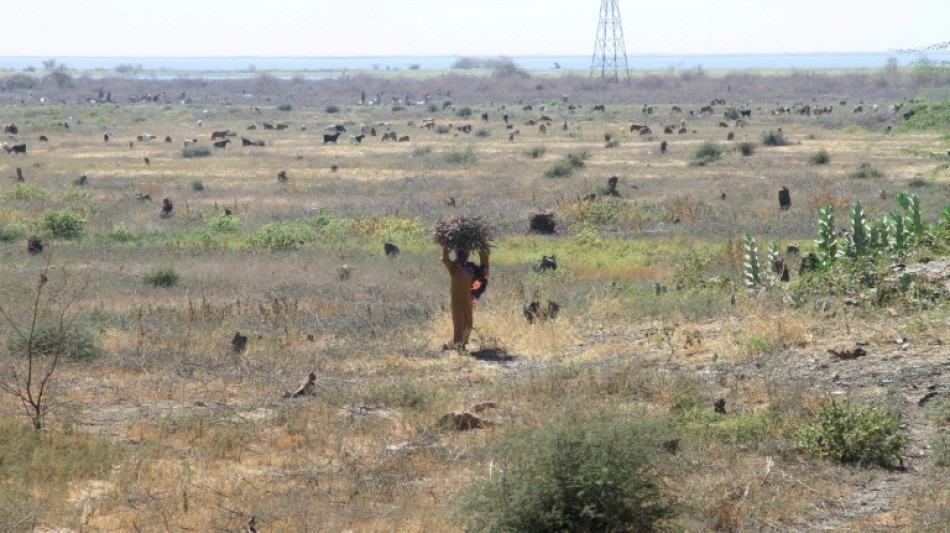
Sudan's historic acacia forest devastated as war fuels logging / Photo: Ebrahim Hamid - AFP

 Putin's party set to retain power after Russia vote hit by cyberattacks, drones
 Germany's Merz under pressure after bruising state election losses

 Messi, Miami frustrated in 2-2 draw with San Diego

 Thousands march in France against 'licence to kill' draft law

 Forest fire threatens tourist town in Colombian Andes

 Torres on target again as PSG beat 10-man Marseille in Ligue 1

 Germany's Merz vows to stay course despite new election defeats

 Carrick demands Man Utd response after 'pathetic' jibes

 Liverpool boss Iraola urges Isak to raise his level

 Evenepoel wins record 4th straight world time-trial title

 France's Macron, Canada's Carney announce closer ties
 Carrick defends troubled Man Utd after Fulham escape

 Horror movie 'Resident Evil' tops N. American box office

 Germany's Merz vows to stay course despite new vote losses

 Man City outgun Sunderland despite Brobbey hat-trick, Man Utd rescue Fulham draw

 Mourinho blames ref committee for Real Madrid derby defeat

 Maresca craves a 1-0 win after eight-goal Man City thriller

 Atletico Madrid beat Real Madrid in tense derby clash

 Reusser retains world time-trial title

 Man City outgun Sunderland despite Brobbey hat-trick, Liverpool win at Bournemouth

 Top US, Chinese economic officials meet ahead of Trump-Xi summit
 Erdogan's LGBTQ crackdown 'first step of election campaign': activist

 Mass drone barrage on Moscow kills two

 82-year-old dies after beach fight in Greece over sun lounger

 US warns of rapid escalation in Mideast war

Vast stretches of a once-verdant acacia forest south of Sudan's capital Khartoum have been reduced to little more than fields of stumps as nearly three years of conflict have fuelled deforestation.
What was once a 1,500-hectare natural reserve has been "completely wiped out", Boushra Hamed, head of environmental affairs for Khartoum state, told AFP.
Al-Sunut forest had long served as a haven for migratory birds and a vital green shield against the Nile's seasonal floods.
"During the war, Khartoum state has lost 60 percent of its green cover," Hamed said, describing how century-old trees "were cut down with electric saws" for commercial timber and charcoal production.
Where tall acacias once cast cool shade over a wetland just upstream from the confluence of the Blue and White Nile, barren ground now lies exposed, criss-crossed by people gathering whatever wood remains.
Hamed called it "methodical destruction", though the perpetrators remain unknown and there has been no investigation.
Similar devastation is unfolding across several regions -- including western Darfur, neighbouring Kordofan and the central states of Sennar and Al-Jazirah -- as insecurity and economic collapse drive unchecked logging, according to Sudan's Forests National Corporation.
According to a 2019 study by the Nairobi-based African Forest Forum, Sudan had already lost nearly half of its forested land since 1960 due to agricultural expansion, firewood collection and overgrazing.
By 2015, the country ranked among Africa's least forested nations, with around 10 percent of its territory still covered by woodland, the study said.
The report had also warned of further degradation if reforestation and sustainable management efforts were not implemented -- concerns now compounded by the ongoing conflict.
- 'Barrier' -
Aboubakr Al-Tayeb, who oversees Khartoum's forestry administration, said the damage "affects not only Khartoum, but Sudan and the wider African continent."
"The forest was home to several migratory species from Europe," he told AFP.
More than a hundred bird species, including ducks, geese, terns, ibis, herons, eagles and vultures, had been recorded in the area, alongside monkeys and small mammals.
Al-Nazir Ali Babiker, an agronomist, said the loss of tree cover could cause more severe seasonal flooding because the "forest acted as a barrier" against rising waters.
Flooding strikes Sudan every year, destroying homes, farmland and infrastructure and leaving many families with no choice but to flee to safer areas.
The war in Sudan, which erupted in April 2023, has already killed tens of thousands, displaced 11 million and shattered critical infrastructure.
Before the fighting, forests supplied roughly 70 percent of Sudan's energy consumption, primarily through charcoal and firewood, according to data from the African Forest Forum.
Al-Sunut had also been a popular leisure spot for Khartoum residents.
"We used to come in groups to study and have a good time," recalls Adam Hafiz Ibrahim, a student at Omdurman Islamic University.
Today, wood gatherers have supplanted the usual walkers. Disregarding army notices alerting them to landmines, men and women traverse the dry, open ground that now stands where the ancient forest once grew.
"We're not cutting the trees. We just pick up whatever wood's already on the ground to use for the fire," said Nafisa, a woman in her forties navigating the dry grasslands.
"We found the trees down. We collect the wood to sell to bakeries and families," said Mohamed Zakaria, a construction worker who lost his job because of the war.
Experts say that the economic hardship caused by the war combined with a lack of enforcement has encouraged logging.
"The logging continues, because those responsible for forest protection cannot access many areas," said Mousa el-Sofori, head of Sudan's Forests National Corporation.
Efforts to replant acacias are underway, Tayeb of the Khartoum forestry administration said, but seedlings grow slowly and can take years to mature.
Restoring the lost woodlands would be "long and costly", said Sofori.
"Some of these forests were centuries old," he added.
V.Fontes--PC