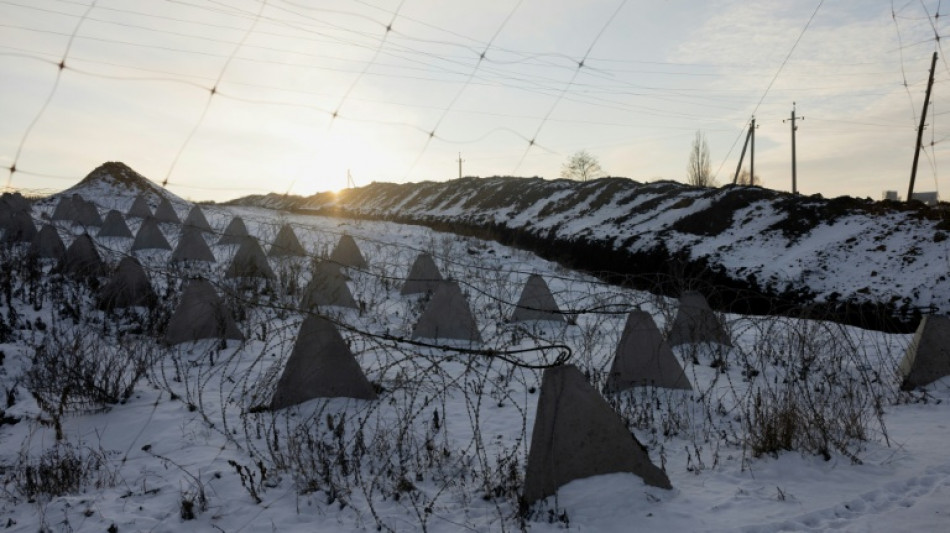
Starlink loss a blow to Russian forces in Ukraine: experts / Photo: Tetiana DZHAFAROVA - AFP

 Putin's party set to retain power after Russia vote hit by cyberattacks, drones

 Germany's Merz under pressure after bruising state election losses

 Messi, Miami frustrated in 2-2 draw with San Diego

 Thousands march in France against 'licence to kill' draft law

 Forest fire threatens tourist town in Colombian Andes

 Torres on target again as PSG beat 10-man Marseille in Ligue 1

 Germany's Merz vows to stay course despite new election defeats

 Carrick demands Man Utd response after 'pathetic' jibes

 Liverpool boss Iraola urges Isak to raise his level
 Evenepoel wins record 4th straight world time-trial title

 France's Macron, Canada's Carney announce closer ties
 Carrick defends troubled Man Utd after Fulham escape

 Horror movie 'Resident Evil' tops N. American box office

 Germany's Merz vows to stay course despite new vote losses

 Man City outgun Sunderland despite Brobbey hat-trick, Man Utd rescue Fulham draw

 Mourinho blames ref committee for Real Madrid derby defeat

 Maresca craves a 1-0 win after eight-goal Man City thriller
 Atletico Madrid beat Real Madrid in tense derby clash
 Reusser retains world time-trial title

 Man City outgun Sunderland despite Brobbey hat-trick, Liverpool win at Bournemouth

 Top US, Chinese economic officials meet ahead of Trump-Xi summit
 Erdogan's LGBTQ crackdown 'first step of election campaign': activist
 Mass drone barrage on Moscow kills two

 82-year-old dies after beach fight in Greece over sun lounger

 US warns of rapid escalation in Mideast war

US tech titan Elon Musk's move to cut Russian access to his Starlink satellites over Ukraine has probably disrupted Russian forces' tactical command and restricted their offensive capacity, but the war goes on.
Here is what we know about the importance of Starlink to Russia and in the Ukraine conflict:
- Critical command and control role -
Linking Russian drones to the Starlink satellites operated by Musk's SpaceX company makes them more accurate, extends their range and makes them more difficult to block.
The satellites are also important for Russia's command and control, "the organisation of the operational chain that allows the military at the top to give orders to all levels of responsibility, down to the combatants," said a western military source.
"All armies that have a little money and need bandwidth use Starlink. It's flexible, it's not expensive, and it complements military systems that do not allow for increased bandwidth," the source added.
In the Ukraine conflict, the US satellites "gave Russian units real-time control over their forces and drones, to have an overview of the line of contact" so they could make better decisions, Yuriy Fedorenko, commander of the Ukrainian 429th Achilles Drone Brigade told Freedom TV.
The satellites are even more important as there is no real front line where the Russia and Ukrainian armies are in contact, according to a high-ranking European officer.
"It is a 'kill zone' several kilometers (miles) wide, patrolled by drones, where small mobile squads operate, trying to strike here and there," the officer told AFP.
"Many Russian soldiers constantly move through the area. These are critical points," Serhii Beskrestnov, a technology advisor to the Ukrainian defence ministry, told AFP.
- Blackout fallout -
Ukraine says that blocking Starlink has an enormous impact on Russian forces. AFP has not been able to independently assess the fallout.
"For the Russians, this is not just a problem, it is a catastrophe," said Beskrestnov. "We knew that they used Starlink on the front", but "we did not believe that it was this crucial."
The Russian side played down the consequences. Valery Tishkov, a communications official for the Russian military, said that Starlink was only used marginally and that the army "has all modern, domestically-produced communication services. The operations control system functions reliably and ensures the command and control of troops at the front."
- How will Russia adapt? -
According to several Ukrainian sources, Russia has sought to pay Ukrainians to organise legitimate Starlink accounts that it can then use for its drones at the front. Ukraine's SBU security service has warned that this is a crime punishable by a sentence jail of life.
Russia has deployed alternative solutions, according to the Ukrainian sources, but these are not as reliable as Starlink's low orbiting network. Russia has instead used its Yamal and Express geo-stationary satellites that are higher up and there are fewer of them.
"They need a satellite receiver equipped with a large parabolic antenna," said Beskrestnov.
These are now a prime target for Ukrainian forces and Russia has had to move back the antennae by 10-15 kilometers (six to nine miles) and deploy reinforced wi-fi from the receivers to the front lines.
"We are trying to locate these terminals," said the advisor.
- Decisive in conflict? -
Ukrainian forces regained territory from Russia in February, a rare occurrence during the four years of war when they have gradually lost terrain amidst bitter battles that have cost thousands of lives.
On February 5, Russian military observers reported disruption of the Starlink internet terminals used by Moscow on the front lines after Musk took measures following a request from Kyiv.
A senior Ukrainian military official said that counter-attacks had been launched all along the front line in a single day, but gave no further details.
The US-based Institute for the Study of War says that Ukrainian forces are probably taking advantage of Russia's loss of Starlink.
But so far there have been no dramatic changes. The European military source said that "very few troops are making direct contact with opposing soldiers, and there is no mechanised combat (which could force a breakthrough), so progress is very slow."
E.Ramalho--PC