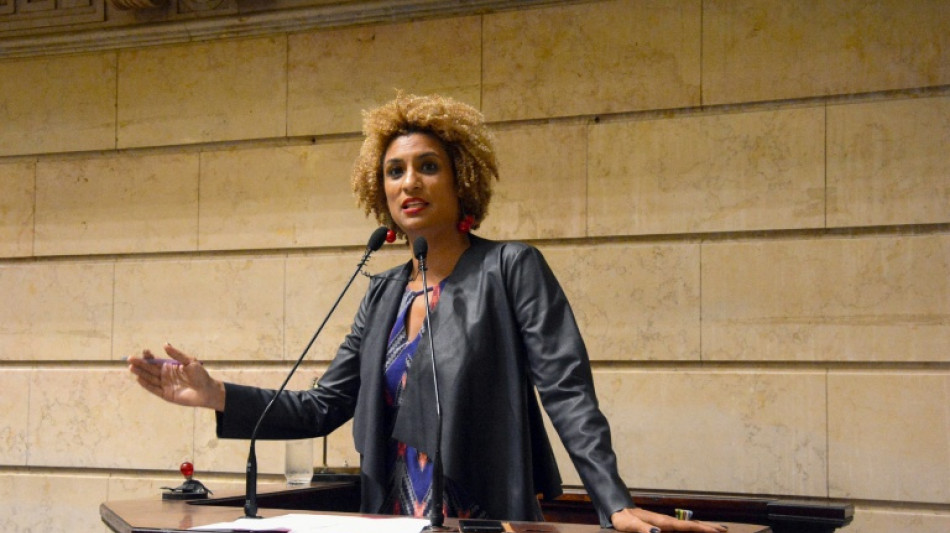
Brazil court tries politicians over hit on Black councilwoman / Photo: Renan OLAZ - Rio de Janeiro Municipal Chamber/AFP/File

 Putin's party set to retain power after Russia vote hit by cyberattacks, drones

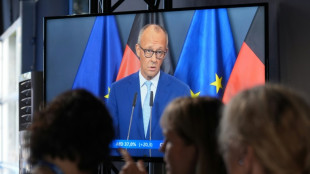
 Germany's Merz under pressure after bruising state election losses

 Messi, Miami frustrated in 2-2 draw with San Diego
 Thousands march in France against 'licence to kill' draft law

 Forest fire threatens tourist town in Colombian Andes

 Torres on target again as PSG beat 10-man Marseille in Ligue 1

 Germany's Merz vows to stay course despite new election defeats

 Carrick demands Man Utd response after 'pathetic' jibes
 Liverpool boss Iraola urges Isak to raise his level
 Evenepoel wins record 4th straight world time-trial title
 France's Macron, Canada's Carney announce closer ties
 Carrick defends troubled Man Utd after Fulham escape
 Horror movie 'Resident Evil' tops N. American box office

 Germany's Merz vows to stay course despite new vote losses
 Man City outgun Sunderland despite Brobbey hat-trick, Man Utd rescue Fulham draw

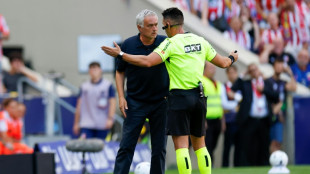 Mourinho blames ref committee for Real Madrid derby defeat
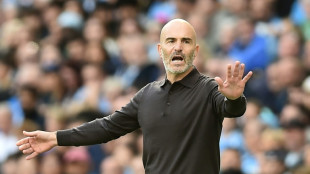 Maresca craves a 1-0 win after eight-goal Man City thriller
 Atletico Madrid beat Real Madrid in tense derby clash
 Reusser retains world time-trial title

 Man City outgun Sunderland despite Brobbey hat-trick, Liverpool win at Bournemouth

 Top US, Chinese economic officials meet ahead of Trump-Xi summit
 Erdogan's LGBTQ crackdown 'first step of election campaign': activist

 Mass drone barrage on Moscow kills two

 82-year-old dies after beach fight in Greece over sun lounger

 US warns of rapid escalation in Mideast war

Brazil's Supreme Court on Tuesday opened the trial of politicians accused of ordering the 2018 murder of Rio de Janeiro councilwoman Marielle Franco, a case that exposed deep ties between politics and organized crime in the city.
Franco, a Black, lesbian activist who grew up in a favela and became an outspoken critic of Rio's powerful militia groups, was 38 when she was gunned down in the city center alongside her driver, Anderson Gomes.
The two former military police officers who carried out the murders were given hefty jail terms in 2024.
The Supreme Court is now trying former federal lawmaker Chiquinho Brazao and his brother Domingos, a former state lawmaker, accused of ordering the assassination.
The prosecution says their motive was Franco's opposition to plans that would have "legalized" land illegally seized by militias that control large parts of the city.
Marielle's sister, Anielle Franco, Brazil's minister of racial equality, was present in the packed courtroom as the trial began along with other family members.
It is "unacceptable that a parliamentarian be murdered," Anielle said before entering the courtroom, adding those behind the crime must be punished.
Franco's widow, Monica Benicio, warned in an editorial in the daily O Globo newspaper that the "criminal ecosystem that killed Marielle continues to operate and extend its tentacles."
Rio's militias emerged around four decades ago when former police officers and security agents created so-called self-defense groups to protect communities from drug gangs.
They quickly evolved into powerful criminal organizations, controlling large parts of the city, extorting residents, seizing public land, and benefiting from high-level political support.
Rivaldo Barbosa, a former police commissioner who first led the investigation, is also being tried for working "to ensure the impunity of those who ordered the killings."
A former military police officer and a former advisor to Domingos Brazao are on trial as well.
The Brazao brothers deny their involvement and have challenged a plea agreement made with shooter Ronnie Lessa, a former military police officer, who confessed to his role in the murder.
Lessa, who was sentenced to 78 years in jail in 2024, said during his trial he was "blinded" and "driven crazy" by the prospect of a million-dollar reward for Franco's murder.
The Supreme Court trial is being led by powerful justice Alexandre de Moraes, who oversaw the conviction of former president Jair Bolsonaro for plotting a failed coup in 2022.
Moraes said the prosecution's case did not rest solely on Lessa's cooperation and that "various pieces of evidence, depositions, and documents" backed up his confession.
F.Cardoso--PC