EU opens door to using US jet fuel as shortages loom / Photo: SEBASTIEN BOZON - AFP

 'Aura' battles leap from social media to Latin America streets

 US, Canada fail to reach trade pact to avert Trump tariffs

 Sudan farms lie barren as El Nino leaves Nile banks dry
 Arctic shipping a daunting prospect in hotly contested region
 In US, rare earths extracted from coal mine wastewater

 Nakashima pounds Fritz, Bejlek beats Keys in Cincinnati upsets

 Canadian negotiator says 'more work to do' on US trade deal

 'Solid' Clark takes solo lead at BMW Championship
 Arteta hails Arsenal's desire after perfect start to title defence

 Betis down Real Sociedad in La Liga opener

 Mexican governor resumes job despite US drug charges

 Arsenal rout Coventry to open Premier League season in style

 Giant-killer Bejlek overhauls Keys to reach Cincinnati semi-finals

 Man Utd agree deal for Brighton midfielder Baleba: reports
 Werro wins Lausanne 800m, well off world record pace

 China mulls bid to host 2028 UN climate talks: sources
 Jones becomes third Englishman to join Inter this summer

 Mexican governor wanted on US drug charges returns to job

 Bolivia's Paz forced to fire economy minister in mid-crisis
 A-Rod ups T-Wolves stake in $4.5bn ownership change
 UK court orders Prince Harry, others to pay Daily Mail initial £9.5mn

 'Grateful' ex-world champion Alaphilippe retires from cycling

 US, Canada work to wrap up trade deal ahead of looming deadline

 Malaysia's JDT claim unbeaten run world record

 At least 2 teens seriously wounded in sword attack at Swedish school

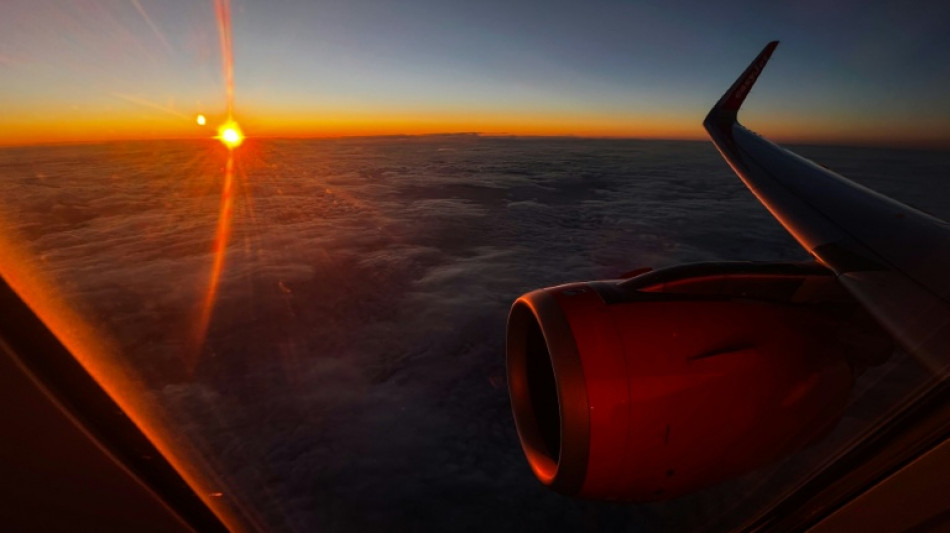
How big is the jet fuel threat to Europe's summer holidays? The EU says it is not facing shortages yet, but it is readying for the worst -- and weighing options including using US kerosene as a back-up.
The US-Israeli war with Iran and the closure of the Strait of Hormuz have sent aviation fuel prices soaring and raised the spectre of shortages during Europe's peak travel season.
On Friday, the EU Aviation Safety Agency (EASA) cleared the way for the use of Jet A, a US-produced aviation fuel that is not currently used in Europe except on return flights from the United States for technical reasons.
In new recommendations, EASA said: "A potential introduction of Jet A in Europe or in other parts of the world would not generate safety concerns provided that its introduction is properly managed."
US-produced Jet A has a higher freezing point from the Jet A‑1 fuel used elsewhere in the world -- making it less resistant to very low temperatures during long-haul flights.
The EASA conditioned its use, warning that its introduction into a system historically running on Jet A‑1 could see "operational" risks when both fuels are used.
At the same time, the European Commission outlined measures available to member states to optimise jet fuel use, including aircraft loading and the allocation of airport slots.
- What about Europe's jet fuel stocks? -
Brussels has repeatedly insisted the 27-nation EU is not yet facing jet fuel shortages.
"At this stage, this is more a problem of economics and fuel costs than availability," Matteo Mirolo, an aviation transport specialist, told AFP.
But "we do have to think about supply, especially as this will not be the last crisis we face."
Before the Middle East war, around 20 percent of the kerosene consumed in Europe transited through the Strait of Hormuz that has been effectively closed by the conflict.
As prices have surged, several airlines, particularly low-cost carriers, have announced flight cancellations.
If the crisis drags on, Brussels is preparing for possible "security of supply issues," EU energy commissioner Dan Jorgensen said Tuesday.
"We are not there yet, but it can happen," Jorgensen said.
The commission said last week it would establish a "fuel observatory" to track EU production, imports, exports and stock levels of transport fuels. It is expected to be up and running in coming days.
Until now, the EU has lacked a detailed overview of strategic fuel stocks across member states.
European legislation requires countries to hold oil stocks equivalent to 90 days of net imports and 61 days of domestic consumption, but does not distinguish between different products such as petrol, diesel or jet fuel.
A commission source said some countries, such as Ireland, are more at risk due to a lack of refining capacity, while others, including Finland, appear better prepared.
The same source also voiced concern some airlines may be using the crisis as an opportunity to drop unprofitable routes.
- What has the EU announced? -
The commission on Friday clarified the rules for governments and airlines on which existing tools can be deployed to ensure jet fuel is used as efficiently as possible and at the lowest possible cost.
It also eased rules restricting "tankering", the practice of aircraft carrying more fuel than necessary to avoid buying more expensive fuel at other airports.
And Brussels confirmed there would be temporary flexibility on airport slots to prevent airlines that exceptionally give up slots because of high fuel costs from being penalised in future slot allocations.
On the sensitive subject of passenger rights, the EU said airlines may be exempt from paying customers compensation if they can prove a cancelled fight was due to "extraordinary circumstances", like a local fuel shortage.
If the crisis drags on, the EU is considering coordinated action by member states to release emergency stocks and voluntarily share jet fuel themselves.
In the longer term, Brussels is also stressing the need to develop non‑fossil sustainable aviation fuels (SAF).
X.Matos--PC