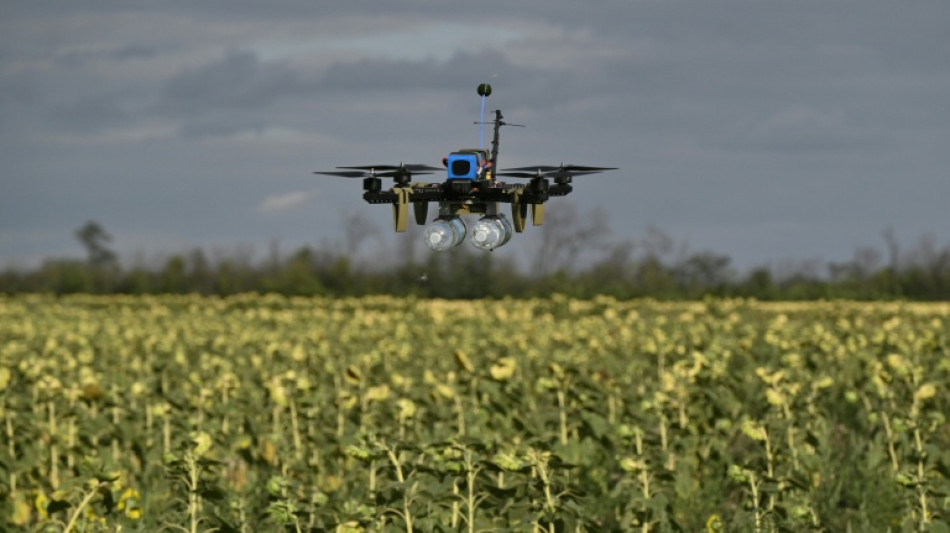
Sci-fi or battlefield reality? Ukraine's bet on drone swarms / Photo: Genya SAVILOV - AFP/File

 Jailed Pakistan ex-PM Khan moved to hospital on court order: party

 Pogacar eyes 'missing' piece ahead of Vuelta return
 US, Canada 'very close' to trade deal, Ottawa says, as details emerge
 Ronaldinho returns in search of 'beautiful' 300th goal

 US pushes allies, China to back Trump's economic war on Iran
 Former NBA MVP Harden reportedly set to return to Cavaliers

 Brook makes Pakistan pay for drop as England dominate first Test
 MemeCore Arrives on Nasdaq Through $1 Billion Landmark Treasury Transaction
 First US deportees land in Liberia
 US, Canada resume talks to finalize trade deal as details emerge

 Europe heatwaves scorch 80 million with 40 C heat: AFP analysis

 Carrick insists Man Utd will make more signings after quiet transfer window

 US warns allies, China to back economic war on Iran

 Manifesto defends Germany's iconic Bauhaus against 'populist attacks'

 Kenya's Kipyegon ends season with hamstring injury

 Nord Stream bomb suspect arrested while working on movie about attack: media
 German football fans plan widespread VAR protests

 Scorching summer triggers record rockfalls in Alps, scientist says

 Newly-crowned European champ Werro turns focus on 800m record

 Hamilton 'fittest ever' as he chases eighth F1 title

 Stocks retreat as bond yield fears persist, oil rises

 ARKBRIDGE’s David Mali Highlights AI-Driven Risk Management at the Finance Magnates London Summit

 Zuckerberg buys Gothic castle in Ireland: spokesman
 Belgium's fire of the century now 'under control'
 Evergrande's Xu Jiayin: from real-estate tycoon to life in prison

Hundreds of AI-controlled robots operating in unison, talking to each other to autonomously attack targets -- a dystopian vision of the future of war that Ukraine's defence industry wants to make a reality.
Four years into the Russian invasion, the idea -- known as drone swarms -- is one of the hottest topics in military tech in a country that describes itself as the world-leader in drone warfare.
"There is a huge interest," military expert Yury Fedorenko told a recent Drone Autonomy conference, held in an undisclosed location in the western Ukrainian city of Lviv.
"No matter who you speak to, they always say: show them to us. Where are they, we want to see!" he added.
The conference was organised by Iron Cluster, a coalition of defence groups operating out of Lviv.
The prospect of drone swarms, groups of drones that can act together and fulfil set tasks without human intervention, has triggered both anxiety and excitement.
"We've been talking about swarm technology for a very long time, and we in the military have been waiting for it even longer," said Volodymyr "Colt", the head of civil-military cooperation at Ukraine's 412th brigade.
"The only question is when it will happen," he added.
- 'A few years' away -
Ukrainian military and defence industry figures told AFP Kyiv had made progress in getting the much-hyped technology off the ground.
Others cautioned it remains some way off and that drone swarms were just one part -- albeit an eye-catching one -- of the much broader race toward autonomous warfare.
The appeal is clear.
The swarms would allow a few operators to deploy dozens or hundreds of attack craft simultaneously -- overwhelming enemy defences and helping Ukraine's army offset Russia's manpower advantage.
"The main purpose is to save the lives of our servicemen," Andrii Lebedenko, the Ukraine armed forces deputy commander-in-chief, told AFP.
"Today we have such projects. They're not large-scale, but they're growing... mass deployment is possible in the coming years," Lebedenko said.
- 'Valid target' -
Defence Minister Mykhailo Fedorov has championed the use of advanced technology to fend off Russian attacks, including launching the Defense AI Center A1.
Its head, Danylo Tsvok, told AFP "drone swarms are currently in the testing phase ... there are a lot of things that we can't say".
Swarmer, a Ukrainian-US company, has emerged as a leader in the field, listing on the US Nasdaq exchange earlier this year
US CEO Alex Finktold AFP the company had been deploying early swarm technology in combat since April 2024.
Its systems can autonomously deploy multiple drones to an area, when human pilots step in to manually engage a target, or operators select targets and the drones carry out the strikes autonomously.
"It's definitely not at the point where we can trust technology to make strategic decisions or even make tactical decisions about what's a valid target," Fink said in a telephone interview.
"We don't want our systems to make that decision. We want the humans to be in charge."
- 'Manhattan Project' -
At the AI defence conference in Lviv, there was some scepticism.
"Drone swarms are totally overhyped... because they make for a good sci-fi story and a visual image," said Yaroslav Azhnyuk, head of the Fourth Law, which specialises in drone autonomy.
Autonomy, he argued, was about more than just drone swarms. It covered everything from navigation, target selection and attack execution -- and could apply to all kinds of drones.
He compared autonomy to the development of Microsoft Word -- concentrating on swarms was like obsessing over the button that makes text italic, instead of the whole programme.
"We're focusing on massively scalable full autonomy," he said.
"This is the Manhattan Project of our era," he added -- a reference to the US WWII initiative that produced the first nuclear weapon.
"Imagine if either the Nazis or the Russians got the nuclear bomb first. That would have been a very, very different world," he said.
"Now imagine if they get the full autonomy first," he said
Russia has set AI and drones as its top military priorities.
It has "likely fielded a fully autonomous unmanned system in combat", according to an April 2026 report by Kateryna Bondar, an expert with the Center for Strategic and International Studies.
Anton Melnyk, co-founder of MITS Capital, set up to fund Ukraine's defence industry was blunt about the stakes involved.
"Either we will achieve this –- the Armed Forces of Ukraine, together with various NATO partners –- or the enemy will."
X.M.Francisco--PC