Ukraine can down Russian drones en masse. But missiles are a problem / Photo: Roman PILIPEY - AFP

 Jailed Pakistan ex-PM Khan moved to hospital on court order: party

 Pogacar eyes 'missing' piece ahead of Vuelta return
 US, Canada 'very close' to trade deal, Ottawa says, as details emerge

 Ronaldinho returns in search of 'beautiful' 300th goal

 US pushes allies, China to back Trump's economic war on Iran
 Former NBA MVP Harden reportedly set to return to Cavaliers

 Brook makes Pakistan pay for drop as England dominate first Test
 MemeCore Arrives on Nasdaq Through $1 Billion Landmark Treasury Transaction
 First US deportees land in Liberia

 US, Canada resume talks to finalize trade deal as details emerge

 Europe heatwaves scorch 80 million with 40 C heat: AFP analysis

 Carrick insists Man Utd will make more signings after quiet transfer window

 US warns allies, China to back economic war on Iran
 Manifesto defends Germany's iconic Bauhaus against 'populist attacks'

 Kenya's Kipyegon ends season with hamstring injury
 Nord Stream bomb suspect arrested while working on movie about attack: media
 German football fans plan widespread VAR protests

 Scorching summer triggers record rockfalls in Alps, scientist says

 Newly-crowned European champ Werro turns focus on 800m record

 Hamilton 'fittest ever' as he chases eighth F1 title

 Stocks retreat as bond yield fears persist, oil rises

 ARKBRIDGE’s David Mali Highlights AI-Driven Risk Management at the Finance Magnates London Summit

 Zuckerberg buys Gothic castle in Ireland: spokesman
 Belgium's fire of the century now 'under control'

 Evergrande's Xu Jiayin: from real-estate tycoon to life in prison

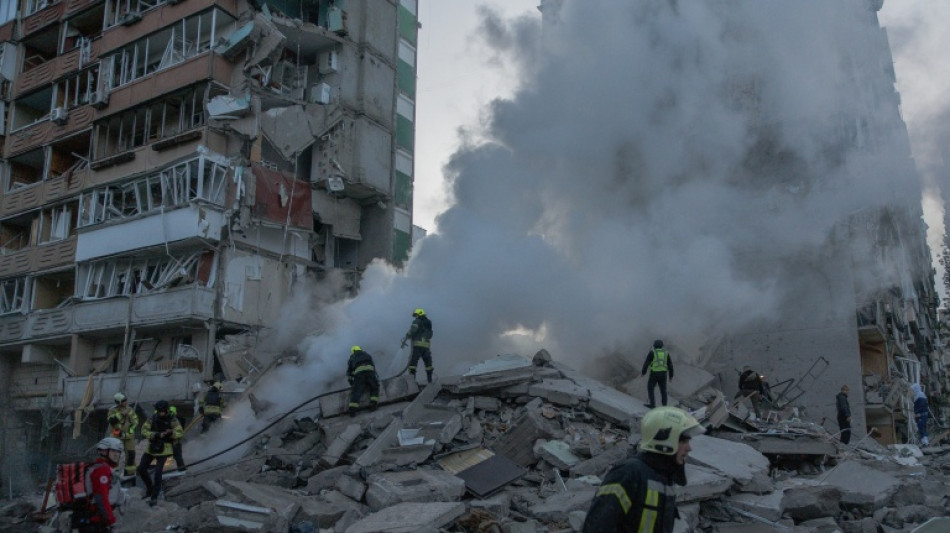
A massive Russian bombardment of Kyiv this week that lit up the night sky, sent thunderous booms echoing through the capital, and killed two dozen civilians, has revealed a stark dichotomy in Ukraine's air defence architecture.
Ukraine -- at war for more than four years -- has become the envy of some of the world's most powerful militaries in combating long-range drones.
But at the same time it is uniquely vulnerable to Russian missiles, and remains almost entirely reliant on its Western allies to counter them.
Russia fired 675 drones and 56 missiles in the seven-hour barrage that ripped open a Kyiv apartment block, killing 24 people.
Ukraine's homegrown air defence network -- electronic jamming systems, anti-aircraft guns, helicopters and jets, and smaller interceptor drones -- took down all but 22 of the Russian drones.
But 15 missiles got through.
For Ukraine, it once again revealed their acute shortage of sophisticated Western anti-missile systems and the expensive ammunition for them.
"The real damage was done by missiles, especially in Kyiv," Sergii Beskrestnov an advisor to the defence minister said in the aftermath of the attack.
President Volodymyr Zelensky praised Ukraine's air force for downing 94 percent of the Russian drones.
But he conceded: "The most difficult challenge is defending against ballistic missiles."
- Ammo is 'hard to find' -
He repeated his call to allies for urgent help, including via the PURL system that Kyiv's partners use to buy US weapons for Ukraine.
After the attack, Britain's Defence Minister John Healey said he had "directed for UK deliveries of air defence and counter-drone systems to be accelerated as fast as possible."
But the war in the Middle East -- which saw US allies expend huge quantities of air defence ammunition protecting sites in the Gulf -- has exacerbated a shortage Ukraine has faced since the start of the war.
Ammunition for the US-made Patriot batteries that Ukraine uses can cost around $4 million apiece.
The United States produces only around 600 per year, and several can be needed to down a single ballistic missile.
Zelensky has said that Middle East countries used 800 PAC-3 interceptors to counter Iranian drones and other projectiles, adding that Ukraine had never had that many during its war.
A senior Ukrainian put the problem with missile interceptors for air defence batteries in stark terms to AFP: "They've become harder to find."
Just days before Russia unleashed its latest barrage, a representative of the Ukrainian air force told state media that ammunition was already being rationed due to "supply problems."
"The launchers that are part of certain units and batteries are half-empty -- and that's putting it mildly. They have a limited number of missiles," the official, Yuriy Ignat, said.
He added that Ukraine's stockpiles were already low following a devastating Russian campaign against Ukrainian energy facilities over the winter.
Air force representatives are sometimes negotiating with allies for as little as between 5 and 10 missiles for Western supplies systems, like Patriot batteries, he said.
- Few short term options -
The war in the Middle East may also present a solution for Kyiv.
Ukraine's success in drone warfare has attracted the attention of rich Gulf states that have been targeted with the same types of Iranian-designed drones that Ukraine is now well versed in countering.
Zelensky, on several visits to the region, has inked various air defence agreements with many countries in the region.
The details have not been revealed, but he had earlier proposed sharing Kyiv's anti-drone expertise in return for Patriot ammunition or investment in Ukraine's defence industry.
Lockheed Martin, the US-based producer of PAC-3 Patriot batteries plans to ramp up production over the next seven years.
Over the long-term, Ukraine can also expand its domestic capacities with help from allies.
But options to fend off the attacks Ukraine is facing right now are limited, said Jade McGlynn, Research Fellow at the Department of War Studies, King's College London.
"Bluntly I can't see any significant solution or significant improvement that's available in the short term, beyond just giving Ukraine more, more of the air defence systems that are a bit more available than the Patriots," she told AFP.
F.Ferraz--PC