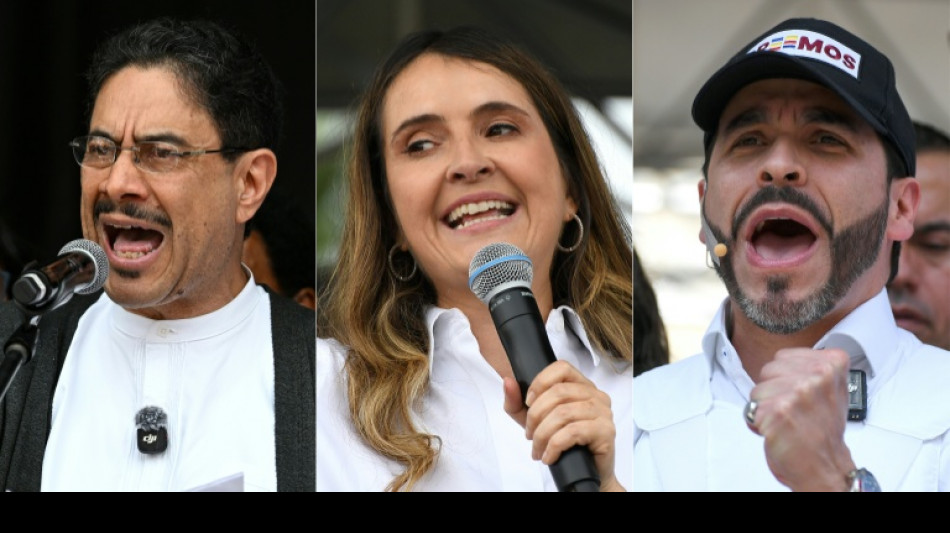
Colombia vote tests leftist rule as violence surges / Photo: Raul ARBOLEDA, Jaime SALDARRIAGA, Jaime SALDARRIAGA - AFP/File

 Mali jails junta-critic broadcaster, influencer for seven years

 'Nowhere to run': Indonesian quake survivors plead for help
 Belgium fire makes 'limited' spread overnight, more help on way

 Vingegaard brings curtain down on season
 Dickwella, Dinusha hit fifties as Sri Lanka fight back

 Bangladesh Test cricket reboot delivers in style with historic win

 Virgin moves closer to launching Eurostar rival in 2030
 Indian marble waste dump becomes unlikely tourist attraction

 Coach says Australia 'let standards slip' in shock Bangladesh loss

 Hawaii recovery efforts begin as Lala downgraded, moves west

 Food safety crackdown snares Mumbai's famed restaurants
 Trump says US scaling back military drills with Seoul hours before start
 Nearly 13,000 displaced after deadly Indonesian quake
 Axe hangs over Australian batters after Darwin 'disaster'

 Is this cave in Turkey where Homer wrote 'The Odyssey'?
 Winning back walls from gangs, artists fill El Salvador's towns with color

 Opening arguments expected in Tupac murder trial

 As machinery removes rubble, hopes for survivors from Colombian quake dwindle

 Trump says US scaling back military drills with South Korea

 Zambia's Hichilema takes early lead in reelection bid
 Sabalenka squeezes out a win on sixth match point in Cincinnati

 Duplantis dominant, Hunt hits four and Asher-Smith makes history

 Spanish soldier dies in Aragon wildfire

 PSG beaten by Lens in French Champions' Trophy

 Rybakina, Andreeva race into Cincinnati third round

Colombians vote Sunday in a presidential election overshadowed by a surge in violence, facing a stark choice between extending four years of leftist rule or shifting sharply right.
Barred from re-election, President Gustavo Petro leaves office after a turbulent term marked by car bombs, explosive drones and the assassination of a presidential candidate.
But joblessness has fallen and wages have risen, and polls show Petro's protege, leftist Senator Ivan Cepeda, 63, as the front‑runner.
The son of a slain senator, Cepeda has pledged to extend social programs and continue peace talks with armed groups, despite limited results.
"I give him my vote because my life changed under this government," said 23-year-old Natalia Rojas, a design student in Bogota and a beneficiary of a subsidized education program.
To win outright, Cepeda must secure more than half the vote.
Polls predict a June 21 runoff against right‑wing lawyer Abelardo de la Espriella.
Nicknamed "the Tiger," the 47‑year‑old millionaire has no political experience and runs an eccentric campaign. He campaigns in a bulletproof vest and delivers a hardline security message.
In an interview during the campaign, he told AFP he would seek US backing for a 90-day campaign of airstrikes and crop fumigation against cocaine-producing armed groups if elected.
"What De la Espriella wants is to put the house in order," said Wilmer Bolivar, a 47‑year‑old ex‑soldier.
He compared the approach to El Salvador's popular president Nayib Bukele.
The comparison is not accidental. De la Espriella has backed building Bukele-style megaprisons and his facial hair bears more than a passing resemblance to the Salvadoran leader.
But De la Espriella faces a tight race for second against opposition Senator Paloma Valencia, aged 50. She is backed by political kingmaker and former president Alvaro Uribe.
- Deeply polarizing -
Petro led Colombia's first-ever leftist government and has been deeply polarizing.
Poorer Colombians cheer his investment in social programs and the raising of the minimum wage. Unemployment fell, partly driven by state hiring.
The country remains one of the most economically unequal in the world.
"This election is marked by class struggle," said political scientist Alvaro Forero. "That is Petro’s main electoral ammunition," he told AFP.
To critics, Petro is erratic and his policy of "total peace" has let armed groups run rampant.
The policy has so far failed to demobilize armed groups that survived the 2016 FARC peace deal.
Experts say armed groups used talks to strengthen themselves.
Colombia remains the world's largest cocaine producer, and much of the violence is tied to drug trafficking.
Juanita Goebertus of Human Rights Watch said "2025 was a very bad year" for the country. Kidnappings more than doubled and displacement hit its highest level in nearly 20 years.
- Challenges -
Each candidate has faced serious threats throughout the campaign.
Last year's killing of right‑wing candidate Miguel Uribe has left many Colombians nervous about a return to the bad old days.
Rising drug trafficking also strained relations between Petro and US President Donald Trump. The dispute escalated into mutual insults and nearly derailed longstanding security cooperation.
Whoever wins will inherit a country with serious security problems and a fiscal deficit that has ballooned to seven percent of GDP.
Petro inherited a weak post‑pandemic economy, but since then tax collection has severely lagged behind bumper social spending.
"What's at stake is continuing Petro's change agenda or rejecting it," Forero said.
E.Paulino--PC