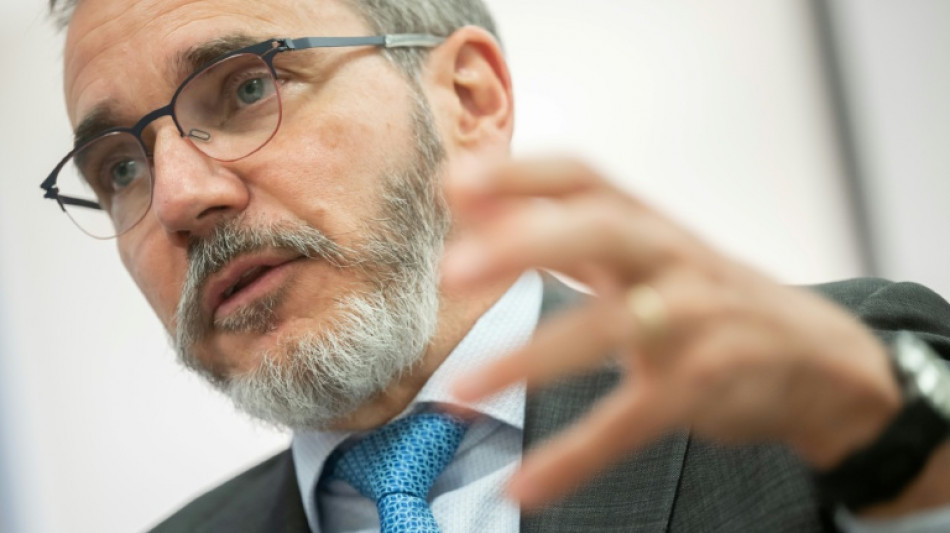
Globalization isn't dead, just 'transformed,' says IMF chief economist / Photo: SAUL LOEB - AFP

 All Blacks knew Nonu would perform solo Haka - coach Rennie

 Britain's Glave upstages Jacobs to win European 100m gold

 Greece's Tentoglou wins fourth European long jump title

 Doctors ignored 'warning signs' before Maradona's death, court hears

 Pereira, the 'zombie city' devastated by Colombia's earthquake

 UN says 2 staff arrested by Afghan intelligence agency
 Colombia scrambles to find survivors as quake kills 240

 Ramsay-Peaty out of medals as Italy's Martinenghi wins European gold

 AI firm Manus to resume 'independent' operations after China blocks Meta deal
 Caught between great powers: the cautionary tale of Manus

 Heatwave hits evicted families sleeping rough in Rome

 US company stokes Greenland tensions by unloading drilling gear

 Cambridge academic in plagiarism row publishes memoir

 LeBron's Sixers hope to spoil Knicks party on NBA opening night
 UK 'on course' to record warmest summer for second year in a row

 Spotify to launch badge identifying AI music

 New plastic treaty document criticised for weaker ambition

 Hungary parliament approves Orban-critic judge as president
 Ebola outbreak in DR Congo kills more than 2,000
 ChargeAfter Powers BYLD Finance Expansion into Consumer Financing for Equipment Retailers

 MEXC Upgrades RealStocks With Three New Features to Enhance U.S. Stock Trading Experience

 Israel demolishes home of slain Palestinian involved in deadly West Bank clash

 Liverpool fans seek clarity on Bezos bid to buy stake

 Solar eclipse sparks scramble for protective glasses across Europe

 Oil prices jump as US-Iran deal hopes falter

While the global economy has faced shocks and trade turmoil, globalization is not dead -- it is simply being "transformed," the International Monetary Fund's chief economist told AFP Friday in an exclusive interview.
The world's lender of last resort will release an update to its World Economic Outlook on July 8, with all eyes on whether -- or how far -- it revises down growth estimates from its April update due to the economic fallout of the US-Israeli war on Iran.
By then, however, Chief Economist Pierre-Olivier Gourinchas will have moved on after completing a four-and-a-half year tenure that saw the IMF grapple with the economic fallout from the Covid-19 pandemic, Russia's invasion of Ukraine, Washington's upending of global trade through tariffs and the recent war on Iran.
Reflecting on a tumultuous time for the world economy, Gourinchas remains confident that recent upheaval in global trade caused by US President Donald Trump's tariffs are not necessarily ending globalization -- just adjusting certain bilateral relationships.
"Well, it's certainly not dead," he told AFP in his office at the IMF's headquarters in Washington, pointing to solid global trade-to-GDP ratios.
"We haven't experienced de-globalization," he said. "We have experienced (that) it's being transformed."
Gourinchas, a 57-year-old Frenchman, said the latest movements should be seen mainly as "a desire to reduce the bilateral level of trade between the US and China. I don't think that is something that is a mystery for anyone."
Since returning to office for a second term, Trump has targeted US friends and foes alike with punishing tariffs, saying he intends to rebase manufacturing to the homeland and to address what he terms unfair trade practices.
Treasury Secretary Scott Bessent and US Trade Representative Jamieson Greer have described globalization as having taken economic integration too far, causing economic pain for American households while benefiting those abroad.
For Gourinchas, however, the latest trade turmoil -- which has seen major US trading partners retaliate with tariffs of their own -- has provided opportunities, too.
"Other actors have stepped in," he said. "The supply chains have adapted, the Mexico's, the Vietnam's of the world have stepped in... the connector countries that have been able to grow on the back of this."
Still, it depends on how far Washington and other advanced economies push this fragmentation of the global economy, he said.
"If the strategy is not just to disengage from China, but it's to disengage more globally -- which I don't think it is, by the way -- I don't think it's sustainable," he said.
He is skeptical, too, on whether the drive to move industries to the United States will end up boosting employment, saying it is "very, very hard" to see that happening. New factories in advanced economies are expected to rely heavily on technology and employ fewer workers.
- 'Middle-income trap' -
For the world's emerging market countries, there is another challenge in a fragmenting world economy: What will drive their own growth, if not demand from larger economies?
The last decade has seen growth in developing countries stall, with the World Bank's Chief Economist Indermit Gill referring to it as a "lost decade" for many.
Gourinchas said that emerging economies had shown remarkable resilience through the shocks of the last five years, mainly due to greater supply-chain integration -- but that resilience was not infinite.
"There is this concern about potentially having a middle-income trap for many emerging market economies," he said, pointing to limited sources of growth in a world where advanced economies were turning inwards.
Since the 1990s, China has been seen as a shining example to be emulated by developing nations -- an economy that capitalized on cost disparities to create an export-oriented growth model that it rode to vast success.
But in a world where advanced economies are potentially "closing up," while China continues to provide cut-throat competition on manufacturing costs, can any of these emerging economies use the same path Beijing did?
"That leaves a very narrow space for them to actually enter into an export-led growth model, which has been the recipe for development and success for many, many countries," Gourinchas said.
"A country like India, for instance, is very unsure whether it can follow in the footsteps of China," he said.
After the IMF, Gourinchas will be headed back to a career in academia at the University of California, Berkeley.
S.Pimentel--PC