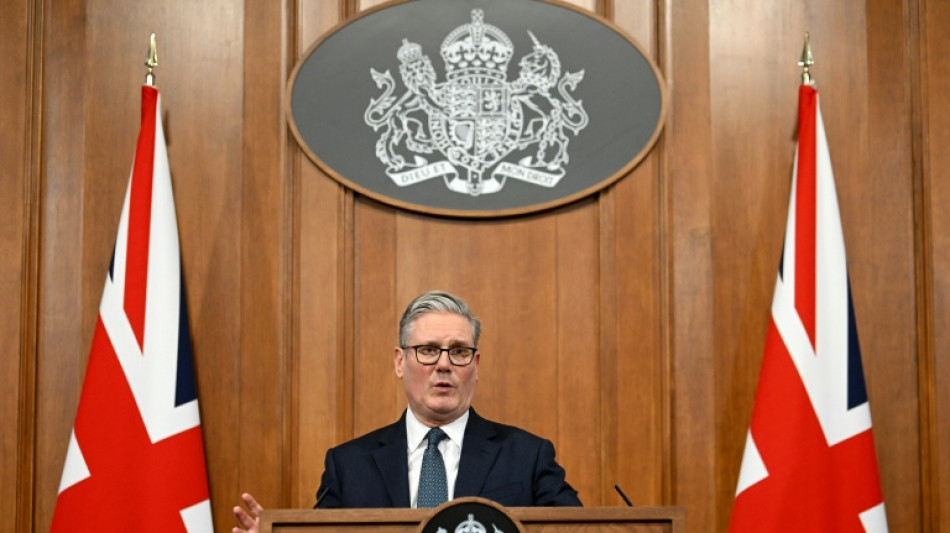
Outgoing UK PM Starmer announces 'record' defence spending / Photo: Jaimi Joy - POOL/AFP

 US warns of rapid escalation in Mideast war
 Iran 'put hearts on the court' to win Asian Games basketball bronze

 School girl Yu helps China dominate in Asian Games swimming openers

 Myanmar win first Asian Games teqball gold as Spain great Puyol watches

 China's 13-year-old Yu scorches to first major gold at Asian Games

 Russians vote on last day of parliamentary elections

 Hong Kong pays final respects to former city leader Tung

 Typhoon put people off Asian Games opening ceremony, official says

 China's 13-year-old Yu cruises as Asian Games swimming begins

 AI 'warning shots' focus Beijing on national security risks

 Philippine tribe in limbo over US-led tech hub

 Leo XIV, first US pope transcends his restrained style

 Singer Ed Sheeran says Gaza situation 'unjustifiable' following controversy

 In 'Tenzing', a Sherpa mountaineer gets his due

 Ed Sheeran set to return to stage after Palestinian controversy

 Toulouse edge Vannes, Lyon beat Pau to take Top 14 summit

 Germans arrested for Louvre stunt in Mona Lisa hall

 Saudi-led coalition says Houthis fired ballistic missile at Riyadh

 France's debt climbs to highest since 1978: ministry

 McIlroy two shots off the lead at Wentworth after eagle on 18

 Martinez brace saves Inter in Serie A top-two clash with Roma

 Rosenior abused but guides Paris FC past old club Strasbourg

 Seven-try Lyon beat Pau, climb to Top 14 summit

 Brighton defeat a 'big lesson' against complacency for Arsenal, says Arteta

 Thousands protest inaction over climate crisis in Switzerland

Outgoing UK Prime Minister Keir Starmer said on Tuesday that Britain would spend a "record" of almost £300 billion ($397 billion) over the next four years to modernise its armed forces in the face of rising threats.
Starmer, expected to leave office next month after losing the support of Labour members of parliament, announced an extra £15 billion for defence spending up to 2030 when he launched his long-awaited Defence Investment Plan (DIP).
The plan, due to be published later on Tuesday, will see increased money for drones and autonomous systems as the nature of modern warfare changes.
"This record investment puts the security of the British public first, transforming our armed forces and giving them the funding and equipment they need to fight and defend our nation," Starmer said.
The plan follows months of wrangling within the Labour government over the resources required to modernise Britain's fighting capabilities to counter greater aggression from countries such as Russia, and a less reliable United States.
Two defence ministers quit earlier this month in a row over the defence plan, including defence secretary John Healey who said it risked making Britain "less safe".
The resignations highlighted Starmer's weakening authority.
He announced on June 22 he was stepping down after MPs from his ruling Labour party switched their support to veteran politician Andy Burnham.
Burnham, the 56-year-old former Greater Manchester mayor, will take over as prime minister in mid-July if he faces no challengers for the Labour leadership.
Starmer has called the defence plan "game-changing investment".
"I am absolutely certain that this is the platform on which whoever comes after me can build," he told reporters on Tuesday.
- 'Hybrid' vessels -
The plan includes more than £5.0 billion for drones and autonomous systems over the next four years, the Ministry of Defence (MoD) said in a press release.
The investment will see capabilities ranging from "highly complex autonomous mine-hunting drones to small 'quadcopter' tactical drones, and low-cost 'kamikaze' one-way attack drones", the MoD added.
The wars in Ukraine and Iran have highlighted the increased use of war-fighting robots.
Ukraine uses roughly 200,000 drones a month to defend itself from Russia's invasion, while at the height of the US-Israel-Iran conflict 700 offensive drones were being launched per day, the MoD said.
US President Donald Trump has demanded that NATO members spend five percent of economic growth on defence by 2035 and become less reliant on Washington for security.
Starmer said the defence plan will take defence spending to 4.2 percent of gross domestic product.
The £15 billion uplift is well short of the £28 billion that military leaders previously said was needed.
The opposition Conservatives' defence spokesperson, James Cartlidge, said the plan was "too little, too late".
"The plan is now almost a year overdue and only being rushed through because Keir Starmer is desperate for a legacy," he added.
On Monday, the government announced that from the early 2030s Britain will replace its six ageing destroyer warships with at least six "hybrid" vessels that will "mix crewed and uncrewed capabilities".
A.Aguiar--PC