
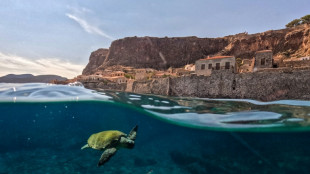
Nature does not respect borders: UN biodiversity chief / Photo: ANDREJ IVANOV - AFP

 Man City charges cloud hangs over Premier League season

 Top NATO commander set to issue warning to Russia over any attack
 Software, sprints, trolls: Singapore Grand Prix talking points

 Riyadh airport hit by fresh Houthi strike day after deadly attack

 Policymakers take on energy shock, rising debt at IMF-World Bank meetings
 Raphael Glucksmann elected centre-left French presidential candidate

 'Dizzy' Lazio join Inter at top of Serie A as Roma, Juve and Milan held

 Jaguars edge Eagles as Packers beat Bears

 Rays chase first MLB crown as Guardians try to snap drought
 Hurricane Simon churns off Mexican coast after shift in course
 'Dizzy' Lazio join Inter at top of Serie A as Roma and AC Milan held

 Man City must make 'own noise' amid financial scandal, says Maresca

 Jaguars down Eagles with wild field goal finish in London

 Sadaqat, Imran help Pakistan thump Sri Lanka to seal T20 series

 Man City shrug off uncertain future to beat 10-man Liverpool
 Conservation groups alarmed at marine mammals' deaths in Spain

 Tens of thousands urge climate action at Brussels demo

 Norway's Hagenes wins historic Paris-Tours classic

 Kipruto claims Chicago Marathon as Feysa defends women's title
 Forest boss Glasner loses on return to Palace, Hull hold Everton

 'Sorry boys': Hamilton takes blame for botched tyre call

 Resurgent Verstappen wins Singapore Grand Prix for first time

 Verstappen wins Singapore Grand Prix for first time

 Djibouti boat wreck leaves 139 migrants dead, 84 missing: UN

 Drone hits Russia's Yandex in third reported attack

War, economic pressure, budget strain -- United Nations biodiversity chief Astrid Schomaker is under no illusions that the upcoming UN nature summit (COP17) is taking place "in some kind of geopolitical vacuum".
"I don't want to be naive," said Schomaker of the headwinds surrounding the biennial negotiations on protecting the natural world that start on October 19 in Yerevan, Armenia.
"Clearly, geopolitics enter also the debate on biodiversity," the executive secretary of the Convention on Biological Diversity (CBD) told AFP in English from Montreal.
Nearly 200 nations must nevertheless find a way forward at the Yerevan summit after falling behind on their pledge to halt the destruction of nature by 2030.
Most of the global targets they set four years ago -- from tackling invasive species to conserving 30 percent of land and oceans, slashing pollution and protecting threatened species -- are off-track.
But Schomaker remains cautiously optimistic that countries can overcome their differences.
"Multilateralism needs to prove its value when things are difficult... We have always been able to move forward, despite the difficulties," she said.
- Competing priorities -
Most of the world's nations signed the landmark international nature pact in 2022.
The United States was a notable exception. It is not a party to the UN biodiversity convention and does not participate in the negotiations.
That's not to say its influence won't be felt at the Yerevan nature summit or the UN climate negotiations (COP31) starting on November 9 in Turkey.
The US midterm elections, conflicts in the Middle East and Ukraine, and concerns over high energy and commodity prices are expected to stalk both conferences.
"There are conflicts around the world, economic pressures, debt and a lot of, let's say, competing demands on government's attention," said Schomaker.
"But on the other hand, nature is recognised as one of those issues that does not respect political borders."
She pointed to food and water security as problems that countries cannot solve alone.
Ahead of the Yerevan summit, Schomaker's secretariat is finalising a global scorecard on progress toward the 2030 goals.
She described the picture as "mixed", with improvements slow and uneven.
"I think it's too early to say whether any of the targets will be reached or not reached," she said.
"But I think we can clearly say they're all still reachable -- but only with significant changes being made."
- Nature peril -
With public finances under strain, Schomaker said COP17 in Armenia would focus on ways to better engage the private sector in helping close the $700-billion annual funding shortfall for the 2030 nature protection goals.
It would also examine why the Cali Fund -- a UN financial instrument launched in February 2025 aiming to attract $1 billion a year in corporate contributions -- had raised only $6,000.
"The beginning has been slower than we had hoped," Schomaker acknowledged.
But the challenge is not just finding new pots of money, she said.
"Finance is always a bit the elephant in the room. Not in the sense there's no money around, but where the money is actually going."
Governments spend $2.6 trillion a year on environmentally harmful subsidies, according to the United Nations.
For every $1 invested in protecting or restoring nature, about $30 still goes into activities that degrade it, according to UN figures.
Schomaker said economic incentives needed to work with nature, not against it.
"This sounds theoretical and naive but you know you destroy nature at your peril and I think we see around the world the consequences of nature degradation," she said.
P.Serra--PC