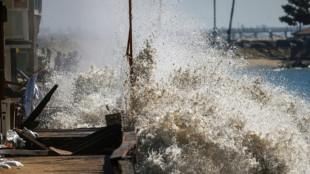
El Nino sets temperature record in key Pacific zone: EU monitor / Photo: Gerardo MENOSCAL - AFP/File

 Man City charges cloud hangs over Premier League season

 Top NATO commander set to issue warning to Russia over any attack

 Software, sprints, trolls: Singapore Grand Prix talking points

 Riyadh airport hit by fresh Houthi strike day after deadly attack

 Policymakers take on energy shock, rising debt at IMF-World Bank meetings

 Raphael Glucksmann elected centre-left French presidential candidate

 'Dizzy' Lazio join Inter at top of Serie A as Roma, Juve and Milan held

 Jaguars edge Eagles as Packers beat Bears

 Rays chase first MLB crown as Guardians try to snap drought

 Hurricane Simon churns off Mexican coast after shift in course

 'Dizzy' Lazio join Inter at top of Serie A as Roma and AC Milan held

 Man City must make 'own noise' amid financial scandal, says Maresca

 Jaguars down Eagles with wild field goal finish in London

 Sadaqat, Imran help Pakistan thump Sri Lanka to seal T20 series

 Man City shrug off uncertain future to beat 10-man Liverpool

 Conservation groups alarmed at marine mammals' deaths in Spain

 Tens of thousands urge climate action at Brussels demo

 Norway's Hagenes wins historic Paris-Tours classic

 Kipruto claims Chicago Marathon as Feysa defends women's title

 Forest boss Glasner loses on return to Palace, Hull hold Everton

 'Sorry boys': Hamilton takes blame for botched tyre call

 Resurgent Verstappen wins Singapore Grand Prix for first time

 Verstappen wins Singapore Grand Prix for first time

 Djibouti boat wreck leaves 139 migrants dead, 84 missing: UN

 Drone hits Russia's Yandex in third reported attack

An intensifying El Nino broke a temperature record in a key zone of the Pacific in September, the EU's climate monitor said Monday, in another sign the weather pattern is gaining exceptional strength.
Global forecasters have been warning for months that this El Nino would likely become the strongest ever observed and the latest record has tumbled even before the episode's expected peak later this year.
The warming phase of a natural climate cycle, El Nino raises sea temperatures in the tropical Pacific, triggering changes in weather that can increase the risk of drought and flooding, and exacerbate man-made global warming.
The Copernicus Climate Change Service said sea surface temperatures in a tell-tale El Nino monitoring region of the Pacific, known as Nino3.4, had reached an "all-time high" of 29.70C last month.
This exceeded the peak temperatures of previously strong El Nino events of 1982/1983, 1997/1998 and 2015/2016, "underscoring the exceptional intensity of the current El Nino", the EU monitor said.
But in a statement to AFP, Copernicus said it "cannot yet say that the current El Nino is the strongest ever recorded".
As climate change raises ocean temperatures, it can make recent El Nino events appear stronger than past ones, complicating historical comparisons.
Copernicus said it had adopted a new index, which accounts for the warming of tropical oceans, that suggested the current event is not yet stronger than past ones.
But the values observed in September "point to an already exceptionally strong El Nino, especially given that the event has not yet reached its peak", Copernicus told AFP.
Not all forecasters use the same scale to interpret El Nino.
On Friday, Japan's weather agency said that El Nino conditions had reached their "strongest intensity on record", with temperatures in the phenomenon's monitoring area 4C above normal.
- Record ocean temperatures -
As El Nino gathers strength, global average sea surface temperatures hit a record 21.05C for September, topping the previous high of 20.92C for the same month in 2023, according to Copernicus.
Overall, the world experienced its second hottest September on record, with surface air temperatures averaging 16.27C, the EU service said.
September was 1.63C hotter than the pre-industrial average, a period defined as 1850-1900.
Nations agreed at the 2015 UN climate talks in Paris to keep global warming "well below" 2C above pre-industrial levels, while pursuing efforts to limit it to 1.5C, in order to limit the effects of climate change.
But the United Nations declared in September that the long-term 1.5C target would be missed in a matter of years.
"We are in a new run of months above 1.5C, and with a strong El Nino still intensifying it is likely to last into 2027," Copernicus director Carlo Buontempo said in a statement.
"Crossing the Paris Agreement's long-term limit is only a matter of time. How far we overshoot, and for how long, is still up to us," he said.
Scientists say it is crucial to reduce greenhouse gas emissions from fossil fuels to limit the period of "overshoot" above 1.5C and bring temperatures back down as quickly as possible.
Experts have warned that this El Nino would likely push global temperatures to a new record in 2027.
El Nino warms surface temperatures in the central and eastern equatorial Pacific Ocean, bringing worldwide changes in winds, pressure and rainfall patterns.
It typically takes place every two to seven years and lasts around nine to 12 months.
B.Godinho--PC