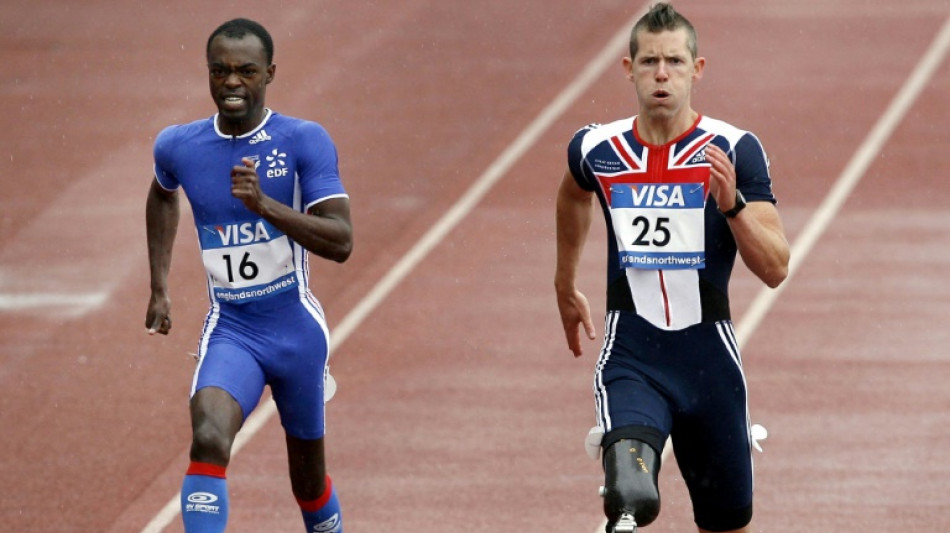
Astronaut carrying flag at Paralympics sends 'powerful message' / Photo: ANDREW YATES - AFP

 Martinez brace saves Inter in Serie A top-two clash with Roma

 Rosenior abused but guides Paris FC past old club Strasbourg

 Seven-try Lyon beat Pau, climb to Top 14 summit

 Brighton defeat a 'big lesson' against complacency for Arsenal, says Arteta

 Thousands protest inaction over climate crisis in Switzerland

 Carapaz out of cycling world championships

 'Fragile' Tottenham beaten by Aston Villa despite late rally
 Mourinho hails Real Madrid grit before Atletico derby clash
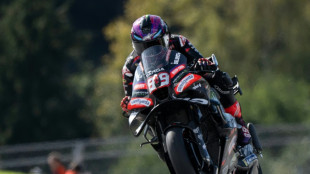
 Martin wins Austrian MotoGP sprint after Acosta crash
 Japan edge Fiji to win Pacific Nations Cup

 Black smoke, flames rising near Riyadh airport: residents to AFP
 UK actor Naomi Watts honoured at Spain film festival
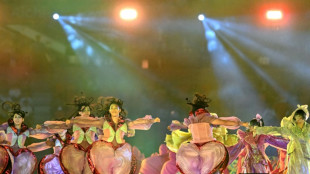 Japan emperor declares Asian Games open after turbulent build-up
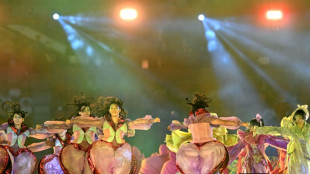 Asian Games open with unity message after troubled build-up
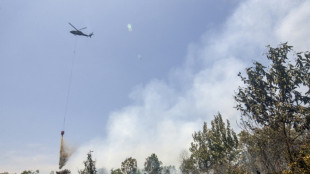
 Denmark hails 'binding' Greenland deal with Trump

 We don't want Games host Japan losing money, says Asian Olympic official
 Ed Sheeran returns to stage after Palestinian controversy

 Asian Games to open in Japan after troubled build-up

 Drone owners rush to offload devices ahead of Beijing ban

 Trump's beef policies irk Texas ranchers, testing their loyalty

 Nvidia, OpenAI CEOs to attend Xi dinner at White House

 Anthropic picks Accenture for in-house AI safety evaluation

 Balogun returns as Monaco beat Lens to continue strong Ligue 1 start

 'Pause' on overt repression in Venezuela, but reforms still needed: HRW

 Global stocks mixed as yen falls despite Bank of Japan rate hike

When John McFall, the world's first parastronaut, carried the Paralympic flag at the opening ceremony of the Games in Paris Wednesday, he knew he was sending a "powerful message".
The 43-year-old Briton had his right leg amputated below the knee after a motorcycle crash in Thailand when he was 19, before becoming a surgeon himself and winning a bronze medal in the 100 metres at the 2008 Beijing Paralympics.
Two years ago the European Space Agency (ESA) recruited him as their first astronaut with a physical disability.
"Astronauts are envoys of humanity," he told AFP. So for "someone with a physical disability to reach this pinnacle is a powerful message for humanity."
It says "'Listen, this is possible,'" he added.
A keen runner and hockey player before his accident, McFall only became a top-level athlete after losing his lower leg.
He quickly embraced paralympic sport, working at the Athens Games in 2004. Four years later, he was one of the stars of Beijing after becoming world 100 metres champion in 2007.
The growing popularity of the Paralympic Games reflects a paradigm shift in attitudes towards disabilities, the sprinter said.
"People still find (disability) new and different... but people notice in a different way because the way they frame disability now is different," said McFall, who recalled watching the 2000 Games in Sydney after his accident.
"It's more normal -- this is a tough word, right," he joked.
McFall is a powerful believer in the spirit of inclusion the Paralympics embody.
"You just get this beautiful mesh of society which I think is wholesome and representative and complete."
The Englishman was recruited as an astronaut by the ESA as part of a programme to test the feasibility of sending someone with disabilities to space.
He believes that the same qualities that enabled him to overcome his accident, turn into a paralympic sportsman and become a surgeon played a role in his selection by the ESA.
- 'Dreaming awake' -
"With my background as an athlete, as a surgeon and knowing my physical disability very, very well, I thought maybe I had a really great set of skills" to show the ESA it was feasible, he said.
McFall had been working as a trauma and orthopaedic specialist in the south of England, the ESA previously said.
Paris is his fourth Games, even if he is only a flagbearer this time.
"I feel like I have come full circle," said the doctor, who described his passion for running as his "dreaming awake".
"It's a time where I get lost in my thoughts," he said.
"I enjoy the breathing, I enjoy the sound of my feet on the ground."
McFall, who has been reviewing and testing all phases of a flight in space, including training, from the ESA's Cologne astronaut centre in Germany, will turn in a feasibility study by the end of the year.
"We just need to select the appropriate candidate and cross and solve the problems that will come up when they arise," he said with a smile, adding they are "all solvable".
If he does make it into space himself, the athlete-turned-astronaut will need a running blade that is more flexible than the one he uses on racetracks to adapt to zero gravity.
He will also need it to run on the treadmill used by the International Space Station's staff to prevent muscle loss and osteoporosis.
F.Carias--PC

