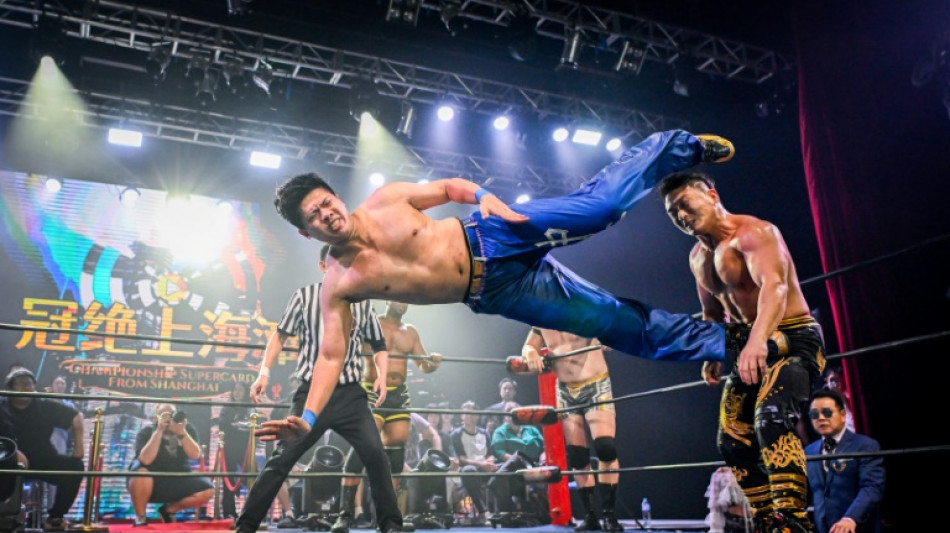
No pain, no gain: Chinese pro wrestlers fight for recognition / Photo: WANG Zhao - AFP

 Inter Milan and Italy icon Mazzola dies aged 83

 Saudi capital issues first air raid alert since renewed fighting in Yemen
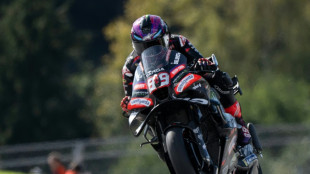 Martin edges title rival Marquez for Austrian MotoGP pole
 Indonesia accepts Malaysia's help to tackle wildfires
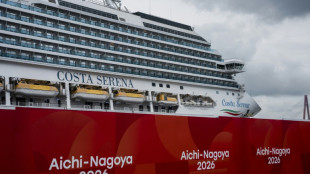 Indians living in Japan on stand-by to house Asian Games athletes
 Trump signs bill authorizing sweeping Russia sanctions

 Protesters form human chain at Kennedy Center after Trump threat

 Death toll from attack at police HQ in Pakistan rises to 31

 Trump says Denmark to give US 'permanent control' over Greenland security

 Kennedy Center: future unclear for iconic Washington arts hub

 Trump claims 'infinite' Greenland security deal with Denmark

 Helicopters battle wildfire threatening Ecuador's capital

 Brentford batter Chelsea to undo Alonso's promising start

 Kane hits Bundesliga century as Bayern rout Union

 Trump says CNN, MS NOW, Politico banned from White House

 Hushing and hedging: US companies retreat on climate

 Springboks to face Fiji before 2027 Rugby World Cup

 Nigeria miners struggled to breathe in cell before 37 died: survivors

 McIlroy on the charge at PGA Championship as Reed withdraws

 McIlroy on the charge at PGA Championship

 Crisis-wracked Volkswagen warns of 10-bn-euro hit to profits

 Costa Rica's Grynspan tops third informal poll for UN chief: diplomat

 Stock markets retreat after central bank rate hikes

 Russia labels director of Cannes Grand Prix winner a 'foreign agent'

 Macron warns of Russian 'hybrid' threat after meeting presidential hopefuls

When Wang Tao ran away from home aged 17 to become a professional wrestler he knew it would be a hard slog to succeed in China's passionate but underdeveloped scene.
Years later, he has endured family disapproval, countless side gigs and thousands of hours of brutal training to become China's "Belt and Road Champion" -- but the struggle is far from over.
Despite a promising potential domestic market the Chinese pro wrestling community has been battling for recognition and financial stability for decades.
"I have done all kinds of jobs (on the side)... because in the end, it is very difficult to earn enough money to live on just through wrestling," the 23-year-old Wang told AFP.
"I have never given up my dream, which is to make more and more people know China has wrestling."
Part sport and part entertainment, it is best known globally as a stereotypically American spectacle, embodied by the juggernaut World Wrestling Entertainment (WWE).
It is a marriage of intense athletic feat and melodramatic, lycra-clad performance.
Hooked from a young age after watching Hollywood film "The Wrestler", Wang quit high school and absconded north to train with other like-minded Chinese athletes.
"I tried to explain to my family... but they all disagreed, and did not understand or support me," Wang said.
These days they have come round -- though he said they still hope he will find "a normal job".
- Facebuster -
In the southern Chinese wilderness earlier this month, Wang and fellow wrestler Chen Wenbin slammed each other violently against the struts of a makeshift bamboo cage, smashing each other into a mudpit as curious villagers watched.
It's rudimentary, but far better than previous training conditions, said Wang.
He typically earns about 1,000 yuan ($140) for fight nights, and tries to boost that income with livestreaming.
In the nearby town, he and Chen have constructed a wrestling ring in an unfinished factory where they broadcast themselves practising moves with names like Backbreaker and Facebuster.
Though the fighting is a pretence -- moves are loosely choreographed and outcomes are predetermined -- Wang has been knocked out for real before.
Wearing a "No pain, no gain" vest, Chen recalled when his wages came from performing in places such as bars -- "it was just hard ground... easy for us to get hurt".
Self-described addiction continues to propel Wang and others.
"I love this industry so much that it doesn't matter if I get hurt, I will stick with it," Wang said.
- 'Huge market' -
The root of the addiction became clear last weekend.
At the Supercard From Shanghai -- a fight night organised by Middle Kingdom Wrestling (MKW), a domestic promoter -- Wang strode down a red carpet into the ring, transformed.
Hair slicked back and wearing a snug black-scaled waistcoat, all trace of the mild-mannered, slightly shy Wang vanished as he leapt like a cat onto the top ropes and roared into the crowd.
To howls of delight, Wang defended his "Belt and Road" title in a frenetic four-way fight with another Chinese fighter, a Hungarian and an Emirati.
Accompanied by booming music and a rolling lightshow, the increasingly feral crowd of around 350 made up for in volume what they lacked in numbers.
"Definitely I would say we have more followers, more people are paying attention to us than ever," said MKW founder Adrian Gomez.
The problem is that audience is still miniscule for China, with momentum lost during pandemic years.
The Supercard had 125,000 livestream viewers, a far cry from the millions targeted.
Nevertheless, many insist there is potential.
WWE China has almost 36 million likes and four million followers on short video app Douyin, and analysts say it too has failed to maximise the country's possibility.
"It's a huge market in China, but we haven't fully opened it yet," said Chen, whose night ended less victoriously than Wang's.
His shamanic alter ego ended up tossed onto a table, then a row of chairs, by China's first-ever pro wrestler, The Slam.
American Knickle Sloane said the show's "grind of independent wrestling" had transported him back to his childhood.
"I feel there's a market for (Chinese wrestling) and there's a lot of people who want to see this happen," he said.
For now, the dream is that "more people can make a living", said Gomez.
"I think they deserve to be able to make a living out of what they're good at."
G.M.Castelo--PC