Many anti-abortion Americans would still help friends and family seeking one

 Botched US execution leaves murderer unconscious on ventilator: lawyers

 Cornell rape case exposes sexual violence at US colleges

 France held by Italy in Zidane's homecoming after Olise stunner

 Ethiopian pro-government militia claims Tigray airport as regional tensions spike

 Ohtani shaking off injuries as Dodgers launch MLB post-season

 Sea levels to rise in California as coastal wave surges up west coast

 New rallies urged in France as protests disrupt over 730 schools

 Djokovic survives China Open scare, Sabalenka starts strong

 King Charles to evoke colonial 'darkest days' on Caribbean tour

 Tesla shares jump after global car sales top estimates

 DR Congo Ebola outbreak killed more than 4,000: official figures

 Djokovic survives China Open scare against wildcard world no. 104

 Lula, Bolsonaro trade blows in final scramble for votes in Brazil

 New clashes erupt as protests disrupt over 560 French schools

 NY governor vows to close loophole after alleged Cornell gang rape

 Ethiopia Tigray rebels pushed back as regional tensions spike

 Stocks rise, yields fall as US job numbers disappoint

 Man City verdict a 'big topic' for England players, says Tuchel

 NY attorney general tasked with investigating alleged Cornell gang rape

 China widens military footprint with Laos air base

 G7 talks as US pressures Europe over diesel stocks

 Man City launch appeal against explosive financial ruling

 Swiss president to quit government

 Europe rejects US threats over diesel stocks, urges joint G7 action

 Philippines tennis star Eala says 'I get overwhelmed sometimes'

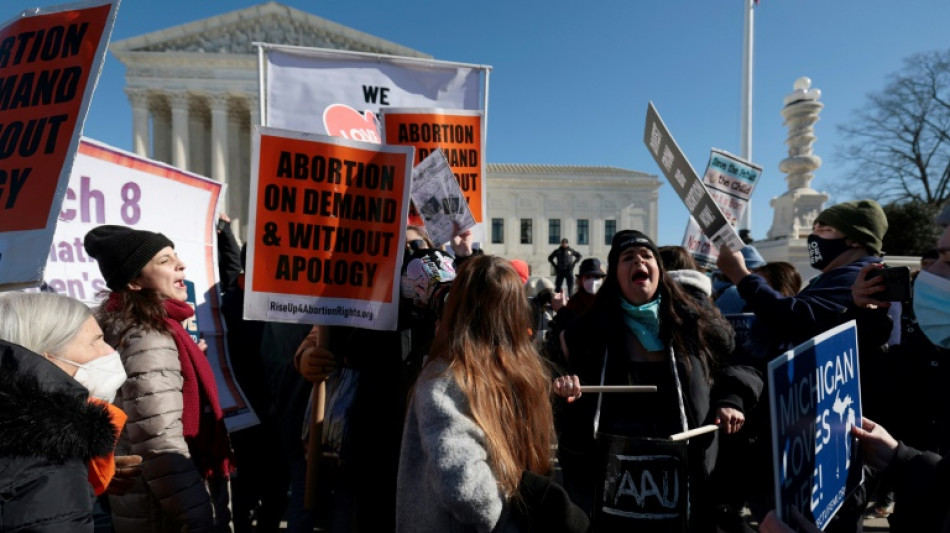
Almost half of Americans morally opposed to abortion would help a friend or family member with arrangements to get one, and a majority would offer emotional support, a new study said Friday.
The authors of the paper, which appeared in the journal Science Advances, wrote the finding showed that people are willing to cross ideological and partisan lines to help others in their personal networks, something they referred to as "discordant benevolence."
"At first blush, these people may appear as hypocrites. They are not," said Sarah Cowan, a sociologist at New York University and the lead author of the article, in a statement.
"They are at a moral crossroads, pulled by their opposition to abortion and by their inclination to support people they care about."
The study was drawn from surveys and interviews conducted in 2018 and 2019 respectively, and comes after Texas passed a law allowing residents of the state to sue others who "aided or abetted" abortions performed after six weeks of pregnancy.
The Supreme Court could soon roll back decades of precedent by ruling abortion is not a constitutional right. The issue is deeply contentious and divides the public along political lines between Democrats and Republicans.
The new study was based on survey responses from more than 1,574 people, and separately 74 in-depth interviews.
Of those morally opposed, 76 percent said they would offer emotional support —- compared to 96 percent of those who are not morally opposed, or whose view depended on circumstances.
But the type of support varied greatly, reflecting the social meaning of money and the view that spending money is a means to enact one's values, the authors said.
Just six percent of those morally opposed would directly help a friend or relative pay for the procedure, compared to the 45 percent who said they would help with ancillary costs.
Among those not morally opposed, 54 percent would help pay for the procedure, which typically costs $500 in the first trimester.
- Moral conflict -
Social scientists have long been interested in what explains helpful behavior.
Factors are thought to range from the act of kindness causing a person to feel good about themselves, to a sense of duty to their kinship networks and expectation of reciprocity in future.
But the authors said scenarios where rendering help placed the helper in a moral conflict were less studied.
Based on their in-depth interviews, they found people who were willing to help despite their inner opposition relied on three main rationalizations.
The first was "commiseration," or reasoning that people are worthy of care despite their imperfections in an imperfect world.
The second was "exemption" -- carving out an exception for their loved ones in particular, while the third was "discretion," -- the idea that what is right or wrong is inherently personal, not universal.
"If it were my sister...I would want to talk to her to make sure she's thinking about every possible thing," said Ryan, a person interviewed in the survey.
"But if, ultimately, she's like 'No, (Ryan), I can handle this,' then, 'Ok, do what you gotta do,' you know? But it's just because you love someone."
N.Esteves--PC



